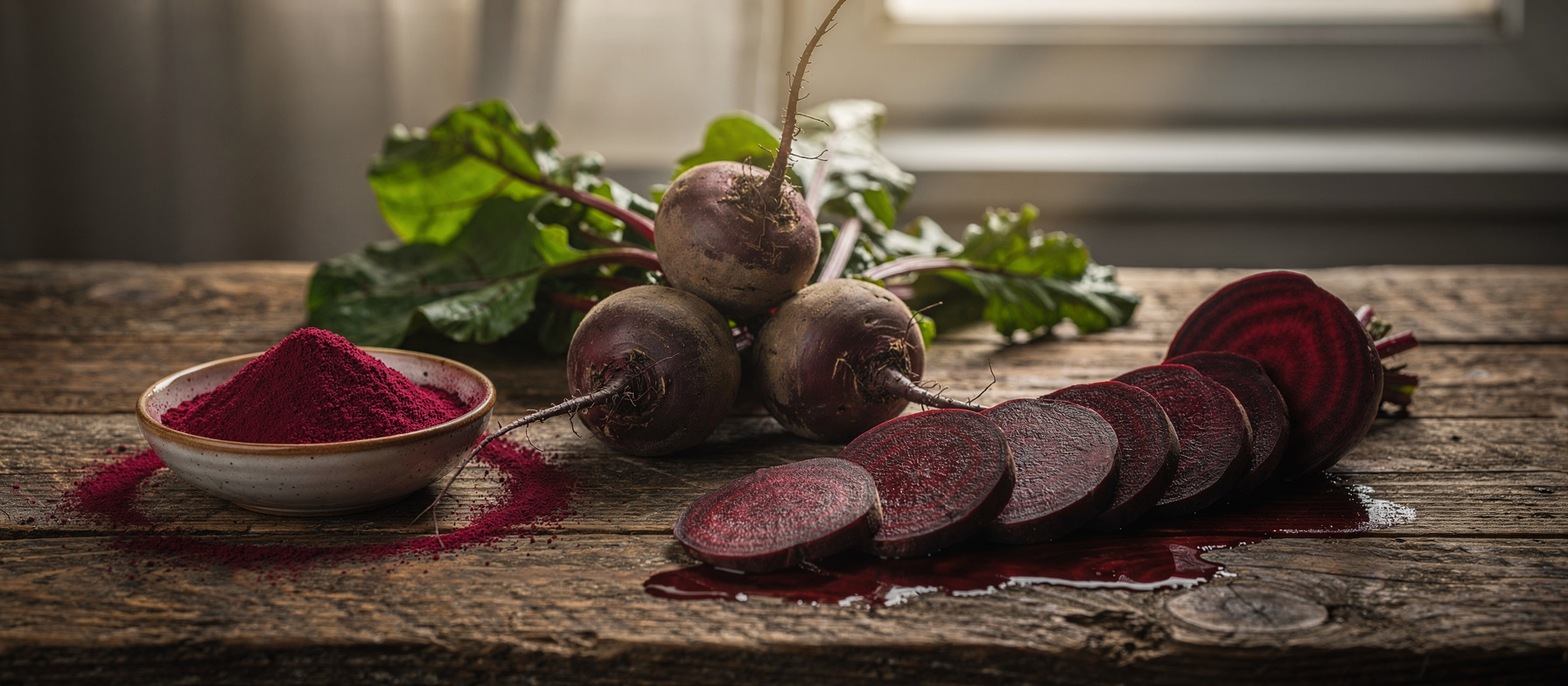
Beetroot Powder Benefits: 6 Backed by Trials (2026): The Short Answer
Beetroot powder reduces the oxygen cost of exercise by 1 to 3% and raises time-to-exhaustion by roughly 15% in controlled trials of healthy young men, via the dietary nitrate to nitric oxide pathway. Beyond performance, it supports cardiovascular health (modest systolic blood-pressure reductions of about 3 to 5 mmHg on average), cognitive blood flow, and post-exercise recovery via betalain antioxidants. Clinical dose is 300 to 600 mg of dietary nitrate per serving, taken 60 to 90 minutes pre-exercise or daily during a 3-day loading window.
Beetroot powder benefits the endurance athlete primarily by lowering the oxygen cost of exercise (1 to 3% less oxygen for the same workload) and extending time to exhaustion by roughly 15%, through the dietary nitrate to nitric oxide pathway. Secondary, well-documented benefits include modest blood-pressure reduction (about 3 to 5 mmHg systolic on average), improved cognitive blood flow, and faster recovery from betalain antioxidants. The effect is dose-dependent: you need 300 to 600 mg of dietary nitrate per serving, a threshold most generic beet powders never disclose or reach.
The general health world celebrates beets for the heart. Endurance athletes use beetroot powder for something more specific and measurable: oxygen efficiency. This review separates the benefits that have controlled-trial evidence from the ones that do not, attaches a real effect size and dose to each, and explains the athlete-specific caveats (sugar, oxalates, underdosing) that consumer health articles skip.
Beetroot Powder Benefits at a Glance
The benefits divide into two tiers: a performance tier with strong, repeated trial evidence (oxygen cost, time to exhaustion, blood pressure) and a supporting tier with smaller but real evidence (recovery, cognition). Effect sizes are modest but meaningful at the elite level, where a 1 to 2% change decides races.
| Benefit | Mechanism | Typical effect | Evidence strength |
|---|---|---|---|
| Lower oxygen cost of exercise | Improved mitochondrial efficiency | 1 to 3% less O2 at fixed workload | Strong |
| Time to exhaustion | More work before fatigue | ~15% longer at high intensity | Strong |
| Time-trial performance | Better O2 economy + power | 1 to 2% faster | Strong |
| Blood pressure | NO-mediated vasodilation | 3 to 5 mmHg systolic (meta-analysis average) | Strong |
| Recovery / reduced DOMS | Betalain antioxidants | Less soreness, faster jump recovery | Moderate |
| Cognitive blood flow | Cerebral vasodilation | Better focus under fatigue | Moderate |
1. Oxygen Efficiency and VO2 Max
The flagship benefit of beetroot powder is a 1 to 3% reduction in the oxygen cost of submaximal exercise, meaning your muscles produce the same power while consuming less oxygen. Larsen et al. (2007) first demonstrated this, and Bailey et al. (2009) showed it extended high-intensity time to exhaustion by roughly 15%. The mechanism is improved mitochondrial efficiency: nitric oxide reduces the oxygen required per unit of ATP, which functionally raises usable VO2 max.
For an endurance athlete, oxygen is the currency of performance. A 1 to 3% reduction in oxygen cost does not sound dramatic until you translate it: at threshold pace, that is the difference between holding the wheel and getting dropped, or the final mile of a marathon feeling sustainable instead of catastrophic. This is the single most replicated finding in the dietary nitrate literature. To know what you are improving on, estimate your current number first with our free VO2 max calculator, which works from a 12-minute run, a 1.5-mile time trial, a walk test, or resting heart rate alone.
2. Power, Threshold, and the Dose-Response Curve
Beetroot powder improves threshold power and time-trial performance by 1 to 2%, but only above a nitrate dose threshold. Wylie et al. (2013) found 4.2 mmol (about 260 mg) did nothing measurable, 8.4 mmol (about 520 mg) extended time to exhaustion by 14%, and doubling to 16.8 mmol added nothing more. An underdosed product produces no measurable benefit.
The dose-response is the most practically important and least discussed finding. Here is what each dose did in that trial (10 healthy men, cycling tests 2.5 hours after the dose), converted to the milligram figures most labels never give you:
| Nitrate dose | Approx. milligrams | Result vs placebo (Wylie et al., 2013) |
|---|---|---|
| 4.2 mmol | ~260 mg | No change |
| 8.4 mmol | ~520 mg | Oxygen cost down 1.7% (not statistically significant); time to exhaustion up 14% |
| 16.8 mmol | ~1,040 mg | Oxygen cost down 3.0%; time to exhaustion up 12%, no gain over 8.4 mmol |
Nitric oxide also acts directly on muscle contractile function, with research indicating a preferential effect on fast-twitch fibers, the fibers recruited for the final sprint or a steep standing climb. Lansley et al. (2011) found that a single dose of about 6.2 mmol (roughly 385 mg), taken about 2.5 hours before, made nine club-level cyclists faster in both time trials tested:
- 4 km time trial: 2.8% faster than placebo
- 16.1 km time trial: 2.7% faster than placebo
3. Benefits by Sport
The performance benefit is consistent across endurance disciplines but expresses differently by sport: cyclists gain sustained power on climbs and time trials, runners gain running economy and stronger finishes from 5K to marathon, and triathletes gain compounding oxygen economy across all three legs plus reduced cumulative fatigue.
- Cyclists and mountain bikers: sustained efforts demand consistent oxygen delivery. Nitrate improves blood flow to working leg muscles, delaying fatigue on climbs and improving time-trial output.
- Runners (road and trail): better running economy means a faster pace at the same effort, with improved lactate clearance for stronger closing miles. See the dose and timing breakdown on our best beetroot powder for runners page.
- Triathletes: improved oxygen utilization compounds across swim, bike, and run, and blunts the cumulative fatigue of long-course racing.
4. Recovery and the Betalain Antioxidants
Beyond nitrate, beets contain betalain pigments (betanin and vulgaxanthin) that act as antioxidants. Clifford et al. (2016) found beetroot juice taken after 100 drop jumps reduced muscle soreness and sped recovery of jump performance versus placebo, although maximal strength and creatine kinase, a blood marker of muscle damage, were unchanged. This matters most during heavy training blocks.
The recovery benefit is why some athletes take beetroot daily rather than only on race day. For the full mechanism, see our deep dive on betalains and exercise recovery.
5. Cardiovascular Health and Blood Pressure
Dietary nitrate lowers resting systolic blood pressure: a meta-analysis of 16 trials found an average fall of 4.4 mmHg (Siervo et al., 2013), and one 500 ml dose of beetroot juice cut it by up to about 10 mmHg in healthy volunteers (Webb et al., 2008). Because eNOS output declines with age, the dietary pathway matters more for masters athletes.
This is the benefit that crosses over from sport into general health, and it is the best-evidenced non-performance effect. The potassium and magnesium that accompany beets support fluid balance and nerve conduction, relevant to cramp prevention in long events. For the full evidence on magnesium, potassium, and omega-3s alongside nitrate, see natural supplements that lower blood pressure. Men develop measurable cardiovascular risk factors earlier in life on average, which makes this pathway especially relevant; see the full breakdown in beetroot benefits for men. The same decline runs sharply after menopause, when the body's own nitric oxide production can fall by up to 50 percent, and iron status gates how much of the response you actually get: beetroot powder benefits for women covers both, plus which women's health claims have controlled evidence behind them and which do not.
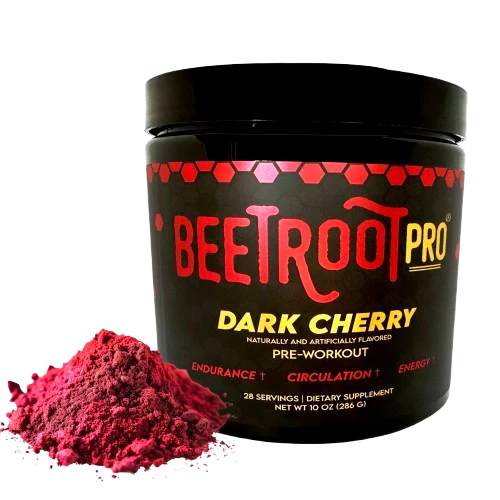
Beetroot Pro delivers standardized dietary nitrate to lower the oxygen cost of every effort.
6. Cognitive Blood Flow Under Fatigue
Nitric oxide influences cerebral blood flow, including to the frontal lobe, which supports focus and decision-making late in long events. Presley et al. (2011) found a high-nitrate diet increased frontal lobe perfusion in adults averaging 75 years old, and Wightman et al. (2015) found beetroot juice altered prefrontal blood flow during mental tasks and improved serial subtraction performance.
Bonking is as much a cognitive failure as a metabolic one. Maintaining cerebral perfusion is a plausible, evidence-supported reason beetroot helps athletes stay sharp deep into an event.
What General Health Articles Get Right (and Where Athletes Differ)
For the general population, beet powder benefits include blood-pressure support, dietary nitrate for vascular health, folate, and antioxidant intake, all legitimate. The athlete's situation differs in one critical way: the performance benefit is dose-gated. A heart-health user benefits from any consistent beet intake; an athlete chasing the oxygen-cost effect needs a verified research-range nitrate dose, which most whole-food powders and juices do not standardize or disclose.
The Athlete's Caveat: Sugar, Oxalates, and Underdosing
Three things separate a beet powder that works from one that wastes your money: published nitrate dose (most do not publish it), sugar content (juice concentrates carry 13 to 17 g per serving), and oxalates (raw beet powders are high-oxalate, a consideration for athletes predisposed to kidney stones). A standardized extract removes the sugar and reduces oxalate load while concentrating the active nitrate.
This is the information generic health content omits. Raw beetroot powder and juice deliver nitrate alongside sugar, fiber, and oxalates. For daily race-week loading, the sugar undermines fueling precision and the oxalate load accumulates.
Consumer wellness products like SuperBeets and BeetElite are popular in this category but are formulated for general cardiovascular health rather than athletic performance. Neither publishes a verified dietary nitrate dose per serving, which makes dose-targeting for the oxygen-cost effect unreliable. If you cannot confirm your nitrate dose, you cannot confirm the effect. See how they compare to Beetroot Pro on dose and standardization.
Bulk raw beet root powders (Terrasoul, BulkSupplements, Nutricost, and similar store brands) share the same blind spot: dried, unstandardized beet powder with a label that lists calories and sugar but almost never a milligram nitrate figure. For the full 100x brand-to-brand variance and how to read a label, see how much nitrate is actually in your beet supplement.
For the underlying mechanism, see beetroot powder, nitric oxide, and endurance. For a head-to-head on format, see beetroot powder vs beet juice, and for choosing a product, the best beetroot supplement buyer's guide.
How Much Beetroot Powder for the Benefits
To get the performance benefits, take a serving delivering 300 to 600 mg of dietary nitrate, 60 to 90 minutes before exercise (standardized extract) or 2 to 3 hours before (raw juice). For a sustained effect, load daily for 3 to 6 days before a target event, then take a final dose on race morning. Consistency beats occasional use: a saturated nitrate pool amplifies the acute dose.
The full timing breakdown is in the 7-phase loading protocol. For juice-specific dosing, see how much beetroot juice before a workout.
Where Beetroot Pro Fits
Every benefit above depends on hitting a real nitrate dose, and most beet powders never tell you what theirs is. Beetroot Pro publishes about 160 mg of dietary nitrate per serving via a standardized betaine nitrate extract, with the fiber and added sugar removed. That is below the range these trials used, but it is a number you can check rather than guess at from grams of powder.
Beetroot Pro® uses a standardized betaine nitrate extract, disclosed at 8,000 mg per serving so its roughly 160 mg of dietary nitrate can be derived, with the fiber and sugar removed:
- 2 scoops deliver the nitrate equivalent of roughly 6 whole raw beets
- 30 calories per serving
- The 8,000 mg extract is disclosed on the label, so the roughly 160 mg of dietary nitrate can be derived rather than guessed at
Frequently Asked Questions
Is beetroot powder actually proven to work? Yes, for specific outcomes. The reduction in oxygen cost and the increase in time to exhaustion are among the most replicated findings in sports nutrition, provided the nitrate dose is high enough.
How long do the benefits take? Acute effects (vasodilation, oxygen cost) appear within 60 to 150 minutes of a single dose. Recovery and blood-pressure benefits build with consistent daily use over days to weeks. See the full beetroot powder for blood pressure dose and brand breakdown.
Is beetroot powder safe for tested athletes? Dietary nitrate is not on the WADA or NCAA prohibited substance lists. Products themselves are not WADA-certified; only the ingredients are not prohibited. Drug-tested athletes should confirm with their governing body.
References:
- Larsen FJ, et al. (2007). Effects of dietary nitrate on oxygen cost during exercise. Acta Physiologica.
- Bailey SJ, et al. (2009). Dietary nitrate supplementation reduces the O2 cost of low-intensity exercise and enhances tolerance to high-intensity exercise. Journal of Applied Physiology.
- Lansley KE, et al. (2011). Acute dietary nitrate supplementation improves cycling time trial performance. Medicine and Science in Sports and Exercise.
- Wylie LJ, et al. (2013). Beetroot juice and exercise: pharmacodynamic and dose-response relationships. Journal of Applied Physiology.
- Jones AM. (2014). Dietary nitrate supplementation and exercise performance. Sports Medicine.
- Siervo M, et al. (2013). Inorganic nitrate and beetroot juice supplementation reduces blood pressure in adults: a systematic review and meta-analysis. Journal of Nutrition.
- Webb AJ, et al. (2008). Acute blood pressure lowering, vasoprotective, and antiplatelet properties of dietary nitrate via bioconversion to nitrite. Hypertension.
- Clifford T, et al. (2016). The effects of beetroot juice supplementation on indices of muscle damage following eccentric exercise. European Journal of Applied Physiology.
- Presley TD, et al. (2011). Acute effect of a high nitrate diet on brain perfusion in older adults. Nitric Oxide.
- Wightman EL, et al. (2015). Dietary nitrate modulates cerebral blood flow parameters and cognitive performance in humans. Physiology and Behavior.
FDA Disclaimer: These statements have not been evaluated by the Food and Drug Administration. This product is not intended to diagnose, treat, cure, or prevent any disease.
Maximize your results: Learn how to build your nutrition system for peak performance in our VO2 Max Supplements Guide, and check your starting point with the VO2 max calculator.
Where these benefits matter most: the oxygen-efficiency effect is largest where oxygen is scarcest, which is why beetroot powder and altitude training is its own question. For how beetroot sits alongside the other options when the goal is simply more usable energy, see the best supplements for energy in endurance athletes.
Technical FAQ Extension
What does beetroot powder do for athletes?
Beetroot powder increases dietary nitrate, which converts to nitric oxide in the body. Nitric oxide widens blood vessels, improving oxygen delivery to working muscles. Clinical trials show a 1-3% reduction in the oxygen cost of exercise, a 1-2% improvement in time trial performance, and roughly 15% longer time to exhaustion at high intensity. Additional benefits include anti-inflammatory betalains for faster recovery.
Is beetroot powder safe for long-term use?
Standardized beetroot extract is safe for daily long-term use. Raw beetroot powder and juice contain oxalates that can accumulate with chronic high-dose use and may contribute to kidney stones in susceptible individuals. Standardized extract removes oxalates during processing, making it safer for daily loading plans.
How is beetroot powder different from raw beet juice?
Standardized beetroot extract delivers a fixed, consistent nitrate dose (no batch-to-batch variability), carries 30 calories and 8 g of total carbohydrate per serving versus 22 to 25g of sugar in juice, removes oxalates and fiber that cause GI distress, and is shelf-stable without refrigeration. Beet juice works but the dose varies by up to 400% between brands and batches, making precision dosing unreliable.
Related Articles

Jul 19, 2026
Beetroot Powder Benefits for Men: Dose by Body Weight
What beetroot powder does for men's blood pressure, circulation and endurance, the nitrate dose for your body weight, and why testosterone is not on the list.
Jun 3, 2026
How Much Beetroot Powder Per Day? 300-600mg (2026)
Dose by milligrams of nitrate, not grams of powder: nitrate varies about 50-fold by product. Target 300 to 600mg daily, with tables by goal and body weight.
Aug 9, 2026
Beetroot Benefits for Women: BP, Iron, Menopause
What beetroot does for women and what it does not. The blood pressure evidence, the iron interaction that gates it, menopause, dosing, and pregnancy safety.
Technical
Beetroot Pro
Our product
- Patented betaine nitrate
- Acute Oxygen Efficiency
- 30 Calories Per Serving
*Technical citations and PubMed references are provided for performance education only. These statements have not been evaluated by the FDA.