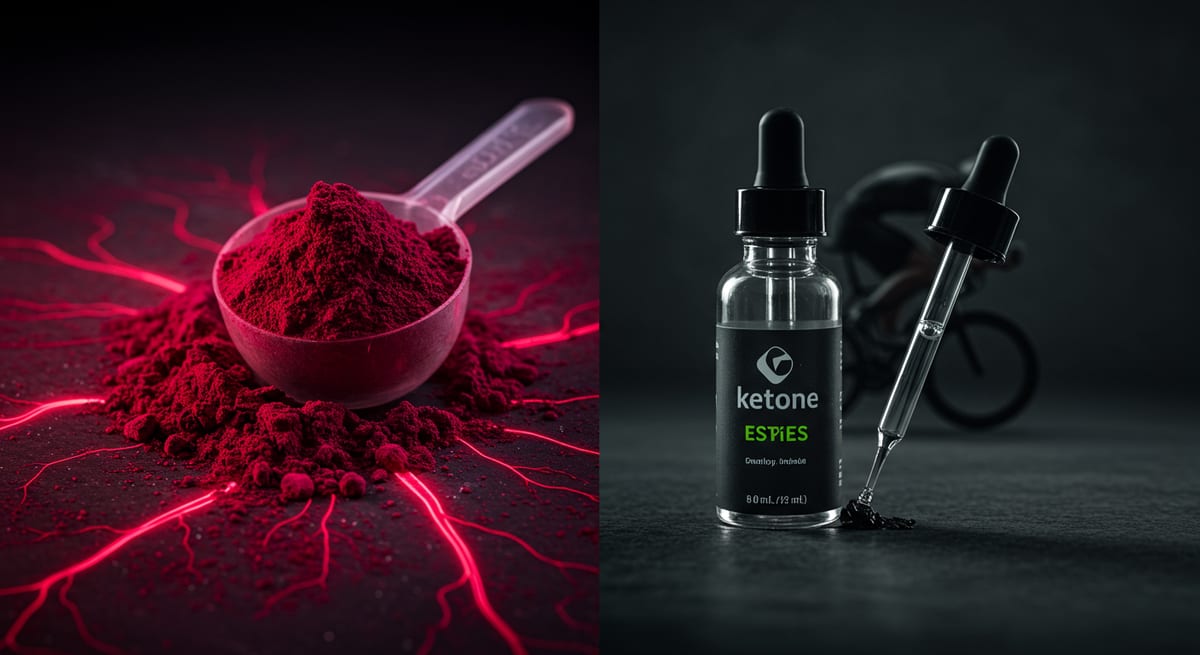
Beetroot Powder vs Ketone Ester for Oxygen Efficiency: The Short Answer
For oxygen efficiency, beetroot powder beats ketone esters on evidence and cost. Dietary nitrate reliably cuts the oxygen cost of submaximal exercise by 1 to 2 percent across well-replicated studies at under $2 per dose. Ketone esters cost $30 to $40 per dose and the flagship 2 percent finding has not been consistently replicated outside elite cyclists. Ketones are only defensible for ultra-distance events over 8 hours where glycogen sparing matters.
Both beetroot powder and ketone esters like HVMN Ketone have been positioned as oxygen efficiency supplements for endurance athletes. Both have published research. Both target performance improvements measured in seconds per kilometer or watts sustained.
The mechanisms could not be more different.
Understanding those mechanisms is how you decide which one belongs in your race-day system, which one belongs in your daily training, and whether either of them is worth the cost.
The Claims Side by Side
Beetroot powder and ketone esters both target oxygen efficiency but through opposite mechanisms: dietary nitrate cuts the oxygen cost of a given pace by 1 to 2 percent via vasodilation, while ketone esters supply an alternate fuel substrate that some elite-athlete data links to a similar 2 percent gain. The evidence quality and the price per dose are not comparable, which is the real decision point for most athletes.
Beetroot powder (dietary nitrate): Reduces the oxygen cost of submaximal exercise by 1 to 2%. The body uses less oxygen to produce the same power output. This translates to holding race pace with less respiratory demand, or holding a higher pace with the same demand.
Ketone esters (exogenous ketones like HVMN Ketone): The primary claim is that ketones provide an alternative fuel substrate to glucose, potentially allowing the muscle to produce ATP more efficiently per oxygen molecule consumed. Secondary claims include glycogen sparing.
Both are making fundamentally an oxygen efficiency argument. They just take completely different routes to get there.
The Mechanisms
Dietary nitrate converts to nitric oxide through the oral-gastric-circulatory pathway, widening blood vessels and, per newer research, improving mitochondrial efficiency directly. Ketone esters instead supply beta-hydroxybutyrate as an alternate fuel to glucose, with a theoretical (and inconsistently proven) edge in ATP produced per oxygen molecule consumed. One mechanism is delivery-side, the other is fuel-side.
Dietary Nitrate: Vasodilation and Mitochondrial Efficiency
Dietary nitrate converts to nitric oxide through the oral-gastric-circulatory pathway. Nitric oxide dilates blood vessels, increasing blood flow and oxygen delivery to working muscles. Additionally, recent research suggests nitric oxide may improve mitochondrial efficiency directly, reducing the oxygen cost of ATP production at the cellular level (Larsen et al. 2011, Cell Metabolism).
The effect peaks 2 to 3 hours after ingestion and is measurable at submaximal workloads. The performance benefit is well replicated across cycling, running, and rowing studies at moderate-to-high training loads.
Ketone Esters: Alternate Fuel Substrate
Ketone bodies (beta-hydroxybutyrate) are produced from fat and can be used by the heart and skeletal muscle as fuel. The theoretical advantage: when muscles burn ketones instead of glucose, they may produce slightly more ATP per oxygen molecule, improving the so-called P:O ratio (phosphate produced per oxygen consumed).
The practical reality is more complicated. Ketone ester research has produced mixed results in trained athletes. Some studies show modest performance improvements; others show no effect or impairment. Digestion of ketone esters at high doses causes significant GI distress for many athletes.
The trial behind most commercial claims (Cox et al. 2016, Cell Metabolism, run at the University of Oxford) found that 8 high-performance athletes covered about 2% more distance (411 m) in a 30-minute cycling time trial when a ketone ester was added to their carbohydrate drink. Later trials in trained athletes have not reliably reproduced a benefit, and some found a performance cost.
What the Evidence Actually Shows
The 2013 Hoon et al. meta-analysis of 17 nitrate studies found a moderate, significant benefit for time-to-exhaustion tests and a small, non-significant effect on time trials, with individual trials reporting 1 to 3 percent gains. Ketone ester evidence rests largely on one 2016 study in high-performance athletes that later trials have not consistently reproduced. For more on how dietary nitrate performs across endurance sports, see nitric oxide from beetroot powder and athletic performance.
Dietary Nitrate Evidence (Strong)
The nitrate-to-nitric-oxide literature is extensive and well-replicated:
| Study | Population | Dose | Result |
|---|---|---|---|
| Lansley et al. (2011), Med Sci Sports Exerc | 9 club-level male cyclists | Single dose, ~6.2 mmol nitrate, 2.5 h before | 4 km time trial 2.8% faster (about 11 seconds); 16.1 km time trial 2.7% faster |
| Cermak et al. (2012), IJSNEM | 12 trained male cyclists | ~8 mmol nitrate per day for 6 days | 10 km time trial 12 seconds faster (953 vs 965 s); lower submaximal VO2 |
| Hoon et al. (2013), IJSNEM | Meta-analysis of 17 studies | 300 to 600 mg nitrate, single dose to 15 days | Moderate benefit on time to exhaustion; small, non-significant effect on time trials |
| Larsen et al. (2011), Cell Metabolism | Healthy volunteers | Dietary inorganic nitrate | Better mitochondrial efficiency (P/O ratio), correlated with lower oxygen cost of exercise |
Studies were conducted in trained cyclists, runners, and rowers across multiple labs. The effect is most pronounced at submaximal workloads, which describes the majority of endurance racing below VO2 max.
Ketone Ester Evidence (Mixed)
| Study | Population | Dose | Result |
|---|---|---|---|
| Cox et al. (2016), Cell Metabolism | 8 high-performance endurance athletes | Ketone ester plus carbohydrate | About 2% (411 m) further in a 30-minute cycling time trial; the landmark study behind most commercial claims |
| Evans et al. (2019), Med Sci Sports Exerc | 8 endurance-trained runners | 573 mg/kg ketone monoester plus carbohydrate | No difference in 10 km running time trial |
| Leckey et al. (2017), Front Physiol | 10 elite male cyclists | Ketone diester, 2 x 250 mg/kg | About 2% slower in a ~31 km time trial, with gut discomfort |
| O'Malley et al. (2017), Appl Physiol Nutr Metab | 10 healthy adult males | 0.3 g/kg ketone salts (not an ester) | About 7% lower average power in a 150 kJ cycling time trial |
| Poffé et al. (2020), J Appl Physiol | 12 highly trained male cyclists | Ketone ester plus 60 g/h carbohydrate in a 3 h simulated race | No glycogen sparing; no change in the final time trial or sprint |
The literature is not settled. The original Cox finding has not been consistently replicated at the training levels most amateur and age-group athletes represent.
Cost: A Real Consideration
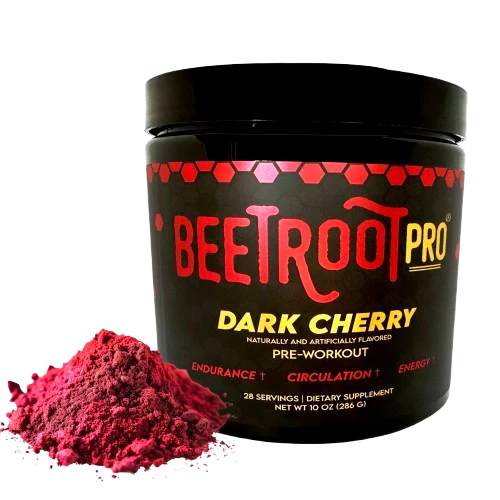
A single ketone ester dose runs $30 to $40, putting a race-week loading protocol at $150 to $200 for one event. Beetroot Pro delivers a standardized 8,000 mg beet extract dose (yielding 160 mg dietary nitrate) at 30 calories and roughly $1.60 per serving, so a 5-day loading protocol costs under $15 total. The cost-per-evidence-unit gap between the two categories is not close.
HVMN Ketone costs roughly $30 to $40 per single serving at race dose. A race-week loading protocol with daily ketone dosing runs $150 to $200 for a single event. This is not a sustainable daily supplement.
Beetroot Pro is approximately $1.60 per serving at the 28-serving canister price, standardized to an 8,000 mg standardized beet extract (yielding 160 mg dietary nitrate) at 30 calories per serving, so dosing is consistent batch to batch rather than a vague "beet concentrate" listing. A 5-day loading protocol with two servings on the heavy loading days costs under $15 total. Daily baseline dosing through a training block is under $50 per month.
If you are going to invest in oxygen efficiency supplementation, the cost-per-evidence-unit calculation strongly favors dietary nitrate. The Beetroot Pro nitrate powder is built around that standardized dose specifically so athletes are not guessing at nitrate content the way many beet-juice and unstandardized-powder products require.
When Ketone Esters Make Sense
Ketone esters are defensible only for events over 8 hours, such as full-distance triathlon or ultramarathons, where glycogen depletion is a genuine performance limiter. For events under 5 hours, glycogen is managed adequately by carbohydrate intake, so the oxygen-delivery and lactate-threshold benefits of dietary nitrate are the higher-value intervention. A structured carb fueling plan covers the glycogen-management side of that equation for shorter events.
There is a use case where exogenous ketones are defensible: ultra-long events (8+ hours) where glycogen depletion is a genuine limiter and fat oxidation capacity is a real performance factor. At Ironman or ultramarathon distances, sparing glycogen through ketone-assisted metabolism has theoretical merit even if the performance data is not clean.
For events under 5 hours, the primary limiter is not glycogen availability (managed by carbohydrate intake) but oxygen delivery and lactate threshold. That is where dietary nitrate has the stronger evidence base.
Combining: Can You Use Both?
Yes. Dietary nitrate and ketone esters work through separate pathways (blood flow versus fuel substrate) and do not interfere with each other. Combining them only makes financial sense for ultra-distance events where glycogen sparing is a real limiter; for events under 5 hours, dietary nitrate alone covers the primary oxygen efficiency opportunity at a fraction of the cost.
Yes, and the mechanisms do not overlap or interfere. If you are racing an ultra-distance event and want to use ketone esters for glycogen sparing plus dietary nitrate for oxygen efficiency, they work through different pathways. There is no contraindication.
For most age-group athletes, the cost-benefit of ketone esters does not justify the price. The 1-2% oxygen efficiency gain from dietary nitrate at under $2 per dose is the higher-ROI intervention.
Comparison Summary
Beetroot powder wins on cost (under $2 versus $30 to $40 per dose), evidence strength (well-replicated versus a single flagship study), and GI tolerance, while ketone esters have a narrower but real edge for ultra-distance glycogen sparing. The table below lines up mechanism, cost, and evidence side by side.
| Factor | Beetroot Powder (Dietary Nitrate) | Ketone Ester (HVMN) |
|---|---|---|
| Mechanism | Nitrate to nitric oxide, vasodilation + mitochondrial efficiency | Alternate fuel substrate, glycogen sparing |
| Evidence base | Strong, well-replicated in multiple labs | Mixed, flagship study not consistently replicated |
| Cost per dose | Under $2 | $30-$40 |
| GI tolerance | Good (especially fiber-removed formulas) | Significant GI distress at race dose for many athletes |
| Timing | Take 60-90 min before exercise; nitrite peaks about 2-3 h after a dose (juice studies) | Peaks 30-60 min post-ingestion |
| Best use case | Any endurance event at submaximal intensity | Ultra-distance where glycogen is a limiter |
| Loading required | 3-5 days pre-event for best results | Single acute dose; no loading benefit |
| Daily training use | Yes, beneficial for baseline NO levels | Not practical at $30-40/dose |
For Masters Athletes
Masters athletes (35+) experience measurable eNOS decline, meaning the body's own enzymatic route to nitric oxide production weakens with age. Dietary nitrate from beetroot powder bypasses that impaired pathway entirely, while ketone esters offer no equivalent compensatory mechanism for age-related vascular changes. See beetroot powder health benefits for the broader vascular and blood pressure research behind this pathway.
Masters athletes (35+) face eNOS decline that makes the nitrate pathway specifically valuable: the enzymatic route to nitric oxide is impaired, and dietary nitrate bypasses that impairment. Ketone esters have no equivalent compensatory mechanism for age-related vascular changes.
If you are a masters athlete choosing where to invest your supplement budget, dietary nitrate has both the stronger evidence base and the more targeted relevance to the specific physiology of aging endurance athletes.
Technical
Beetroot Pro
Our product
- Patented betaine nitrate
- Acute Oxygen Efficiency
- 30 Calories Per Serving
Frequently Asked Questions
The most common questions on this comparison cover whether the two supplements overlap, whether ketone esters are worth their price, and what to look for in a standardized nitrate product. Answers below.
Are ketone esters and beetroot powder the same thing? No. They work through completely different mechanisms. Beetroot powder (dietary nitrate) improves oxygen delivery and mitochondrial efficiency via the nitrate-to-nitric-oxide pathway. Ketone esters provide an alternative fuel substrate (beta-hydroxybutyrate) that may reduce reliance on glycogen. They address different performance limiters.
Is HVMN Ketone worth it for endurance athletes? The evidence is mixed. The landmark 2016 study by Cox et al. found high-performance athletes covered about 2% more distance in a 30-minute cycling time trial, but multiple subsequent studies in trained and sub-elite athletes have not consistently replicated the effect. At $30-40 per dose, the cost-per-benefit calculation is difficult to justify for most athletes compared to dietary nitrate at under $2 per dose.
Can you take beetroot powder and ketone esters together? Yes. They work through different pathways and do not interfere with each other. For ultra-distance events where glycogen sparing is a real limiter, combining both is theoretically defensible. For events under 5 hours, dietary nitrate alone addresses the primary oxygen efficiency opportunity at far lower cost.
What is the best beet supplement for oxygen efficiency? The most important factor is standardized nitrate content. Look for a product that specifies dietary nitrate mg per serving rather than listing beet concentrate without a nitrate guarantee. Beetroot Pro discloses an 8,000 mg standardized beet extract per serving, which at a 2% standardization yields roughly 160 mg of dietary nitrate with batch-to-batch consistency. That is below the 300 to 600 mg used in the published trials, but it is derivable from the label instead of unknown.
Does beetroot powder improve VO2 max? Dietary nitrate does not raise your aerobic ceiling (VO2 max). What it does is reduce the oxygen cost of exercising at a given pace or wattage, which means you use a smaller fraction of your VO2 max at race pace. The practical effect is similar to a VO2 max improvement: you can go faster or further at the same perceived effort.
Technical FAQ Extension
What is the difference between beetroot powder and ketone esters?
They improve oxygen efficiency through completely different mechanisms. Beetroot powder (dietary nitrate) converts to nitric oxide, dilating blood vessels and improving oxygen delivery, reducing the oxygen cost of submaximal exercise by 1 to 2%. Ketone esters provide an alternative fuel substrate (beta-hydroxybutyrate) that may produce more ATP per oxygen molecule and spare glycogen. They address different performance limiters.
Is HVMN Ketone worth it for endurance athletes?
The evidence is mixed. An Oxford-led 2016 study (Cox et al., Cell Metabolism) found trained cyclists rode 2% further in a 30-minute time trial with a ketone ester and carbohydrate than with carbohydrate alone, but multiple later studies in trained and sub-elite athletes did not consistently replicate the effect. At roughly $30 to $40 per dose versus under $2 per dose for dietary nitrate, the cost-per-benefit is hard to justify for most athletes. Ketone esters also cause significant GI distress at race dose for many athletes.
Which is cheaper, beetroot powder or ketone esters?
Beetroot powder is dramatically cheaper. Beetroot Pro is approximately $1.60 per serving at the 28-serving canister price, with a 5-day loading protocol costing under $15 total. HVMN Ketone runs roughly $30 to $40 per single serving, and a race-week loading protocol runs $150 to $200 for one event. The cost-per-evidence-unit calculation strongly favors dietary nitrate.
Related Articles

Jul 16, 2026
How Long Beetroot Powder Takes to Lower Blood Pressure
A single dose raises plasma nitrite in about 45 minutes and lowers blood pressure within 60 to 150 minutes. The full timeline, by product format.

Jul 14, 2026
Beetroot Powder for Blood Pressure: Dose and Brands
Beetroot powder can lower systolic blood pressure about 3 to 5 mmHg, but only at a real nitrate dose. See how Beetroot Pro, SuperBeets, and Xendurance compare.

Jun 3, 2026
How Much Beetroot Powder Per Day? 300-600mg (2026)
Dose by milligrams of nitrate, not grams of powder: nitrate varies about 50-fold by product. Target 300 to 600mg daily, with tables by goal and body weight.
*Technical citations and PubMed references are provided for performance education only. These statements have not been evaluated by the FDA.