
Cordyceps for Endurance: Mycelium vs Fruiting Body: The Short Answer
The human evidence on cordyceps for endurance is small and mixed. In older adults, 12 weeks of CS-4 mycelium extract at about 1 g per day raised metabolic and ventilatory thresholds by 8 to 11 percent without changing VO2 max, while trials in trained cyclists found no benefit. One small study of a Cordyceps militaris blend reported a VO2 max gain after 3 weeks. For most endurance athletes, cordyceps is a supporting ingredient in a broader adaptogen blend rather than a standalone performance booster.
The most common response to any adaptogen supplement question in serious endurance communities is some version of: "Those are designed to take your money." It comes up on Slowtwitch, TrainerRoad, r/Velo, and r/triathlon, reliably, every time someone asks about cordyceps.
That skepticism is healthy. The supplement industry earns it. But in the case of cordyceps for endurance performance, the skeptics are partially wrong, and the believers are partially wrong too. The truth requires distinguishing between the two forms of cordyceps, understanding the actual research, and setting realistic expectations about timing and magnitude.
This article is for the athlete who wants the honest version.
What Is Cordyceps?
Cordyceps is a genus of medicinal fungi with two species relevant to endurance athletes: Cordyceps sinensis (typically supplemented as the CS-4 mycelium extract, the form used in most human clinical endurance research) and Cordyceps militaris (a fruiting body cultivar with higher cordycepin concentration and one small human trial, in a blend). Both are legitimate cordyceps; CS-4 has most of the performance evidence base.
Cordyceps is a genus of fungi with over 400 species. For performance purposes, two matter:
-
Cordyceps sinensis (CS-4 mycelium extract): the traditional medicinal form, historically harvested from the Tibetan plateau. The wild form is extraordinarily expensive and rare. Modern supplements use a cultivated mycelium extract, typically labeled as CS-4. This is the form used in most human clinical endurance research.
-
Cordyceps militaris (fruiting body extract): easier to cultivate at scale, contains higher concentrations of cordycepin (the primary bioactive compound), and has become popular in the premium mushroom supplement market.
Both are real cordyceps. They are not the same thing, and they do not have the same research base.
The Mycelium vs Fruiting Body Debate
For endurance performance, CS-4 mycelium extract is the form most human trials have tested, with mixed results: the 2010 Chen study found higher metabolic and ventilatory thresholds in older adults, while two trials in cyclists found no benefit. C. militaris has higher cordycepin per gram and one small positive human trial, of a mushroom blend containing it.
This is the most technically active debate in mushroom supplement communities, and it is worth addressing directly.
The fruiting body argument: Cordyceps militaris fruiting body contains more cordycepin per gram than CS-4 mycelium. Cordycepin is the bioactive compound most associated with ATP synthesis and energy metabolism. Gram for gram, fruiting body fans argue you are getting more of the active compound.
The mycelium argument: Most of the human clinical trials on endurance performance used CS-4 mycelium extract. The 2010 Chen et al. study, the most cited positive trial, used CS-4, as did a 2004 trial in trained cyclists by Parcell et al. that found no effect. The one small human trial involving C. militaris (Hirsch et al., 2017) tested a mushroom blend, so it cannot isolate the fruiting body on its own.
The honest answer: Both forms have merit depending on what you are trying to accomplish. For endurance performance specifically, the CS-4 mycelium form has most of the human clinical data, positive and negative. For general immune and cellular health applications, fruiting body may have advantages. Neither form is fraudulent.
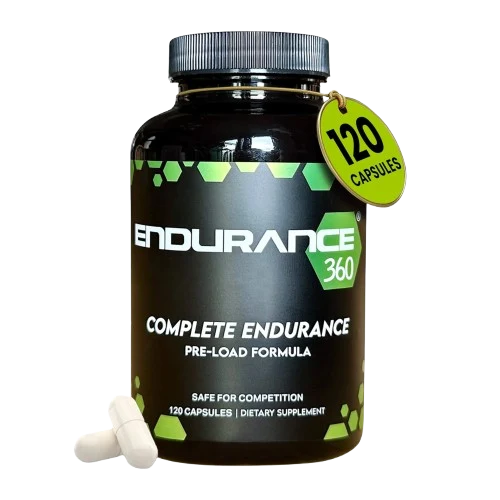
Endurance360 uses cordyceps mycelium extract (10:1), 900 mg per five-capsule serving.
What the Research Actually Shows
The human clinical evidence on cordyceps for endurance is small and mixed. Twelve weeks of CS-4 mycelium raised the metabolic threshold 10.5 percent and ventilatory threshold 8.5 percent in older adults without changing VO2 max (Chen 2010), while 5 weeks at 3 g per day did nothing for trained cyclists (Parcell 2004). Cordyceps is not a stimulant.
The human clinical data on cordyceps and endurance is smaller than the marketing suggests, but it is not nothing.
| Study | Population | Dose | Result |
|---|---|---|---|
| Chen et al., 2010 | 20 healthy adults aged 50 to 75 | CS-4, 333 mg three times daily for 12 weeks | Metabolic threshold up 10.5%, ventilatory threshold up 8.5%, no change in VO2 max |
| Parcell et al., 2004 | 22 endurance-trained male cyclists | CS-4, 3 g per day for 5 weeks | No effect on VO2 peak, ventilatory threshold or time trial |
| Colson et al., 2005 | 8 male cyclists | Cordyceps sinensis and rhodiola formula | No change in VO2 max, ventilatory threshold or time to exhaustion |
| Hirsch et al., 2017 | 28 young adults, 10 continuing to 3 weeks | 4 g per day of a mushroom blend containing C. militaris | No significant change after 1 week; VO2 max up 4.8 ml/kg/min after 3 weeks |
Lactate threshold: The metabolic threshold in the Chen trial is the point above which blood lactate accumulates, so its rise means those older adults could work harder before lactate built up. The cyclist trials did not replicate a threshold change.
Oxygen efficiency: The traditional explanation for cordyceps effects involves improved mitochondrial oxygen utilization. The mechanisms are not resolved at the molecular level, and the human trials above report threshold, VO2 max and performance outcomes rather than oxygen economy.
What has NOT been shown: Cordyceps is not a stimulant. It does not provide an acute pre-workout boost. Single-dose or short-term studies have generally shown minimal effect. The benefits are chronic and adaptation-dependent.
How Long Does It Take to Work?
Give cordyceps 8 to 12 weeks of consistent daily dosing before judging it. The one positive CS-4 trial ran 12 weeks, and a 5-week trial in trained cyclists found no effect. Take the dose at the same time every morning, do not skip days, and start at least 8 to 10 weeks before your target event.
This is where most athletes give up too soon.
The positive CS-4 trial used a supplementation period of 12 weeks. A 5-week trial in cyclists found nothing, though whether longer dosing would have changed that result is untested. Expecting to feel a difference after one week is a category error. Cordyceps is an adaptogen. It works by shifting how your body responds to repeated physiological stress over time, not by flipping a switch.
Practical protocol:
- Start at least 8 to 10 weeks before your target event or key training block
- Take it at the same time every day (morning is recommended; some people find cordyceps mildly stimulating and report sleep disruption when taken in the evening)
- Do not skip days during the loading period
If you try cordyceps for 2 to 3 weeks, notice nothing, and conclude it does not work, you have not given it a fair trial.
The Skeptic Community's Main Objection
Cordyceps skepticism in endurance communities is largely justified: many products on the market use grain-based mycelium with minimal actual cordyceps biomass, fail to specify extract form or concentration, contain low amounts of the bioactive compounds, and have never been tested in human performance trials. The right question is not "does cordyceps work" but "does THIS cordyceps product meet the specifications (mycelium extract, 4:1 concentration, named species) that were used in the supporting research."
The "designed to take your money" crowd is not entirely wrong. Many cordyceps supplements on the market:
- Use grain-based mycelium products with minimal actual cordyceps biomass
- Do not specify the extract concentration or form
- Contain low amounts of the actual bioactive compounds
- Have not been tested in human performance trials
The quality gap between a well-formulated 4:1 mycelium extract and a generic "cordyceps powder" is significant. When someone tries a low-quality product and sees no effect, their conclusion that "cordyceps does not work" is understandable but based on a flawed test.
The question to ask about any cordyceps supplement: what extract form, what concentration, what total dose? If the label cannot answer those questions, the skeptics have a point.
How Popular Cordyceps Products Compare
The market separates into three tiers: named-extract products with specified concentration, generic powders with no extract information, and combination blends where cordyceps is one ingredient in a broader formula. Only the first tier matches the research protocols.
| Product | Form | Species | Extract Concentration | Dose per Serving | Human Trial Form |
|---|---|---|---|---|---|
| Real Mushrooms Cordyceps-M | Mycelium extract | CS-4 | Specified (>1% cordycepic acid) | 1,000mg | Yes |
| Host Defense MycoBotanicals | Mycelium | CS-4 blend | Not specified | 500mg | Partial |
| Four Sigmatic Mushroom Coffee | Mycelium extract | CS-4 | Not specified | 250mg | No (underdosed) |
| Om Mushroom Cordyceps | Mycelium powder | CS-4 | Not specified (grain-based risk) | 1,667mg | No |
| Endurance360 (E360) | Mycelium extract | Cordyceps mycelium | 10:1 concentration | 900mg, published | Mycelium form |
| Optygen HP (First Endurance) | Mycelium biomass | CS-4 + C. militaris | Not specified | 800mg, disclosed | Yes |
| Generic cordyceps capsules | Variable | Not named | Not specified | Variable | No |
Key findings from the table: Four Sigmatic's 250mg dose is the lowest here. Om Mushroom uses a mycelium powder format with unspecified grain content. Endurance360 carries the most cordyceps of the multi-ingredient formulas in the table: 900mg of a 10:1 mycelium extract, against Optygen HP's 800mg. The full Endurance360 vs Optygen HP label comparison covers where each formula wins.
For a full buyer's guide to choosing between commercial products, covering species, extraction concentration, and third-party testing, see Best Cordyceps Supplements for Endurance Athletes.
For endurance performance specifically, dose matters as much as form. A well-labeled 500mg product at 4:1 concentration delivers 2,000mg equivalent. An unlabeled 1,000mg "powder" may deliver almost no active cordycepin if it is grain substrate with minimal fungal biomass.
Endurance360® uses cordyceps mycelium extract (10:1), 900 mg per serving. It is paired with 300 mg of rhodiola root extract (4:1) in the 1,200mg Cellular Oxygenation blend, plus creatine for ATP regeneration, beta-alanine for lactate buffering, and a full amino acid matrix. One 5-capsule daily dose covers the full formula.
Shop Endurance360®Three Blends, One Plan
Endurance360 targets three separate performance layers. Here is what each blend does and why you cannot replicate it by buying adaptogens alone.
Why 5 capsules: The three blends total 3,510 mg of active compounds. Standard capsule capacity is 500 to 700 mg. Fitting an effective dose requires 5 capsules. No filler.
Cordyceps in Endurance360
Endurance360 uses cordyceps mycelium extract (10:1), 900 mg per five-capsule serving. It sits in the 1,200 mg Cellular Oxygenation blend beside 300 mg of rhodiola root extract (4:1), and Beetroot Pro publishes every ingredient amount although the label prints only blend totals. The same daily dose also carries creatine, beta-alanine and five amino acids.
Endurance360 uses cordyceps mycelium extract (10:1), 900 mg per serving. It is part of the 1,200mg Cellular Oxygenation blend alongside Rhodiola Rosea extract. Use the adaptogen timing guide to plan the 8 to 12 week loading window against a target race date.
The individual cordyceps dose is not disclosed (proprietary blend). For athletes who require a specific milligram amount per serving, a standalone cordyceps supplement is an option. The trade-off is the same as with standalone rhodiola: you lose the full amino acid and creatine matrix that supports the muscular and metabolic layers of endurance performance alongside the adaptogen layer.
Summary
For endurance athletes, cordyceps is worth taking if you commit to the right form (CS-4 mycelium extract with specified concentration) and the right timeline (8 to 12 weeks of consistent daily dosing). The fruiting body case for endurance rests on cordycepin content and one small blend trial. Low-quality products and short-duration trials deserve the skepticism they receive. A high-quality cordyceps supplement taken consistently for 10 weeks is the minimum fair test.
Cordyceps has a small and mixed human evidence base for endurance, most of it on the CS-4 mycelium form: one positive 12-week trial in older adults and null results in trained cyclists. The mycelium vs fruiting body debate is legitimate: fruiting body contains more cordycepin but has only one small human trial, of a blend; mycelium is the form with most of the performance research. Neither is a scam. Product quality varies enormously, and low-quality cordyceps products deserve the skepticism they receive.
The two requirements for a fair trial: the right form (mycelium extract with a specified concentration), and enough time (8 to 12 weeks). An athlete who takes a high-quality cordyceps supplement consistently for 10 weeks at the right dose has a reasonable basis for evaluating whether it works for them. Anything shorter is not a real test.
Technical FAQ Extension
Does cordyceps actually improve endurance performance?
The evidence is thin and does not show a VO2 max gain. The most cited study (Chen et al., 2010) gave 20 adults aged 50 to 75 CS-4 mycelium extract for 12 weeks: metabolic threshold rose 10.5% and ventilatory threshold 8.5%, but VO2 max did not change. A small trial in male cyclists taking a cordyceps and rhodiola blend (Colson 2005) found no effect on VO2 max, ventilatory threshold or time to exhaustion. Cordyceps is not a stimulant and single-dose studies show minimal effect.
Is mycelium or fruiting body cordyceps better for athletes?
For endurance specifically, CS-4 mycelium extract is the form backed by human clinical trials, including the Chen 2010 threshold study in older adults, though that trial found no VO2 max change and a cyclist trial of a cordyceps blend (Colson 2005) found no benefit. Fruiting body extract has higher cordycepin content per gram but only in vitro and animal endurance data. Both are real cordyceps; neither is fraudulent. Mycelium has the human performance research.
How long do I need to take cordyceps before it works?
There is no established minimum. The positive CS-4 trial (Chen 2010) ran 12 weeks at about 1 g a day and improved metabolic and ventilatory thresholds but not VO2 max, while a mushroom blend containing Cordyceps militaris (Hirsch 2017) showed no change after 1 week and a VO2 max rise after 3 weeks. Start at least 8 to 10 weeks before your target event, take it at the same time each morning, and do not skip days during loading.
Related Articles

Aug 17, 2026
Best Cordyceps Supplements for Endurance Athletes
How to choose a cordyceps supplement: species, extraction form, dose, and third-party testing. Full comparison table and dosing guidance for athletes.

Apr 26, 2026
Rhodiola Rosea for Endurance Athletes: The Evidence
What rhodiola rosea does for endurance athletes: how it lowers RPE and cortisol under heavy load, a cycling protocol, and how it fits into Endurance360.
Apr 13, 2026
Beta-Alanine for Endurance: Lactic Acid Buffering
How beta-alanine raises muscle carnosine to buffer lactic acid, lift threshold, and delay the burn for endurance athletes. Dose, timing, and the tingling.
Complete
Endurance 360
Our product
- Chronic Lactic Acid Buffering
- ATP & Cellular Saturation
- Cordyceps & Adaptogen Matrix
*Technical citations and PubMed references are provided for performance education only. These statements have not been evaluated by the FDA.