Beetroot Pro® vs HumanN BeetElite
Nitrate Dose, Sugar Content, and Price Per Serving
BeetElite is a legitimate product from a real sports science company. This comparison covers the three questions that matter most for endurance athletes: how consistent is the nitrate dose, how much sugar are you taking in, and what does it cost per serving?
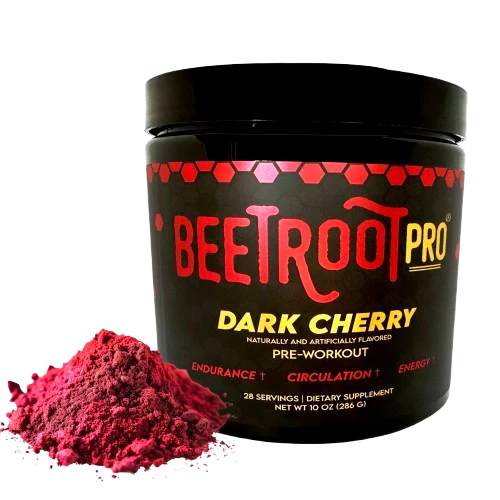
Standardized Extract Wins on Every Measurable Variable
BeetElite uses whole beet root extract without disclosing or standardizing nitrate content. Beetroot Pro uses a patented, chemically defined betaine nitrate compound with a fixed dose per serving. For athletes who want the performance mechanism of dietary nitrate to actually work, the dose has to be consistent. Beyond standardization, Beetroot Pro costs 40 to 50% less per serving. BeetElite is not a bad product. But Beetroot Pro is a better-engineered one.

How Beetroot Pro Is Rated
Our own product
- 5 ★94
- 4 ★3
- 3 ★1
- 2 ★0
- 1 ★2
Every published rating is counted above, low scores included. Nothing is left out of this breakdown.
READ ALL 100 REVIEWSThese are ratings of Beetroot Pro, our own product. They are not ratings of any other brand mentioned on this page.
Dose Reliability
Patented compound, fixed nitrate per serving
Calories
Per 2 scoop serving, sweetened with xylitol
Price per Dose
Roughly 30 to 40% less than BeetElite per serving
Side-by-Side Comparison
| Factor | Beetroot Pro | HumanN BeetElite |
|---|---|---|
| Nitrate per Serving | Standardized via NO3-T betaine nitrate | Not standardized (whole beet extract) |
| Sweetener | Xylitol, a sugar alcohol (1 g per serving) | Stevia plus ~3 g naturally occurring sugars |
| Calories per Serving | 30 kcal | 15 kcal |
| Price per Serving | ~$1.50 | ~$2.50 to $3.00 |
| Manufacturing Standard | cGMP certified facility | cGMP certified facility |
| Dose Consistency Batch to Batch | Fixed (chemically defined compound) | Variable (crop and harvest dependent) |
| SweetenerPreference-dependent | None | Stevia |
| Betaine (TMG) Included | Yes (via betaine nitrate) | No |
| Third-Party Sport Certification | Not independently certified | Not independently certified |
| Oxalate Content | Negligible (not whole beet) | Present (whole beet concentrate) |
Why Standardization Is the Key Issue
The Clinical Dose Problem
The published research on dietary nitrate and endurance performance converges on a target of 300 to 600 mg of nitrate per dose taken 2 to 3 hours before exercise. This is the range used in well-cited trials measuring time-trial performance, VO2 max economy, and oxygen cost at submaximal intensities. The mechanism is well-established: dietary nitrate reduces to nitrite in saliva, then to nitric oxide in hypoxic tissue during exercise, improving mitochondrial efficiency and vasodilation.
The problem with whole beet root extract is that the nitrate content of beets varies substantially depending on soil nitrogen concentration, growing season, storage conditions, and processing method. Published analyses of dried beet powders have found nitrate content ranging from below 200 mg per 100 g to above 1,800 mg per 100 g. At a typical 3 to 5 g serving size of beet powder, that range translates to somewhere between 6 and 90 mg of nitrate per serving, far below the clinical threshold in the worst case.
HumanN BeetElite uses a beet root concentrate process that improves consistency relative to raw powder, and the company cites its own in-house testing. But the product label does not list a standardized nitrate content. Without that disclosure, you cannot work out what a given canister actually delivers. Beetroot Pro publishes an 8,000 mg standardized extract, from which about 160 mg of dietary nitrate is derived, below the 300 to 600 mg range used in published research but a figure you can check rather than assume.
How Patented Betaine Nitrate Solves This
Betaine nitrate is a chemically synthesized compound: betaine (trimethylglycine) bonded to nitrate. Because it is a defined chemical species rather than a plant extract, the nitrate content per gram of compound is fixed by the molecular formula. Every batch is the same. Every serving delivers the same nitrate dose. The dose that goes on the label is the dose you get.
Betaine itself also contributes independently to performance through methylation support and osmolyte function. Studies on betaine supplementation at 2.5 g per day over two to three weeks have reported improvements in peak power and endurance capacity, suggesting the two compounds in betaine nitrate may have additive mechanisms rather than just one carrying the load.
For an athlete trying to run a controlled experiment on their own performance, the comparison is straightforward: either you know the dose you are taking or you do not. With patented betaine nitrate you know. With whole beet extract you are guessing within a wide range.
The Oxalate Question
Beets are one of the highest-oxalate foods in the human diet. For most healthy athletes this is not a clinical concern at moderate serving sizes. But athletes with a history of calcium oxalate kidney stones, hyperoxaluria, or inflammatory bowel conditions are sometimes advised to limit high-oxalate foods. Whole beet concentrates like BeetElite carry the oxalate load of the source beet.
Beetroot Pro uses betaine nitrate rather than whole beet extract, so the oxalate load per serving is negligible. Athletes with oxalate sensitivity who want dietary nitrate supplementation have essentially no other practical option than a standardized extract form.
Cost Comparison
What about the Early Breakaway Pack?
The Early Breakaway Pack bundles Beetroot Pro with Endurance360 at a reduced per-product price. For athletes who want both a pre-workout nitrate supplement and a daily loading formula for beta-alanine and creatine, the bundle price brings the per-serving cost of Beetroot Pro below $1.50. There is no comparable bundle from HumanN that combines a beet pre-workout with a loading formula at a competitive price point.
Common Questions
What is HumanN BeetElite and how does it work?+
Why does nitrate standardization matter?+
Does BeetElite contain sugar?+
Is Beetroot Pro cheaper than BeetElite?+
What is NO3-T betaine nitrate and why is it used in Beetroot Pro?+
Can I use Beetroot Pro if I am a drug-tested athlete?+
How long does it take Beetroot Pro to work compared to BeetElite?+
Is BeetElite a good product?+
The Standardized Nitrate Alternative
Patented betaine nitrate, 30 calories per serving, 28 servings, cGMP certified. Take 45 to 90 minutes before your key session. Pair with Endurance360 for the full loading protocol.
FDA Disclaimer: These statements have not been evaluated by the Food and Drug Administration. This product is not intended to diagnose, treat, cure, or prevent any disease.