
Beetroot and Nitrate for Female Endurance Athletes: Dosing, Iron, and Cycle Timing: The Short Answer
Female endurance athletes require the same 5 to 8 mmol dietary nitrate dose as male athletes, but iron status and menstrual cycle phase significantly affect nitric oxide conversion efficiency. Iron deficiency reduces eNOS activity by up to 40 percent, making iron screening a prerequisite. Follicular phase produces higher baseline nitric oxide; luteal phase warrants a 20 percent dose increase for equivalent effect.
The foundational research on dietary nitrate and exercise performance enrolled predominantly male subjects averaging 75 to 80 kg. That evidence base is robust, but applying it directly to female athletes requires accounting for three variables the original studies did not control for: body weight relative to dose, iron status, and menstrual cycle phase. Each of these shifts the effective nitrate exposure and nitric oxide conversion efficiency in measurable ways.
Why female physiology changes nitrate response
Dietary nitrate converts to nitric oxide through two parallel pathways, and female physiology modulates both. The eNOS-dependent pathway is directly regulated by estrogen, while body weight determines the plasma concentration achieved from a fixed absolute dose. A 300 mg serving delivers meaningfully different nitrate exposure to a 58 kg athlete versus an 80 kg athlete.
The standard clinical dose of 6 to 8 mmol (roughly 300 to 500 mg) dietary nitrate was calibrated on male subjects with a mean body weight near 78 kg. Blood volume scales with body weight, so plasma nitrate concentration after a fixed dose is inversely proportional to mass. For a 58 kg female athlete, a single 300 mg serving achieves a plasma nitrate concentration comparable to what a 500 mg dose provides in an 80 kg male. This means one serving is the correct starting point for most female athletes, not a deficit.
Estrogen also directly upregulates endothelial nitric oxide synthase (eNOS), the enzyme that produces nitric oxide through the classical L-arginine pathway. When estrogen levels are higher, eNOS activity is higher and baseline NO production is elevated. Dietary nitrate from beetroot works through the nitrate-nitrite-NO pathway, which is independent of eNOS, so it stacks on top of whatever endogenous NO the body is producing. The ergogenic ceiling is therefore higher during high-estrogen phases and lower when estrogen is suppressed.
Iron deficiency and nitric oxide conversion
Iron deficiency impairs nitric oxide production through two independent mechanisms simultaneously. eNOS requires heme-iron as a cofactor, so low iron compromises the endogenous pathway. Studies estimate this reduces eNOS-derived NO output by 30 to 40 percent in iron-depleted individuals. Iron deficiency is three times more prevalent in female endurance athletes than in the general population.
The reasons for elevated iron deficiency rates in female endurance athletes are well documented: menstrual blood loss (typically 1.5 to 2.5 mg iron per day during menstruation), foot-strike hemolysis from high mileage running, gastrointestinal microbleeding during intense efforts, and chronically inadequate dietary iron intake relative to training demand. The combination creates a population where low ferritin is common even in the absence of clinical anemia.
The practical implication is significant. An athlete with ferritin below 30 ng/mL has compromised eNOS function. Her endogenous NO production is already impaired, which means the relative benefit of dietary nitrate supplementation is larger: she is replacing a larger NO deficit, not supplementing an already-primed system.
Crucially, the nitrate-nitrite-NO pathway does not require heme-iron at any conversion step. Oral bacteria reduce dietary nitrate to nitrite, and systemic enzymes (including xanthine oxidoreductase and myoglobin) convert nitrite to NO under low-oxygen conditions. None of these steps are iron-dependent. Beetroot nitrate therefore provides a bypass around the compromised eNOS pathway in iron-deficient athletes.
Iron screening (serum ferritin plus hemoglobin) should be completed before establishing a baseline nitrate protocol. If ferritin is below 30 ng/mL, iron repletion under medical supervision is the primary intervention. Beetroot nitrate is complementary, not a substitute.
Dosing by menstrual cycle phase
Estrogen fluctuates nearly threefold across the menstrual cycle, producing measurable shifts in baseline NO availability. The follicular phase (days 1 to 13) is characterized by rising estrogen and upregulated eNOS; a single pre-exercise serving is sufficient. The luteal phase (days 15 to 28) brings lower relative NO and may warrant an extended loading approach before key events.
A 2001 study by Taddei et al. published in Hypertension demonstrated that NO availability is directly modified by estrogen status, with lower estrogen correlating with impaired NO-mediated vasodilation. The same mechanism plays out within each menstrual cycle as estrogen rises through the follicular phase and then falls as progesterone dominates the luteal phase.
| Cycle Phase | Dominant Hormone | Baseline eNOS Activity | Recommended Protocol |
|---|---|---|---|
| Follicular (days 1 to 13) | Estrogen rising | Higher | Single serving 60 to 90 min pre-exercise |
| Ovulation (days 13 to 15) | Estrogen peak | Highest | Single serving 60 to 90 min pre-exercise |
| Early luteal (days 15 to 21) | Progesterone rising | Moderate | Daily morning serving plus pre-exercise serving |
| Late luteal (days 22 to 28) | Progesterone dominant | Lower | Daily serving plus 4-day load before key events |
Because dietary nitrate bypasses eNOS entirely, it is particularly useful in the luteal phase where endogenous NO is reduced. Athletes who track their cycle can time their most intensive loading blocks to coincide with important competitions that fall in the luteal phase.
The research on cycle-phase-specific nitrate dosing is limited. These recommendations are derived from established estrogen-eNOS physiology rather than controlled female-specific dose-response trials, which remain an unaddressed gap in the literature (Jonvik et al., 2020).
Practical protocol for female athletes
A standard single serving 60 to 90 minutes before exercise is the correct starting point for most female athletes. The body-weight adjustment that was previously assumed to require a lower dose is accounted for by blood volume scaling: a 300 mg dose in a 58 kg athlete already achieves the target plasma concentration. Iron status screening before beginning any sustained protocol is recommended.
For training:
- Single serving 60 to 90 minutes before key sessions
- Daily morning serving during high-volume training blocks when recovery matters
- Avoid antibacterial mouthwash in the 2 hours before and after taking beetroot nitrate (it kills the oral bacteria responsible for nitrate-to-nitrite conversion)
For racing:
- Follicular phase: 3-day loading protocol (one serving AM and PM for 3 days) plus one serving 60 to 90 minutes before the start
- Luteal phase: 4-day loading protocol (one serving AM and PM for 4 days) plus one serving 60 to 90 minutes before the start
- Events over 4 hours: add a second serving approximately 3 hours into the event
For iron-depleted athletes:
- Continue working with a healthcare provider on iron repletion (ferrous sulfate or ferrous gluconate, typically 40 to 60 mg elemental iron daily with vitamin C for absorption)
- Use beetroot nitrate as a complementary NO source during the repletion period
- Expect a larger-than-average performance response from nitrate supplementation until iron status is restored
On vitamin C co-supplementation: ascorbic acid increases intestinal iron absorption. Taking an iron supplement with orange juice or a vitamin C tablet (250 to 500 mg) roughly doubles absorption. This is the most evidence-supported approach for accelerating iron repletion in endurance athletes.
References
- Wylie LJ, et al. Beetroot juice and exercise: pharmacodynamic and dose-response relationships. Journal of Applied Physiology. 2013.
- Jonvik KL, et al. Plasma nitrite pharmacokinetics for extract versus juice delivery formats. Nitric Oxide. 2020.
- Lansley KE, et al. Acute dietary nitrate supplementation improves cycling time trial performance. Journal of Applied Physiology. 2011.
- Taddei S, et al. Age-related reduction of NO availability and oxidative stress in humans. Hypertension. 2001.
- Bailey SJ, et al. Dietary nitrate supplementation reduces the O2 cost of low-intensity exercise. Journal of Applied Physiology. 2009.
- Govoni M, et al. The increase in plasma nitrite after a dietary nitrate load is markedly attenuated by an antibacterial mouthwash. Nitric Oxide. 2008.
Continue reading
Related Articles
Jun 19, 2026
Beetroot Powder for Menopause, Hormonal Contraception, and Female Athlete Triad
Menopause reduces eNOS activity by 50 percent, oral contraceptives suppress nitric oxide further, and the Female Athlete Triad compounds vascular impairment. Beetroot nitrate dose guidance for each.

May 15, 2026
Beetroot and Brain Health in Aging Athletes
Nitric oxide regulates cerebral blood flow. As eNOS declines with age, beetroot nitrate supports cognition, focus, and reaction time for masters athletes.
Jul 19, 2019
12 Proven Beetroot Benefits for Endurance Athletes
The beetroot benefits endurance athletes rely on: nitric oxide, faster VO2 max, lower blood pressure, less muscle soreness. Dosing guide included.
Technical
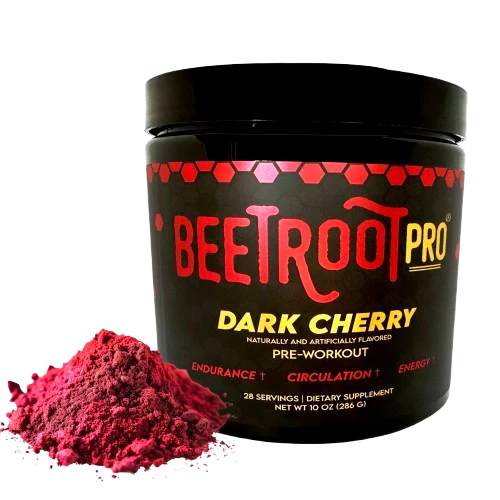
Beetroot Pro
- Patented betaine nitrate
- Acute Oxygen Efficiency
- Low Sugar / Oxalate Free
*Technical citations and PubMed references are provided for performance education only. These statements have not been evaluated by the FDA.