
Beetroot for Menopause, Birth Control, and the Triad: The Short Answer
Nitric-oxide-mediated vasodilation declines with age, and in women the decline becomes evident after menopause, which makes the eNOS-independent nitrate pathway especially relevant for female masters athletes. Combined oral contraceptive use is linked to higher hypertension risk in large cohort data, though the one nitrate trial in contraceptive users found no performance benefit. The Female Athlete Triad creates compounding vascular impairment through energy deficiency and bone stress, where 5 to 8 mmol nitrate can partially offset the circulation deficit while root causes are addressed.
Three distinct hormonal contexts affect female athletes in ways that standard nitrate supplementation research does not address: menopausal transition, combined oral contraceptive use, and the low-estrogen state associated with the Female Athlete Triad. Each suppresses nitric oxide production through partially overlapping mechanisms, and each responds to dietary nitrate differently. This post covers the physiology, the evidence, and the practical dose adjustments for each context.
Menopause and nitric oxide decline
Endothelium-dependent vasodilation, a standard human measure of eNOS-derived nitric oxide, declines steadily with age, and in women the decline becomes evident after menopause as estrogen support is lost. For female masters athletes that is a compounding deficit, and dietary nitrate is well positioned to address it because the nitrate-nitrite-NO pathway does not depend on eNOS or estrogen.
Estrogen is a direct upregulator of eNOS. It binds to estrogen receptors on vascular endothelial cells and increases both eNOS expression and phosphorylation at the activating serine-1177 site. As estrogen declines during perimenopause and menopause, this transcriptional support disappears. The result is a measurable drop in NO-mediated vasodilation. Taddei et al. (1996, Hypertension) found no endothelial dysfunction in normally menstruating women, with the age-related impairment in endothelium-dependent vasodilation appearing only after menopause. A 2001 study from the same group traced the age-related decline to an early loss of NO availability followed later by oxidative stress (Taddei et al., 2001).
For a 55-year-old female masters athlete, the two effects add up: the age-related decline every athlete experiences, plus the loss of the estrogen support that had held it off. We are not aware of a study that puts a single percentage on the combined deficit, but the direction is consistent across this vascular literature.
The eNOS-independent mechanism of dietary nitrate is directly relevant here. Oral bacteria convert dietary nitrate to nitrite, which is then reduced to NO through enzymatic pathways (xanthine oxidoreductase, myoglobin, hemoglobin) that do not require eNOS, estrogen, or any hormone. These pathways work at the same efficiency regardless of menopausal status, making dietary nitrate a uniquely targeted intervention for this population.
Beyond athletic performance, NO is essential for cardiovascular health, cerebral blood flow, and bone remodeling through osteoblast regulation. Female athletes over 45 who maintain dietary nitrate support are addressing a broader health-span benefit, not only a racing benefit.
Oral contraceptives and nitric oxide suppression
Combined oral contraceptives suppress ovarian estrogen production and flatten the hormonal cycle. Current users have a higher risk of developing hypertension in large cohort data, but we found no study quantifying their eNOS-derived NO against naturally cycling athletes. Their stable hormonal profile makes the nitrate protocol simpler: consistent daily dosing without cycle-phase adjustments.
Combined oral contraceptives (containing synthetic estrogen and progestin) work by suppressing ovarian function. The synthetic ethinyl estradiol in most OC formulations does bind estrogen receptors, but at lower effective concentrations than the endogenous estrogen peaks of the natural follicular phase, particularly the LH surge. The net effect on eNOS is a partial, chronic suppression rather than the dramatic cyclical variation seen in naturally cycling athletes.
In a prospective cohort of 68,297 US nurses, current oral contraceptive users had a 1.8-fold higher risk of developing hypertension over 4 years than women who had never used them (Chasan-Taber et al., 1996, Circulation). The progestin type appears to matter: formulations with anti-androgenic progestins (such as drospirenone) may have different vascular effects than those with androgenic progestins. The direct evidence on nitrate response in OC users is sparse and so far not encouraging: in 12 recreationally active women using hormonal contraceptives, beetroot juice (about 26 mmol nitrate per day for 8 days) raised plasma nitrate and nitrite but did not improve exercise economy or time-trial performance (Wickham et al., 2019, Physiological Reports).
Practically, the absence of a natural hormonal cycle is an advantage for protocol design. OC users do not need to adjust their nitrate timing by cycle phase. A consistent daily protocol is appropriate:
- One serving in the morning on training days, taken 30 to 60 minutes before the key session
- A 4-day loading protocol (one serving AM and PM for 4 days) before important races
- One serving 60 to 90 minutes before race start
The 4-day load (versus the standard 3-day load) accounts for the lower eNOS baseline. Athletes on OCs should test their individual response during training before relying on a protocol for race day.
Female Athlete Triad and vascular impairment
The Female Athlete Triad (low energy availability, menstrual dysfunction, low bone mineral density) has a vascular component that is rarely discussed: suppressed estrogen from hypothalamic amenorrhea reduces eNOS activity, impairing both recovery blood flow and bone remodeling. Dietary nitrate can partially offset this circulation deficit, but it is not a treatment. Restoring energy availability is the only effective primary intervention.
The Triad is defined by three interrelated conditions: low energy availability (often with disordered eating), menstrual dysfunction ranging from cycle irregularity to full amenorrhea, and reduced bone mineral density. The common thread is energy deficiency, which suppresses the hypothalamic-pituitary-ovarian axis and reduces estrogen to levels comparable to or below those seen in menopause.
The vascular consequences are significant. Low estrogen suppresses eNOS, reducing NO-mediated vasodilation to working muscles during exercise and to periosteal blood vessels during bone remodeling. This impaired blood flow contributes to slower recovery between sessions, higher injury risk, and compromised bone adaptation to training load.
Nitric oxide is also directly involved in bone physiology. Both osteoblasts (bone-forming cells) and osteoclasts (bone-resorbing cells) express nitric oxide receptors and require NO signaling for normal function. The mechanical response of bone to loading, which drives the adaptive thickening that protects against stress fractures, is partially mediated through NO. When NO availability is chronically low, this adaptive response is blunted.
Dietary nitrate provides NO through the eNOS-independent pathway, which remains functional regardless of estrogen status. In athletes in Triad recovery, beetroot nitrate can support recovery blood flow and bone remodeling processes while the primary intervention (restoring energy availability) takes effect. The time course for eNOS restoration after energy availability is normalized is measured in weeks to months, not days. During that window, dietary nitrate offers a bridge.
This is a supportive role, not a treatment. Any athlete with suspected Triad presentation should be working with a physician, sports dietitian, and where appropriate a mental health provider. Adding a beetroot supplement without addressing the underlying energy deficiency will not restore menstrual function or bone density.
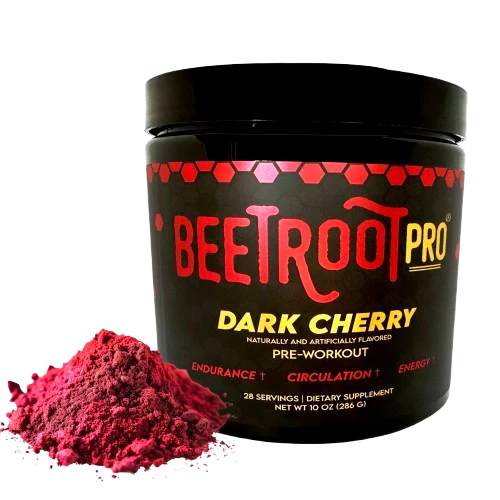
Beetroot Pro delivers standardized dietary nitrate to lower the oxygen cost of every effort.
Dosing guidance by hormonal context
The eNOS-independent mechanism of dietary nitrate means the 5 to 8 mmol dose is appropriate across all three hormonal contexts. What differs is the loading duration and whether daily baseline dosing is warranted. Contexts with greater eNOS suppression benefit from longer loading windows and year-round rather than race-only protocols.
| Hormonal Context | Primary eNOS Impairment | Recommended Loading | Year-Round Daily Dose |
|---|---|---|---|
| Perimenopausal (irregular cycles) | Estrogen declining, partial loss | 4-day AM/PM load before key races | Yes, one serving daily |
| Postmenopausal | Full estrogen loss, maximum deficit | 5-day AM/PM load before key races | Yes, one serving daily |
| Combined OC user | Partial suppression, stable profile | 4-day AM/PM load before key races | Yes, one serving daily |
In this table, one serving means a dose in the 5 to 8 mmol (about 300 to 500 mg) range. One 2-scoop serving of Beetroot Pro yields about 160 mg (roughly 2.6 mmol), below it. | Female Athlete Triad (amenorrhea) | Functional estrogen suppression | Standard 3-day load (under medical guidance) | Yes, but caloric restoration is primary | | Naturally cycling (reference) | None (phase-dependent variation) | 3 to 4 days depending on cycle phase | Optional |
For postmenopausal athletes, the 5-day loading protocol reflects the larger baseline NO deficit. One serving AM and PM for 5 days before race morning, plus one serving 60 to 90 minutes before the start. A daily maintenance serving year-round is appropriate rather than using nitrate only as a race-week intervention.
For athletes on OCs or in Triad recovery, the 4-day protocol is appropriate. The antibacterial mouthwash caution applies universally: avoid using mouthwash in the 2 hours before and after taking beetroot nitrate, as it kills the oral bacteria required for the first conversion step.
What beetroot cannot fix
Dietary nitrate provides NO through one specific pathway. It cannot restore eNOS expression, replace estrogen, correct iron deficiency, or reverse bone mineral density loss. These root-cause interventions require clinical management. For athletes in any of these contexts, beetroot nitrate is additive support on top of appropriate medical care, not a substitute for it.
For menopausal athletes, hormone therapy (where appropriate and prescribed by a physician) directly restores eNOS upregulation and has cardiovascular and bone health benefits that dietary nitrate cannot replicate. Beetroot nitrate and hormone therapy address different mechanisms and are complementary where both are indicated.
For OC users experiencing performance concerns, the relevant consideration is whether the formulation and its vascular effects are a significant factor. A sports medicine physician can assist with formulation review if this is clinically indicated.
For athletes with Triad presentation, the only path to restoring menstrual function and arresting bone density loss is restoring energy availability. No supplement addresses the hypothalamic suppression that causes the Triad. Any athlete with stress fracture history, menstrual irregularity, or disordered eating concerns should seek a multidisciplinary evaluation before adding any performance supplement.
Dietary nitrate occupies a narrow and specific role: providing an alternative NO source when the eNOS pathway is compromised. Understanding what it can and cannot do allows athletes and clinicians to position it appropriately.
For premenopausal athletes without these hormonal contexts, see beetroot dosing for female endurance athletes for cycle-phase and iron-status guidance. The eNOS-independent pathway described throughout this post is explained in more depth in how nitric oxide improves oxygen delivery, and Beetroot Pro® is the standardized product referenced in the dosing tables above.
References
- Taddei S, et al. Menopause is associated with endothelial dysfunction in women. Hypertension. 1996.
- Taddei S, et al. Age-related reduction of NO availability and oxidative stress in humans. Hypertension. 2001.
- Chasan-Taber L, et al. Prospective study of oral contraceptives and hypertension among women in the United States. Circulation. 1996.
- Wickham KA, et al. No effect of beetroot juice supplementation on exercise economy and performance in recreationally active females despite increased torque production. Physiological Reports. 2019.
- Tanaka H, Seals DR. Endurance exercise performance in Masters athletes. Journal of Physiology. 2008.
- Jones AM. Dietary nitrate supplementation and exercise performance. Sports Medicine. 2014.
- Bailey SJ, et al. Dietary nitrate supplementation reduces the O2 cost of low-intensity exercise. Journal of Applied Physiology. 2009.
- Govoni M, et al. The increase in plasma nitrite after a dietary nitrate load is markedly attenuated by an antibacterial mouthwash. Nitric Oxide. 2008.
- Wylie LJ, et al. Beetroot juice and exercise: pharmacodynamic and dose-response relationships. Journal of Applied Physiology. 2013.
Related Articles

Jun 19, 2026
Beetroot for Female Endurance Athletes: Dosing Guide
Female endurance athletes need 5-8 mmol dietary nitrate 2-3 hours pre-race, but iron deficiency cuts conversion efficiency up to 40%.

May 15, 2026
Beetroot and Brain Health in Aging Athletes
Nitric oxide regulates cerebral blood flow. As eNOS declines with age, beetroot nitrate supports cognition, focus, and reaction time for masters athletes.

Aug 9, 2026
Beetroot Benefits for Women: BP, Iron, Menopause
What beetroot does for women and what it does not. The blood pressure evidence, the iron interaction that gates it, menopause, dosing, and pregnancy safety.
Technical
Beetroot Pro
Our product
- Patented betaine nitrate
- Acute Oxygen Efficiency
- 30 Calories Per Serving
*Technical citations and PubMed references are provided for performance education only. These statements have not been evaluated by the FDA.