
Beetroot Fasted vs. With Food on Race Morning: The Short Answer
Taking beetroot powder fasted has no demonstrated absorption advantage, and no published trial we found has directly compared fasted and fed nitrate uptake. The key conversion step (nitrate to nitrite) depends on oral bacteria rather than stomach contents. Take it 60 to 90 minutes before race start, keep your pre-race meal low in fat (under 15 grams), and avoid antibacterial mouthwash. Doing the 3-day loading protocol matters far more than fasting.
One of the most common questions from athletes who are dialing in their race-morning protocol is whether to take their beet supplement fasted or with food. The concern makes intuitive sense: many supplements are absorbed differently depending on whether the stomach is empty, and race-morning nutrition is tightly managed.
The short answer: no research shows that taking dietary nitrate fasted improves absorption, and there is no compelling reason to take Beetroot Pro in a fasted state. The more practical question is about timing relative to your pre-race meal, not about fasting.
How Dietary Nitrate Is Absorbed
There is no evidence that taking dietary nitrate fasted improves absorption. The key conversion step depends on oral bacteria rather than stomach contents, and no published trial we found has directly compared fasted and fed nitrate uptake, so the practical question is timing, not fasting.
Dietary nitrate from beet extract is absorbed in the small intestine. The absorption process does not require specific fat or carbohydrate co-ingestion and is not blocked by food in the stomach. Pharmacokinetic studies (which measure plasma nitrate and nitrite over time after ingestion) show that the nitrate-to-nitrite conversion that drives nitric oxide production happens primarily through the action of oral bacteria, not through digestion in the gut.
This is an important distinction. Because the first step of the conversion pathway (nitrate to nitrite) happens in the mouth via oral bacterial reduction before anything reaches the stomach, the presence or absence of food in the stomach does not block the process. The nitrite produced in the mouth is swallowed and subsequently converted to nitric oxide in the acidic environment of the stomach and in tissues throughout the body.
Food may slow gastric emptying and delay the rise in plasma nitrate and nitrite (the key intermediate) somewhat, but no trial we found has measured how much, or whether the peak concentration changes.
What Does Slow Gastric Emptying Mean in Practice?
A full meal can slow gastric emptying enough to shift the peak nitrate effect window by 20 to 30 minutes, which is well within the margin of error for a serving taken 90 minutes before a race start. The practical fix is taking Beetroot Pro 2 to 2.5 hours after your pre-race meal so the two windows don't overlap.
If food slows gastric emptying, taking dietary nitrate with a full meal might shift the peak effect window by 20 to 30 minutes. For a race start 90 minutes after your serving, this is well within the margin of error and not clinically meaningful.
For athletes who eat a large pre-race meal 3 hours before start and take their beet supplement at the same time, the delayed gastric emptying from a large meal might push the nitrate absorption later. The practical solution: take Beetroot Pro 60 to 90 minutes before the race start, after your pre-race meal has had time to partially digest (2 to 2.5 hours after the meal). This separates the meal-induced gastric emptying delay from the nitrate absorption window.
Race Morning Practical Guidance
Standard protocol:
- 3 hours before race start: pre-race meal (carbohydrate-focused, low fiber, low fat)
- 90 minutes before race start: one serving Beetroot Pro dissolved in 300 to 400 mL water
- 30 to 45 minutes before race start: caffeine if using
For athletes with sensitive stomachs on race morning:
- If the idea of food before a race causes GI anxiety, you can take Beetroot Pro fasted (no meal) and still get the full performance benefit. The fasted state does not improve absorption; it simply removes the meal from the equation.
For early morning races (6 to 7 AM start):
- If the race starts so early that a full pre-race meal is not feasible 3 hours before, a small carbohydrate snack (banana, white rice, energy bar) 60 to 90 minutes before start is the standard practice. Take Beetroot Pro at the same time as this small snack.
What About High-Fat Foods and Nitrate Conversion?
No trial we found has measured how a high-fat meal changes nitrate uptake, but fat slows gastric emptying, so a very fatty pre-race meal could delay the rise in plasma nitrite. Keeping the pre-race meal under 15 grams of fat, which oatmeal, toast, and banana already fall within, sidesteps the question.
High-fat foods can slow gastric emptying significantly. We found no published trial measuring the effect of a high-fat meal on nitrate or nitrite levels, so any effect is inferred from the general fact that fat slows gastric emptying and small intestine transit.
For race morning, this is straightforward to manage: keep your pre-race meal low in fat (under 15 grams). Typical race-morning foods (oatmeal, white rice, toast, banana, bagel) fall well within this range. The high-fat problem is really only relevant for athletes who habitually eat very fatty pre-race meals, which is not a common practice.
The pH Question
Coffee's acidity has a negligible effect on nitric oxide production; the relevant acidity is gastric acid in the stomach, not beverage pH. Proton pump inhibitors like omeprazole, which reduce stomach acid, do measurably blunt nitrite-to-NO conversion, so athletes on PPIs should expect a reduced effect from dietary nitrate.
Nitric oxide production from dietary nitrite is enhanced in an acidic environment. The stomach provides this acidity normally. Some athletes ask whether taking dietary nitrate with coffee (acidic) versus water makes a difference.
The coffee effect on NO production is probably negligible. The relevant acidity is gastric acid in the stomach, not the beverage pH. More relevant: proton pump inhibitors (PPIs) like omeprazole, which reduce stomach acid, do measurably blunt nitrite-to-NO conversion. Athletes using PPIs should be aware that their dietary nitrate supplement may deliver a reduced effect.
Loading Protocol Is More Important Than Fasting
Loading matters more than the fasted-versus-fed question. Daily dosing keeps plasma nitrite elevated and the lower oxygen cost of exercise in place for at least 15 days, and a 17-study meta-analysis found performance benefits were more often seen when nitrate was loaded over several days.
The fasted-versus-fed question, while interesting, is a second-order concern compared to whether you are following the loading protocol correctly. The 3-day loading block (one serving AM and one PM for the 3 days before race morning) matters far more for tissue nitrate saturation than whether you take your race-morning serving 20 minutes before or after eating.
The research on loading is more specific than it is often presented:
| Study | Population | Dose | Result |
|---|---|---|---|
| Vanhatalo et al. (2010), Am J Physiol Regul Integr Comp Physiol | 8 healthy subjects | 5.2 mmol nitrate per day | Plasma nitrite up 39% at 2.5 h, 25% at 5 days and 46% at 15 days; oxygen cost of moderate exercise about 4% lower at every point |
| Hoon et al. (2013), IJSNEM | Meta-analysis of 17 studies | 300 to 600 mg nitrate, single dose to 15 days | Performance benefits more often seen with chronic loading over several days |
Loading does not multiply the acute plasma peak. It keeps the effect in place from day to day, and in the performance literature it is the pattern more often linked to a measurable result.
If you are doing the loading protocol, the fasted-versus-fed question for your race-morning dose is a small refinement. If you have not done the loading protocol and are relying on a single race-morning dose, you are leaving the majority of the potential performance benefit on the table.
See the full loading protocol guide for exact timing and dosing across race distances and event types.
Summary
Dietary nitrate absorption is not meaningfully impaired by food, since the first conversion step happens in the mouth via oral bacteria before food enters the equation. Take Beetroot Pro 60 to 90 minutes before race start, keep the pre-race meal low in fat, avoid antibacterial mouthwash, and prioritize the 3-day loading protocol over any fasting consideration.
The practical race-morning guidance is:
- Take Beetroot Pro 60 to 90 minutes before race start
- A normal pre-race meal 2 to 3 hours before start does not meaningfully impair absorption
- Keep the pre-race meal low in fat (standard practice anyway)
- Avoid antibacterial mouthwash, which kills the oral bacteria needed for conversion
- Do the 3-day loading protocol; it matters more than any fasting consideration
For a comparison of how different beet products handle the dose transparency question (which is also more important than fasting), see the comparison guide. For the broader evidence base, see the IOC supplement overview.
FDA Disclaimer: These statements have not been evaluated by the Food and Drug Administration. This product is not intended to diagnose, treat, cure, or prevent any disease.
Technical
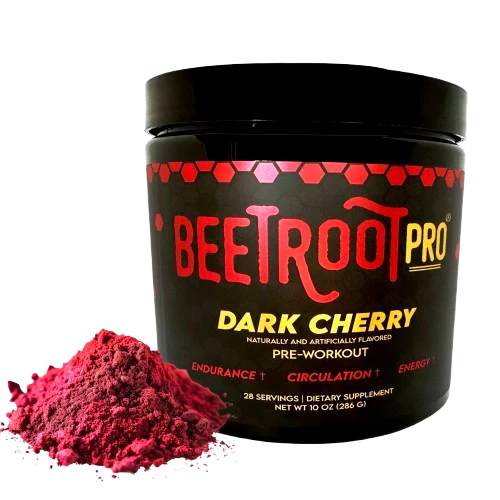
Beetroot Pro
Our product
- Patented betaine nitrate
- Acute Oxygen Efficiency
- 30 Calories Per Serving
Technical FAQ Extension
Should I take beetroot powder on an empty stomach?
No, you do not need to take Beetroot Pro fasted. Dietary nitrate absorption is not meaningfully impaired by food, and a fasted state does not improve absorption. The first conversion step (nitrate to nitrite) happens in the mouth via oral bacteria before food enters the equation. If pre-race food causes you GI anxiety, taking it fasted is fine, but it offers no absorption advantage.
Does eating before a race reduce beetroot absorption?
A normal pre-race meal does not meaningfully impair absorption. No trial has directly compared fed and fasted dosing for performance. In dose-response work (Wylie 2013), plasma nitrite peaked about 2 to 3 hours after a dose, and food may slow gastric emptying and delay that peak somewhat. Keep the meal low in fat, under 15 grams.
What matters more than fasting for beetroot timing?
The 3-day loading protocol matters far more than whether you take your race-morning dose fasted or fed. Loading (one serving AM and PM for the 3 days before race morning) elevates plasma nitrate and nitrite well above a single acute dose because muscle tissue gradually accumulates nitrate. A single fasted dose delivers less total nitric oxide than a 3-day loaded dose, regardless of fasting state.
Related Articles

Apr 24, 2026
The Mouthwash Mistake That Kills Your Beet Dose
Antibacterial mouthwash kills the oral bacteria that convert dietary nitrate to nitric oxide. Use it on race morning and your beet supplement is mostly inert.

Apr 21, 2026
When to Take Beetroot Powder Before a Race
We recommend beetroot extract 60 to 90 minutes before a race. Here is why, what the timing research actually measured, and what nobody has tested yet.
Sep 27, 2026
Does Beetroot Lower Cholesterol? No. Here's What Does
Pooled trials found no significant effect of beetroot juice or powder on LDL or total cholesterol. What beetroot does help, and the fiber dose that lowers LDL.
*Technical citations and PubMed references are provided for performance education only. These statements have not been evaluated by the FDA.