
Beetroot Powder for Ironman: 5-Day Loading Protocol: The Short Answer
For a full Ironman, load dietary nitrate for 5 days (2 servings daily), then take 1 serving 60 to 90 minutes before your wave start. For events over 5 hours, take a second serving at the 4 to 5 hour mark on the bike, since plasma nitrate declines after 3 to 4 hours. A 2 percent oxygen cost reduction saves roughly 6 to 7 minutes over a 5:30 finish. 70.3 athletes under 5 hours need only the pre-race dose.
Ironman and 70.3 triathlon present a different physiological challenge than a 5K or a 40-minute criterium. You are racing for 4 to 17 hours. Gut tolerance at race intensity is a genuine variable. The nitrate loading protocol that works for a 10K runner needs to be adapted for a full-day effort.
This post covers the specific nitrate loading approach for long-course triathlon, including the rationale for extending the loading window to 5 days, the second-dose protocol for events exceeding 5 hours, and why the source of your nitrate matters more in Ironman racing than in shorter events. For a fully personalized version of this timeline built around your own wave start and expected finish time, run the Race Blueprint tool, which converts this protocol into a countdown checklist.
Why Nitrate Matters Differently in Long-Course Triathlon
Dietary nitrate produces its most consistent performance effect at 65 to 80% of VO2 max, the exact intensity band Ironman and 70.3 athletes hold for 4 to 17 hours. Published research shows a 1 to 3% reduction in oxygen cost at a given power output or pace, and that economy gain compounds over long-course durations in a way it cannot in a 20-minute effort.
At Ironman and 70.3 race intensity, the primary performance limiter shifts progressively from acute neuromuscular capacity toward oxygen delivery efficiency and substrate availability. This is exactly the zone where dietary nitrate has the most consistent performance effect.
The studies usually cited here measured different things, and the dose mattered in each:
| Study | Population | Dose | Result |
|---|---|---|---|
| Lansley et al. 2011, Medicine and Science in Sports and Exercise | 9 club-level male cyclists | About 6.2 mmol, 2.5 h before | 4 km and 16.1 km time trials 2.8% and 2.7% faster; higher power output for the same oxygen uptake |
| Bailey et al. 2010, Journal of Applied Physiology | 7 men, knee-extensor exercise | 5.1 mmol a day for 6 days | Lower oxygen uptake and ATP cost during low-intensity exercise; time to exhaustion at high intensity extended from 586 to 734 s |
| Wylie et al. 2013, Journal of Applied Physiology | 10 healthy men, cycling | 4.2, 8.4 and 16.8 mmol | Steady-state oxygen uptake at moderate intensity 1.7% and 3.0% lower after 8.4 and 16.8 mmol; 4.2 mmol changed nothing |
| Hoon et al. 2014, International Journal of Sports Physiology and Performance | 10 highly trained rowers, 2,000 m | 4.2 and 8.4 mmol | 4.2 mmol trivial; 8.4 mmol possibly beneficial, about 1.6 s faster than placebo |
Every positive result above came from about 5 mmol of nitrate or more; one Beetroot Pro serving yields roughly 160 mg, below that. At race intensities below lactate threshold, an oxygen economy improvement compounds over the duration of the event.
For a 5:30 Ironman finish, a 2% oxygen cost reduction translates to roughly 6 to 7 minutes. That is before accounting for the fatigue-resistance benefits in the latter half of the bike and across the marathon.
The 5-Day Loading Protocol for Long-Course Racing
Ironman and 70.3 athletes should extend nitrate loading to 5 days instead of the standard 3-day protocol used for shorter events. Take two servings of Beetroot Pro daily through race eve, then one serving 60 to 90 minutes before your wave start. The extra days let tissue-level nitrate adaptations continue accruing past the plasma plateau that forms by day 3.
Standard nitrate loading for short events uses 3 days of pre-loading (two servings daily) finishing 2 to 3 hours before the start. For Ironman and 70.3, extending to 5 days provides two additional advantages.
Why 5 days instead of 3:
Plasma nitrate levels reach a meaningful plateau within 2 to 3 days of consistent dosing. But tissue-level adaptations, particularly in skeletal muscle, continue accruing through day 5 in some athletes. Masters athletes (35+) benefit most from the extended window because eNOS-dependent nitric oxide production declines with age, making the dietary nitrate pathway relatively more important as a source of NO at exercise intensity.
The 5-day Ironman protocol:
| Day | Dose | Timing |
|---|---|---|
| Days 1 to 4 | 2 servings of Beetroot Pro daily | Any time, with water |
| Day 5 (race eve) | 2 servings | Evening, with final pre-race carbohydrate loading meal |
| Race morning | 1 serving | 60 to 90 minutes before wave start |
Take the race-morning dose with 10 to 12 oz of water and allow 60 minutes minimum before any vigorous warmup. Plasma nitrite is rising by the start; in published studies on beet juice it peaks about 2 to 3 hours after a dose and stays elevated for several hours, which covers the swim and the start of the bike. To pair this loading window with your carbohydrate targets for race week, the carb fueling plan tool builds a matching day-by-day intake schedule.
The Second Dose for Events Over 5 Hours
Plasma nitrate from a single pre-race dose begins declining after 3 to 4 hours, so full Ironman finishers need a second serving at the 4 to 5 hour mark on the bike to re-elevate nitric oxide availability for the run. Mix 2 scoops into 12 oz of plain water, separate from carbohydrate solution. 70.3 athletes finishing under 5 hours typically do not need this second dose.
This is the protocol detail most athletes miss for full Ironman events. The plasma nitrate elevation from a single dose begins declining after approximately 3 to 4 hours. In a race that runs 9, 10, or 11 hours, the acute pre-race dose is no longer driving the same physiological effect by the back half of the run.
For full Ironman events (140.6 miles), take a second serving at the 4 to 5 hour mark on the bike, mixed in your nutrition bottle or dissolved in water at an aid station. The second dose re-elevates plasma nitrate for the remainder of the bike and the full run.
Practical notes for the second dose:
- Dose: 2 scoops mixed into approximately 12 oz of plain water, separate from carbohydrate or electrolyte solution
- Timing: at the start of the third lap or at the 4-hour mark on the bike, whichever comes first
- Avoid doubling up: do not time the second dose with a large carbohydrate bolus, which can slow gastric emptying and delay absorption
- Under 5 hours: 70.3 athletes finishing in under 5 hours typically do not need a second dose
Why Fiber-Free Nitrate Matters in Ironman Racing
Gut blood flow can drop 60 to 80% below resting levels at Ironman race intensity, which slows small intestine transit and raises the risk that insoluble fiber in whole beet concentrate causes bloating or cramping. Beetroot Pro uses betaine nitrate extract, which delivers the same nitrate dose without the fiber load, lowering GI risk specifically at long-course intensity and duration.
At Ironman intensities, gut blood flow can decrease by 60 to 80% compared to resting state. The small intestine moves content more slowly. Insoluble fiber that would pass through normally at rest can sit and cause GI distress, bloating, or cramping when you are racing at 70% of VO2 max for six hours.
Whole beet concentrate products retain the insoluble fiber from the source beet. This is not a significant issue in a sprint triathlon or a 70-minute training ride. In a 5 to 12 hour race, it is a meaningful risk.
Beetroot Pro uses betaine nitrate extract, which retains the nitrate without the insoluble fiber. The result is a lower GI burden at race intensity, which is one reason it was developed specifically for endurance applications rather than general use. Because sodium losses compound the same gut and fluid-balance risk over an all-day race, pairing this with the sodium calculator helps set a matching electrolyte plan for the bike and run legs.
The Mouthwash Protocol Warning for Triathletes
Antibacterial mouthwash kills the oral bacteria required to convert dietary nitrate into nitrite, the first step in the nitrate-nitrite-nitric oxide pathway; in one study a week of chlorhexidine rinsing cut oral nitrite production by about 90%. Use plain water only on race morning, and avoid antibacterial mouthwash, gum, or breath strips for 24 hours before an Ironman or 70.3.
Dietary nitrate requires oral bacteria to convert nitrate to nitrite before absorption can occur. If you use antibacterial mouthwash on race morning, you kill the oral bacteria that enable this conversion and significantly reduce the effectiveness of your pre-race dose.
Do not use antibacterial mouthwash on race morning or during the 24 hours before your event. Plain water rinsing is fine. Avoiding antibacterial gum and breath strips is also prudent for the same reason.
This is a common protocol failure athletes discover after a race where the product seemed not to work. The product is dependent on your oral microbiome being intact. For more on the timing mechanics behind this pathway, see why nitrate timing matters in the 60 minutes before you race.
Masters Athletes: Why the Extended Loading Window Matters More
Endothelial nitric oxide synthase (eNOS) activity declines progressively from around age 35, reducing the body's own capacity to produce nitric oxide during exercise. Since more Ironman finishers are over 40 than under 35 in most race cohorts, the dietary nitrate pathway becomes relatively more important for masters triathletes, and the full 5-day loading window is where that advantage compounds.
Endothelial nitric oxide synthase (eNOS) activity declines progressively from approximately age 35. eNOS is the primary endogenous pathway for nitric oxide production in blood vessel walls, which drives vasodilation and blood flow regulation during exercise.
As eNOS activity decreases with age, the dietary nitrate pathway becomes relatively more important as a supplemental source of nitric oxide at exercise intensity. Masters triathletes are also typically competing in longer events (more Ironman finishers are over 40 than under 35 in most race cohorts), where the duration multiplies the performance effect of any improvement in oxygen economy.
The 5-day loading window is particularly relevant for masters athletes because the additional loading days allow plasma nitrate to reach a higher stable plateau before race day, partially compensating for reduced endogenous NO production.
Pairing with Endurance360 for the Full Long-Course System
Beetroot Pro handles the acute race-day nitric oxide mechanism, while Endurance360 builds chronic capacity over a 14-day loading period through beta-alanine for lactic acid buffering, creatine for phosphocreatine resynthesis, and cordyceps for VO2 max support. Starting Endurance360 14 days before race week and layering the Beetroot Pro 5-day protocol on top covers both the chronic and acute sides of the same oxygen-delivery problem.
Beetroot Pro addresses the acute race-day nitric oxide mechanism. Endurance360 addresses the chronic loading mechanisms: beta-alanine for lactic acid buffering, creatine for phosphocreatine resynthesis between hard efforts, and cordyceps for VO2 max support over a 14-day loading period.
For Ironman and 70.3 athletes doing a structured build, starting Endurance360 loading 14 days before race week builds the chronic adaptations while the Beetroot Pro 5-day protocol handles the acute race-day optimization. The two products address different aspects of the same oxygen-delivery and power-output problem, without overlapping mechanisms or ingredients. Athletes still working out what actually caps their long-course performance can start with what limits the stamina of endurance athletes to see where nitrate fits among the other limiters.
Technical
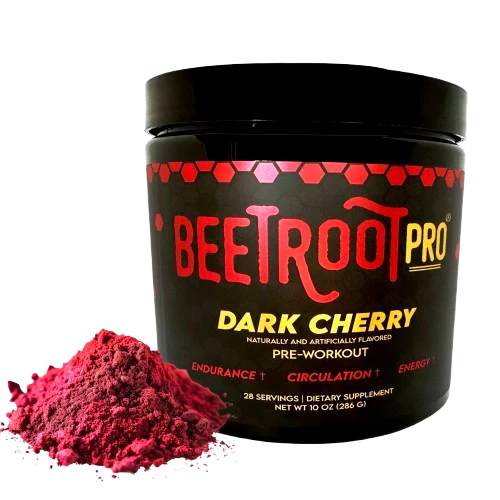
Beetroot Pro
Our product
- Patented betaine nitrate
- Acute Oxygen Efficiency
- 30 Calories Per Serving
Frequently Asked Questions
Below are direct answers to the most common questions athletes ask about nitrate loading for Ironman and 70.3 triathlon, covering timing, second dosing, GI tolerance, and the mouthwash interaction.
How many days before an Ironman should I start loading beetroot powder? Start 5 days before race day for a full Ironman, or 3 days before for a 70.3. Take two servings daily during the loading window, with the final pre-race serving 60 to 90 minutes before your wave start. Masters athletes and anyone over 45 should use the 5-day window for both distances.
Do I need a second dose of beetroot powder during an Ironman? Yes, for events expected to take longer than 5 hours. Plasma nitrate from a single pre-race dose begins declining after 3 to 4 hours. A second serving at the 4 to 5 hour mark on the bike re-elevates plasma nitrate for the remainder of the race. Mix with plain water, separate from carbohydrate solution.
Can I use beetroot powder during 70.3 triathlon? Yes. Take one serving 60 to 90 minutes before the race start, using the same race-morning protocol as for full Ironman. Most 70.3 athletes finishing in under 5 hours do not need a second dose during the race. Begin loading 3 to 5 days before race day.
Does beetroot powder cause GI problems during triathlon? Whole beet concentrate products contain insoluble fiber that can cause GI distress at race intensity due to reduced gut blood flow. Beetroot Pro uses betaine nitrate extract without insoluble fiber, which significantly reduces this risk. The most common GI issues athletes report with beet products are attributable to fiber load, not to the nitrate itself.
Should I use antibacterial mouthwash before an Ironman if I am taking beetroot powder? No. Dietary nitrate requires oral bacteria to convert nitrate to nitrite, which is the first step in the nitrate-nitrite-nitric oxide pathway. Antibacterial mouthwash kills these bacteria; in one study a week of chlorhexidine rinsing cut oral nitrite production by about 90% (Kapil et al. 2013). Use plain water only on race morning and avoid antibacterial oral products for 24 hours before your event.
How is betaine nitrate different from regular beet powder for triathlon? Betaine nitrate is a chemically defined compound that delivers a fixed nitrate dose regardless of crop variation. Regular beet powder or beet concentrate relies on the natural nitrate content of beets, which varies by growing conditions, soil, and processing. For a 5-day loading protocol before a goal race, knowing the exact dose you are taking each day matters. For a 9-hour Ironman, using an unstandardized nitrate source introduces uncertainty at the worst possible time.
Technical FAQ Extension
How many days before an Ironman should I start loading beetroot powder?
Start 5 days before race day for a full Ironman, or 3 days before for a 70.3, taking two servings daily during the loading window. Take the final pre-race serving 60 to 90 minutes before your wave start. Masters athletes and anyone over 45 should use the 5-day window for both distances, since the extra days let plasma nitrate reach a higher stable plateau.
Do I need a second dose of beetroot powder during a full Ironman?
Yes, for events expected to take longer than 5 hours. Plasma nitrate from a single pre-race dose begins declining after 3 to 4 hours, so in a 9 to 11 hour race the pre-race dose no longer drives the same effect by the back half. Take a second serving (about 2 scoops in 12 oz of plain water) at the 4 to 5 hour mark on the bike, separate from carbohydrate solution.
Why use fiber-free betaine nitrate instead of whole beet powder for triathlon?
At Ironman intensities gut blood flow can drop 60 to 80% versus rest, and the insoluble fiber in whole beet concentrate can sit in the gut and cause distress, bloating, or cramping over a multi-hour race. Beetroot Pro uses betaine nitrate extract that retains the nitrate without insoluble fiber, lowering GI burden, and delivers a fixed labeled dose that does not vary by crop.
Related Articles
Jul 16, 2026
How Long Beetroot Powder Takes to Lower Blood Pressure
A single dose raises plasma nitrite in about 45 minutes and lowers blood pressure within 60 to 150 minutes. The full timeline, by product format.
Jul 14, 2026
Beetroot Powder for Blood Pressure: Dose and Brands
Beetroot powder can lower systolic blood pressure about 3 to 5 mmHg, but only at a real nitrate dose. See how Beetroot Pro, SuperBeets, and Xendurance compare.
Jun 3, 2026
How Much Beetroot Powder Per Day? 300-600mg (2026)
Dose by milligrams of nitrate, not grams of powder: nitrate varies about 50-fold by product. Target 300 to 600mg daily, with tables by goal and body weight.
*Technical citations and PubMed references are provided for performance education only. These statements have not been evaluated by the FDA.