
When to Take Beetroot Powder Before a Race: The Short Answer
Take Beetroot Pro 60 to 90 minutes before a race. Plasma nitrite is rising by then; in published studies, all on beet juice or sodium nitrate, it peaks about 2 to 3 hours after a dose and stays elevated for several hours, so a 60 to 90 minute dose covers the start and the hours of racing after it. No study has measured timing for a standardized extract. Sip over 60 to 90 seconds, swish briefly, and avoid antibacterial mouthwash for 2 hours before, since it kills the oral bacteria needed for conversion.
If you have ever Googled "when to take beet powder before a race," every result tells you the same thing: 2 to 3 hours before performance.
That advice is not wrong. It answers a slightly different question from the one you are asking: it describes when plasma nitrite peaks, not the only sensible time to take a dose. We recommend 60 to 90 minutes, and this page explains why without pretending the research says more than it does.
Where the 2-3 Hour Recommendation Comes From
The 2 to 3 hour recommendation comes from pharmacokinetic studies on beet juice and sodium nitrate, which found that plasma nitrite peaks about 2 to 3 hours after a dose and stays elevated for several hours after that (Webb 2008, Wylie 2013). That finding is sound. It tells you when nitrite peaks, which is a separate question from when to dose.
| Event duration | Recommended timing | Dose (dietary nitrate) | Notes |
|---|---|---|---|
| Under 30 min | 60-90 min before | 5-6 mmol (300-360 mg) | Plasma nitrite rising at the start |
| 30-90 min | 60-90 min before | 6-8 mmol (360-500 mg) | Juice studies put the peak 2-3 hours after a dose |
| 90 min to 3 hours | 60-90 min before | 6-8 mmol (360-500 mg) | Single acute dose sufficient |
| 3+ hours (endurance) | 60-90 min before + 3-day loading | 5-8 mmol/day x 3 days | Loading raises baseline plasma nitrite |
| Multi-day stage race | Begin 3 days before stage 1 | 5-8 mmol/day | Maintain daily through final stage |
The landmark performance studies, Lansley 2011 and Bailey 2009 (the original papers that made dietary nitrate a household name in sports science), gave subjects beet juice. The timing studies did the same: Webb 2008 and Wylie 2013 measured plasma nitrite after beet juice and found it peaks about 2 to 3 hours after the dose, then stays elevated for several hours.
Most "how long before exercise" guides turn that peak into a dosing instruction: take it 2 to 3 hours out so the peak lands at the start. That is a reasonable reading, and it is what the IOC consensus protocol uses. It is not the only reasonable one.
Why We Recommend 60 to 90 Minutes
We recommend a dose 60 to 90 minutes before the start. Plasma nitrite is already rising by then, and going by the juice studies it peaks about 2 to 3 hours after the dose and stays elevated for several hours, so the peak falls during the race rather than before it. This is our protocol, not a claim that extract peaks sooner than juice.
Beetroot Pro beet powder is a standardized NO3-T® Betaine Nitrate extract. No published study has measured plasma nitrite timing for a standardized beet extract, so we do not claim it absorbs faster or slower than juice, and we do not claim to have moved the peak. The case for 60 to 90 minutes rests on the juice kinetics plus race-morning practicality:
How It Works
The 60-minute cascade that turns a scoop into measurable threshold power.
Nitrate Uptake
T-60 MINAn 8,000 mg standardized beet extract absorbs through the gut and enters the bloodstream intact, unlike raw beet juice, which varies batch to batch.
Conversion to Nitrite
T-45 MINOral bacteria reduce nitrate to nitrite. Swishing with each gulp maximizes sublingual absorption and speeds the conversion.
Nitric Oxide Release
T-30 MINNitrite converts to nitric oxide (NO) in active tissue. NO is the master signal molecule for blood vessel dilation.
Vasodilation + O2 Delivery
T-0 · RaceBlood vessels widen, oxygen delivery to working muscles climbs, and the oxygen cost of every watt drops. Threshold power goes up.
- It covers the race, not just the start. With the peak about 2 to 3 hours after the dose and levels elevated for several hours after, a dose 60 to 90 minutes out keeps nitrite high through the start and the hours of racing that follow.
- It fits a normal race morning. Most athletes eat their pre-race meal 2 to 3 hours out. Taking the serving later, during warmup preparation, keeps it separate from the meal and easy to remember.
- Taking it 2 to 3 hours out is also fine. That follows the studies more literally. If it suits your routine better, it is a legitimate choice.
The Enterosalivary Pathway: Why Your Mouth Matters
Dietary nitrate becomes nitric oxide through a three-step enterosalivary cascade: oral bacteria reduce nitrate to nitrite in the first 10 to 20 minutes, some nitrite converts to nitric oxide in the acidic stomach by 20 to 40 minutes, and the remainder converts systemically in hypoxic tissue from 40 to 60 minutes onward. Antibacterial mouthwash disrupts the first step and blunts the entire pathway.
Understanding the timing of beetroot supplementation requires understanding the path nitrate takes to become nitric oxide. It is not a direct conversion. It is a three-step cascade that runs through your mouth, stomach, and bloodstream in sequence:
- Oral phase (first 10 to 20 minutes). You swallow nitrate (NO3-). Saliva concentrates roughly 25 percent of circulating nitrate and delivers it to the tongue, where commensal oral bacteria (particularly Veillonella and Actinomyces species) reduce nitrate to nitrite (NO2-). This is the enterosalivary pathway.
- Gastric phase (20 to 40 minutes). Nitrite-rich saliva is swallowed into the stomach. In the acidic environment, some nitrite converts directly to nitric oxide (NO) and other reactive nitrogen species. The rest continues on.
- Systemic phase (40 to 60 minutes and beyond). Remaining nitrite enters circulation. In hypoxic tissue (exactly the condition created by hard exercise), enzymes including xanthine oxidoreductase convert nitrite to nitric oxide at the local level, triggering vasodilation exactly where you need it.
Two operational consequences follow from this cascade:
- Mouthwash blocks step 1. Antibacterial mouthwash kills the oral bacteria required for nitrate-to-nitrite reduction. Any mouthwash use within 2 hours of your serving cuts the pathway at its foundation. In Govoni 2008, a chlorhexidine rinse before a nitrate dose abolished nitrite formation in saliva and markedly attenuated the rise in plasma nitrite in healthy volunteers; in Petersson 2009, an antiseptic mouthwash abolished the blood pressure lowering effect of dietary nitrate in rats. Neither study measured exercise performance.
- Swishing speeds step 1. Holding the dose in your mouth briefly before swallowing, or sipping slowly over 60 to 90 seconds, increases the residence time on oral bacteria and improves conversion efficiency. Athletes who swish report faster subjective onset than those who drink it in one gulp.
| Compound | Found in | Effect on nitrate conversion | Action |
|---|---|---|---|
| Cetylpyridinium chloride (CPC) | Most antibacterial mouthwashes | Kills oral bacteria; blocks 90%+ NO2- production | Avoid on race morning |
| Chlorhexidine | Prescription mouthwash | Same oral microbiome disruption | Avoid 24 hours before |
| Alcohol (ethanol) | Many mouthwashes | Mild bactericidal effect | Avoid race morning |
| Fluoride alone | Most toothpastes | No meaningful effect on oral bacteria | Safe to use normally |
How Long One Serving Lasts
In the published juice studies, plasma nitrite peaks about 2 to 3 hours after a dose and stays elevated for several hours after that, so one serving 60 to 90 minutes before the start covers most endurance events. No study has measured how long that window lasts for a standardized extract, so treat it as a working estimate rather than a guarantee.
We do not claim the window is longer or shorter for extract than for juice; nobody has measured it. For longer efforts, a second serving keeps levels up:
| Race Type | Protocol |
|---|---|
| Crit / Short Race (under 2 hrs) | 1 serving 60 to 90 min before start |
| Century / Gran Fondo (2-5 hrs) | 1 serving 60 to 90 min before, optional 2nd at hour 3 |
| Ultra / Ironman (5+ hrs) | 1 serving 60 to 90 min before, 2nd serving at hour 4-5 |
The Race Week Loading Protocol
Daily loading for 3 days before race day, one serving morning and evening, adds a modest performance benefit on top of the acute pre-race dose by saturating the nitrate pool. Loading provides insurance against an imperfect race morning: even a missed or mistimed dose still lands on top of an elevated baseline.
For key events, daily loading for 3 days before race day provides a modest additional performance benefit on top of the acute dose. The protocol is straightforward:
- Days minus 3, minus 2, minus 1: Take 1 serving in the morning and 1 serving in the evening.
- Race morning: Take 1 serving 60 to 90 minutes before the start.
Loading saturates the nitrate pool so that even if race-morning conditions are imperfect (you slept poorly, ate late, got stuck in traffic), your baseline plasma nitrite is already elevated when you line up. The 3-day loading protocol also buys you insurance against a single missed dose: if race morning goes sideways, you still have saturation.
What About Caffeine, Training, and Other Combinations
Standardized beetroot extract is caffeine-free and pairs cleanly with a normal pre-race routine, since vasodilation and CNS stimulation operate through different mechanisms that do not antagonize each other. Take caffeine separately 30 to 45 minutes before the gun, and continue normal on-course carb fueling since the extract is a pre-race serving, not an in-race fuel.
Beetroot Pro is caffeine-free, which makes it a clean layering element with any pre-race routine. Common combinations that work well:
- Caffeine. Take caffeine separately, usually 30 to 45 minutes before the gun. Nitric oxide (vasodilation) and caffeine (CNS stimulation) operate through different mechanisms and do not antagonize each other.
- Pre-race meal. A small carbohydrate meal 2 to 3 hours before the start is compatible with a 60-minute Beetroot Pro dose. The dose is small enough (a few ounces of water) that it does not interfere with meal digestion.
- Carb fueling on course. Beetroot Pro is a pre-race serving, not an in-race fuel. Continue your normal gel, bar, or drink-mix fueling strategy during the race.
- Hydration. Mix Beetroot Pro in 6 to 8 ounces of water. You can add lemon, ice, or a small pinch of salt without affecting the nitrate content.
Case Study: Application to a Typical Amateur Race Morning
For a typical 8:00 am race start, the protocol is: load one serving morning and evening for the 3 days prior, take the final serving 60 minutes before the start, and avoid antibacterial mouthwash from the night before through race morning. Plasma nitrite is rising at the start line and, going by the juice studies, peaks during the race and stays elevated for several hours.
To make this concrete, here is a walk-through for a cyclist or runner doing an 8:00 am race start.
T minus 3 days to 1 day (Wednesday to Friday for a Saturday race): one serving of Beetroot Pro in the morning, one serving in the evening. No other changes to your taper protocol.
T minus 12 hours (night before): light dinner, early bed. Brush teeth as normal; do not use antibacterial mouthwash before bed.
T minus 3 hours (5:00 am): wake up, eat your normal pre-race carb meal, drink water or coffee as preferred. If you use mouthwash, this is your last safe window.
T minus 60 minutes (7:00 am): mix one serving of Beetroot Pro in 6 to 8 oz water. Sip over 60 to 90 seconds, swishing briefly between swallows. Continue with normal warmup.
T minus 0 (8:00 am): start with plasma nitrite rising. Going by the published juice studies, it peaks about 2 to 3 hours after your 7:00 am serving, so somewhere between 9:00 and 10:00 am, and stays elevated for several hours after.
Post-race (T plus 4+ hours): continue normal hydration and recovery nutrition. Beetroot Pro supports recovery via sustained blood flow, but nothing special is required.
What the Research Says About Acute Dose Timing for Extract
Few studies compare nitrate vehicles head to head, and none has tested a standardized beet extract. Equimolar sodium nitrate and beetroot juice raise plasma nitrate and nitrite to similar levels, one trial found juice lowered oxygen cost more than sodium nitrate, and plasma nitrite from concentrated juice peaks about 2 to 3 hours after a dose.
Peer-reviewed comparisons of extract and juice timing are limited because extract products are newer than the original juice research. What the studies that do exist show:
| Study | Population | Dose | Result |
|---|---|---|---|
| Jonvik et al. 2016, Journal of Nutrition | 18 healthy adults | 800 mg nitrate as sodium nitrate, beetroot juice, rocket or spinach drink | Similar peak plasma nitrate with all four; the juice and vegetable drinks lowered blood pressure more than sodium nitrate |
| Flueck et al. 2016, Applied Physiology, Nutrition, and Metabolism | 12 well-trained men | 3, 6 or 12 mmol nitrate as beetroot juice or sodium nitrate | Oxygen uptake in severe exercise about 4% lower with 6 mmol juice than with 6 mmol sodium nitrate; plasma nitrite similar |
| Wylie et al. 2013, Journal of Applied Physiology | 10 healthy men | 70, 140 or 280 ml concentrated juice (4.2, 8.4 or 16.8 mmol nitrate) | Plasma nitrite peaked about 2 to 3 hours after dosing; 4.2 mmol did not change exercise responses, 8.4 mmol extended time to task failure by 14%, 16.8 mmol gave no further gain |
Larsen 2010 (sodium nitrate) and Coggan 2015 (beetroot juice) each tested a single vehicle, so neither speaks to extract versus juice.
A Beetroot Pro serving yields about 160 mg of dietary nitrate, roughly 2.6 mmol, so it sits below even the lowest dose Wylie tested (4.2 mmol, about 260 mg). The figure is derivable from the disclosed extract, so you can check it against the research yourself rather than take our word for it.
The honest reading: the dose-response kinetics above come from concentrated juice, and they put peak plasma nitrite about 2 to 3 hours out. No published study has measured plasma nitrite timing for a standardized beet extract, so we make no claim that extract peaks sooner or later than juice. The 60 to 90 minute recommendation on this page is a protocol built around the juice kinetics, not a claim that we moved the peak.
Common Mistakes That Blunt the Effect
The most common mistakes that blunt the nitrate effect are using antibacterial mouthwash or toothpaste within 2 hours of dosing, taking the dose too close to the start (under 15 to 30 minutes, when plasma nitrite has barely begun to rise), and skipping the race-week load before a target event.
Even on the 60 to 90 minute protocol, a few small mistakes reliably blunt the effect:
- Using mouthwash in the 2 hours before. See earlier section. Skip mouthwash on race morning entirely.
- Brushing with an antibacterial toothpaste right before. Same mechanism. Brush the night before if you are concerned.
- Taking the dose too close to the gun. At T minus 15 to 30 minutes, plasma nitrite has barely begun to rise when you start, and in a short race the peak may arrive after you have finished.
- Skipping the race-week load for a target event. The acute dose alone works, but loading means a mistimed race-morning dose still lands on an elevated baseline.
Timing for Training vs. Racing
The 60-minute protocol is worth using for hard interval sessions and threshold or tempo runs, where the session bottlenecks on oxygen delivery. For long slow distance, easy rides, strength work, or rest days, daily use is optional since the acute effect matters most above roughly 70 percent of max heart rate.
Not every session needs the full race-morning protocol. For day-to-day training:
- Hard interval sessions: one serving 60 minutes before is worth it.
- Threshold or tempo runs: 60-minute protocol recommended.
- Long slow distance / easy rides: optional. Daily use during training blocks is fine, but the acute effect is most relevant for efforts above about 70 percent of max heart rate.
- Strength or rest days: no serving required; not a stimulant.
The key insight: Beetroot Pro is a performance leverage supplement, not a foundation supplement. You get the most return when the session is hard enough to bottleneck on oxygen delivery.
Related reading: Beetroot Pre-Workout Guide: dosing by sport and distance | Why Beet Supplements Cause GI Distress | What is NO3-T Betaine Nitrate? | Dietary Nitrate Loading Protocol | The Clean Athlete's Guide to Nitric Oxide and Lactic Acid Buffering | Frequently Asked Questions | Cyclist Performance Protocol | Triathlete Performance Protocol
Technical
Beetroot Pro
Our product
- Patented betaine nitrate
- Acute Oxygen Efficiency
- 30 Calories Per Serving
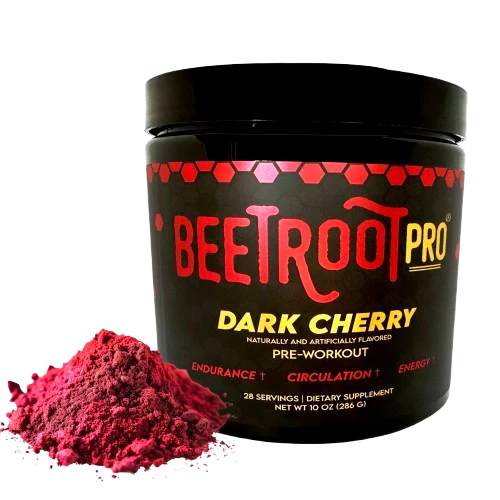
Technical FAQ Extension
How long before a race should I take beetroot powder?
Take Beetroot Pro 60 to 90 minutes before your race or training session. Plasma nitrite is rising by then; in published studies on beet juice it peaks about 2 to 3 hours after a dose and stays elevated for several hours, so a 60 to 90 minute dose covers the start and the hours after it. The IOC consensus protocol doses 2 to 3 hours out, which is also reasonable.
How long does the nitric oxide effect from beet powder last?
In published studies on beet juice, plasma nitrite peaks about 2 to 3 hours after a dose and stays elevated for several hours. No study has measured this window for a standardized extract. For events over 4 hours, a second serving at hour 3 keeps levels up through the finish.
Should I do a beetroot loading plan before a race?
Yes. Take one serving morning and evening for 3 days before your event to saturate the nitrate pool. Then take a final acute dose 60 minutes before the start. Loading provides a meaningful additional performance benefit on top of a single acute dose.
Related Articles
Jul 16, 2026
How Long Beetroot Powder Takes to Lower Blood Pressure
A single dose raises plasma nitrite in about 45 minutes and lowers blood pressure within 60 to 150 minutes. The full timeline, by product format.
Jul 14, 2026
Beetroot Powder for Blood Pressure: Dose and Brands
Beetroot powder can lower systolic blood pressure about 3 to 5 mmHg, but only at a real nitrate dose. See how Beetroot Pro, SuperBeets, and Xendurance compare.
Jun 3, 2026
How Much Beetroot Powder Per Day? 300-600mg (2026)
Dose by milligrams of nitrate, not grams of powder: nitrate varies about 50-fold by product. Target 300 to 600mg daily, with tables by goal and body weight.
*Technical citations and PubMed references are provided for performance education only. These statements have not been evaluated by the FDA.