
How Much Nitrate Is In Your Beet Supplement?
Lab analyses find beet supplements vary enormously in nitrate: 50 beetroot supplements tested in a 2023 study delivered 0.2 to 169 mg per daily dose, and 24 beet juice products tested in 2019 spanned a roughly 50-fold range, with no required labeling standard. The dose used in performance research is about 300 to 600 mg (roughly 5 to 9 mmol). To verify a product, look for milligrams of dietary nitrate (NO3-) explicitly listed on the label, ideally with a third-party lab assay reference. Most retail products fall well below the clinical threshold.
Here is a fact that most beet supplement brands do not want you to know: when researchers tested 50 beetroot supplements, the nitrate in a manufacturer's recommended daily dose ranged from 0.2 mg to 169 mg, and only four of the 50 declared a nitrate content at all.
That is a spread of several hundred fold between the weakest and strongest products. And the label on most of those products will not tell you which category you are buying.
The Clinical Dose You Need to Actually See Results
The dose used in performance research is about 300 to 600 mg of dietary nitrate, roughly 5 to 9 mmol, per the IOC's 2018 consensus statement. In the clearest dose comparison, 4.2 mmol (about 260 mg) did not change exercise responses, while 8.4 mmol (about 520 mg) extended time to exhaustion by 14 percent.
The performance research on dietary nitrate and endurance exercise is based on doses in a specific range. The IOC's 2018 consensus statement puts the acute performance dose at 5 to 9 mmol (310 to 560 mg), taken 2 to 3 hours before exercise, and the 17 studies pooled in a 2013 meta-analysis (Hoon et al.) used 300 to 600 mg.
Direct dose comparisons are few, but they point the same way:
| Study | Population | Dose | Result |
|---|---|---|---|
| Wylie et al. 2013, Journal of Applied Physiology | 10 healthy men, cycling | 4.2, 8.4 and 16.8 mmol | 4.2 mmol changed nothing; 8.4 mmol extended time to task failure by 14%; 16.8 mmol gave no further gain |
| Hoon et al. 2014, International Journal of Sports Physiology and Performance | 10 highly trained rowers, 2,000 m | 4.2 and 8.4 mmol | 4.2 mmol had a trivial effect; 8.4 mmol was possibly beneficial, about 1.6 s faster than placebo |
If your supplement delivers 50 mg per serving, you would need 6 to 12 servings to reach the clinical dose. At that point, the cost per effective dose is dramatically higher than the label price suggests.
The Dose Spread in Practice
A 2023 lab analysis of 50 beetroot supplements found nitrate per recommended daily dose ranging from 0.2 mg to 169 mg, with medians of about 4 mg for capsules and tablets and 22 mg for powders. Only four of the 50 declared a nitrate content on the label at all.
A 2023 analysis published in Foods (Brzezińska-Rojek et al.) tested 50 beetroot-based dietary supplements and found:
- Range: 0.2 mg to 169 mg of nitrate per manufacturer's recommended daily dose
- Medians: about 3.9 mg for capsules, 3.8 mg for tablets and 22 mg for powders, all far below the research dose
- Disclosure: only four of the 50 declared a nitrate content, and two of those contained no measurable nitrate despite the claim
- Best performer: the highest product delivered 169 mg per daily dose, about 85 percent of its declared figure
Beet juice is more concentrated but no more consistent. A 2019 analysis of 45 lots of 24 beet juice products marketed to athletes (Gallardo and Coggan) found a roughly 50-fold range between products and an average 30 percent variation between lots of the same product; only five products consistently supplied at least 5 mmol (about 310 mg) per serving.
Independent product testing shows the same spread across juices, powders and chews together: ConsumerLab's beetroot review found a single serving could supply anywhere from 4.3 mg to 495.7 mg of nitrate, more than a 100-fold difference.
The brands at the bottom of this range are not selling you a performance supplement. They are selling you a marketing story. The capsule or powder technically contains beet root, but at a dose so low that no peer-reviewed study would predict a benefit.
How to Read a Beet Supplement Label
A transparent beet supplement label states the milligrams of dietary nitrate per serving explicitly, ideally naming a specific patented ingredient and patent number. A vague label lists only total powder weight, a proprietary blend, or "organic beet root" with no nitrate assay, numbers that tell you nothing about your actual dose.
What a transparent label shows:
- Milligrams of dietary nitrate per serving (e.g., "300 mg NO3" or "provides 400 mg nitrate")
- Specific nitrate form (betaine nitrate, sodium nitrate, beet root extract with standardized nitrate content)
- The identity of any patented ingredient (e.g., "NO3-T Betaine Nitrate" with the patent number)
What a vague label shows:
- "Beet Root Powder" with a milligram weight for the whole powder (not the nitrate content)
- Proprietary blend with total weight but no per-ingredient breakdown
- "Organic beet root" with no nitrate assay
The translation problem: A serving of 1,500 mg of beet root powder might contain 80 mg of nitrate or 400 mg of nitrate depending on the quality of the raw material, growing conditions, and processing method. Without an assay, you cannot know.
Reference diagram, not interactive
Why the Variance Is So High
Raw beet root nitrate content varies mainly due to four factors: soil nitrate levels during growing, beet variety, processing method (heat drying destroys nitrate, freeze drying preserves it), and whether the manufacturer standardizes to a tested nitrate floor. A patented compound like NO3-T Betaine Nitrate sidesteps this variability because the dose is chemically defined, not dependent on beet quality.
Raw beet root nitrate content varies significantly based on:
- Soil nitrate levels during growing (nitrogen-rich soil produces higher-nitrate beets)
- Beet variety (red beets, golden beets, and sugar beets have different nitrate profiles)
- Processing method (high-heat drying destroys some nitrate; freeze-drying preserves more)
- Standardization (some manufacturers test and standardize to a nitrate floor; many do not)
A patented compound like NO3-T Betaine Nitrate sidesteps this variability entirely because the nitrate dose is chemically defined, not dependent on beet quality.
What "20x Concentrated" and Similar Claims Actually Mean
Marketing claims like "20x concentrated" or "equivalent to X whole beets" describe volume reduction, not verified nitrate content. A product can legitimately concentrate beet powder 20 fold and still deliver only 50 mg of nitrate if the starting beets were low in nitrate to begin with.
Marketing language like "20x concentrated" or "equivalent to X whole beets" refers to volume reduction, not verified nitrate content. A product can legitimately concentrate beet root powder 20-fold and still deliver 50 mg of nitrate if the starting material was low-nitrate beets.
The only claim that matters is a verified milligram amount of dietary nitrate per serving.
The Honest Comparison
Nitrate content by format ranges from as little as 5 mg in a cheap capsule to about 400 mg in a beet juice shot. Cheap capsules and standard beet powder fall well short of the 300 to 600 mg research range. Only juice shots reliably reach it on one serving: Beet It Sport discloses 400 mg on its label. A standardized betaine nitrate extract yields about 160 mg per serving, so it takes more than one.
| Format | Typical Nitrate per Serving | Notes |
|---|---|---|
| Cheap capsule (generic beet root) | 5 to 30 mg | Sub-clinical at any reasonable serving size |
| Standard beet root powder | 50 to 150 mg | Usually sub-clinical; highly variable |
| Beet root powder (high quality) | 200 to 350 mg | Approaching clinical range; depends on sourcing |
| Beet juice shots (Beet It Sport) | ~400 mg | Clinical range; perishable, refrigeration needed |
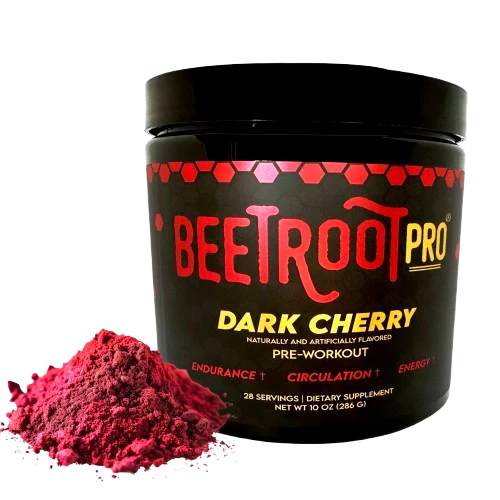
| Betaine nitrate extract (Beetroot Pro) | ~160 mg, below the research range, derived from a label-disclosed 8,000 mg standardized extract at 2 percent nitrate | Shelf-stable; 30 calories per serving; gut-friendly |
Reference diagram, not interactive
The Beetroot Pro bar reflects about 160 mg of dietary nitrate, derived from the disclosed 8,000 mg standardized extract at a 2% nitrate standardization. The label itself prints no nitrate figure.
Weighing Beet It Sport shots against a powder? The Beet It Sport alternative comparison puts the two labels side by side, including the rows Beet It Sport wins.
Technical
Beetroot Pro
Our product
- Patented betaine nitrate
- Acute Oxygen Efficiency
- 30 Calories Per Serving
Where Do Popular Bulk-Powder Brands Fall?
Widely sold raw beet root powders like Terrasoul, BulkSupplements, and Nutricost sit in the standard beet root powder tier above: none of them publish a milligram-per-serving nitrate figure on the label or product page, so by default they fall in the sub-clinical-to-variable 50 to 150 mg range rather than the disclosed 300 to 600 mg clinical range.
Third-party aggregators like ConsumerLab occasionally spot-test nitrate content across store-bought brands, but the full results sit behind a subscription paywall and do not cover every SKU on the market. The same rule from the section below applies here: if the brand cannot answer "how many milligrams of dietary nitrate per serving," you are buying beet root powder, not a dosed nitrate supplement.
The Ask Before You Buy
Ask any beet supplement brand exactly one question before buying: "How many milligrams of dietary nitrate does one serving contain?" A brand that cannot answer with a specific number is not selling a dosed performance product, and you have no way to know whether it will work.
Before purchasing any beet supplement, ask one question: "How many milligrams of dietary nitrate does one serving contain?"
If the brand cannot answer that with a specific number, you do not have enough information to evaluate whether the product can work. The dose is the product. This is exactly the gap behind popular raw-capsule products: see how a label like Rosabella's organic beet capsules discloses raw powder weight but not a nitrate dose.
This is why Beetroot Pro® sports pre-workout beetroot powder standardizes its extract to 2 percent nitrate and publishes the result, about 160 mg of dietary nitrate per serving, rather than leaving you with a gram weight alone. The label itself prints the 8,000 mg extract weight, not a nitrate figure.
Related Reading
These related guides go deeper on the clinical evidence, the nitrate-to-nitric-oxide mechanism, and how to turn a verified dose into a daily and race-week protocol.
- Beetroot powder benefits, backed by 30+ studies: the effect sizes and clinical evidence behind the dose.
- Beetroot powder, nitric oxide, and endurance: why nitrate dose matters, the mechanism from saliva to muscle.
- How much beetroot powder per day?: turning the nitrate target into a daily and race-week dosing plan.
- Beetroot powder for blood pressure: dose and brands: the same disclosed-dose principle applied to blood pressure, with a brand-by-brand comparison.
- Beetroot benefits for men and the dose by body weight: how the nitrate target above scales with blood volume, plus what beetroot does and does not do for testosterone.
Technical
Beetroot Pro
Our product
- Patented betaine nitrate
- Acute Oxygen Efficiency
- 30 Calories Per Serving
FDA Disclaimer: These statements have not been evaluated by the Food and Drug Administration. This product is not intended to diagnose, treat, cure, or prevent any disease.
Technical FAQ Extension
How much nitrate is actually in beet supplements?
It varies enormously. ConsumerLab's independent testing of beetroot juices and supplements found a serving could supply anywhere from 4.3 mg to 495.7 mg of nitrate, more than a 100-fold difference. A 2023 lab analysis of 50 beetroot supplements (Brzezińska-Rojek et al.) found 0.2 mg to 169 mg per recommended daily dose, and only four of the 50 declared a nitrate content on the label.
What is the clinical dose of nitrate for performance?
Research uses 300 to 600 mg of dietary nitrate per acute dose (about 5 to 10 mmol) as the range for measurable improvements in exercise economy and time-trial performance. Studies using doses below this range found no significant effect, while studies hitting 300 to 600 mg found meaningful improvements in oxygen cost, VO2 max efficiency, and time-to-exhaustion.
What is the one question I should ask before buying a beet supplement?
Ask: how many milligrams of dietary nitrate does one serving contain? A transparent label lists milligrams of dietary nitrate (e.g. 300 mg NO3), the specific nitrate form, and any patented ingredient identity. Marketing claims like 20x concentrated refer to volume reduction, not verified nitrate content. If a brand cannot give a specific milligram number, you cannot evaluate whether the product works.
How long does beetroot take to increase nitric oxide?
Plasma nitrite, the step just before nitric oxide, starts rising within the first hour of a dose and, in published studies on beet juice, peaks about 2 to 3 hours after it, which is why the IOC consensus times a dose 2 to 3 hours before exercise. We recommend a dose 60 to 90 minutes before exercise, so the peak falls during the session. Antibacterial mouthwash blocks the first conversion step, so avoid it near a dose.
Is there a downside to taking beetroot?
For most healthy adults the downsides are minor. Beeturia, pink or red urine or stool, is harmless and affects roughly 10 to 14 percent of people. Raw beet powder and juice carry fiber that can upset the stomach during hard exercise, and beets are a higher-oxalate food, which matters for anyone with a history of calcium oxalate kidney stones. Anyone taking blood pressure medication should ask a physician first.
Related Articles
Apr 24, 2026
Why Your Beet Supplement Isn't Working: 5 Fixes
Most beet supplements fail not because the science is wrong but because of five protocol errors. A systematic diagnosis with a fix for each one.
Apr 13, 2026
Beetroot Powder vs Beet Juice: Which Wins? (2026)
Compared head to head: nitrate dose reliability, sugar content, GI tolerance, and cost. See which form, beet powder or beet juice, wins for athletes.
Jun 3, 2026
How Much Beetroot Powder Per Day? 300-600mg (2026)
Dose by milligrams of nitrate, not grams of powder: nitrate varies about 50-fold by product. Target 300 to 600mg daily, with tables by goal and body weight.
*Technical citations and PubMed references are provided for performance education only. These statements have not been evaluated by the FDA.