
Why Beet Supplements Cause GI Distress: The Short Answer
Beet supplements cause GI distress because of fiber, not nitrates. A single whole beet carries 3 to 4 g of insoluble fiber, and commodity powders 4 to 7 g per serving. At race intensity, blood flow to the gut drops up to 80 percent, so undigested fiber draws water in and triggers cramping, bloating, and urgency; GI symptoms affect an estimated 30 to 50 percent of endurance athletes. A refined extract removes the fiber and the juice volume (leaving 8 g of carbohydrate and 30 calories per serving) while standardizing the nitrate dose.
You have trained for months. Your nutrition is dialed in. You take a beet juice shot 90 minutes before the gun, line up at the start, and 45 minutes in you are looking for a porta-potty instead of a podium.
If this sounds familiar, the cause is not beets. The cause is fiber.
Common Symptoms of Beet-Related GI Distress
Beet-related GI distress produces a predictable symptom cluster 20 to 60 minutes into hard effort: bloating, cramping that tracks with pace, urgency measured in minutes rather than hours, and nausea at high intensity. Reviews put GI complaints during exercise at 30 to 50 percent of endurance athletes generally; no study has measured the rate in beet users specifically.
Athletes who react to raw beet products at race intensity typically experience a predictable cluster of symptoms, usually starting 20 to 60 minutes into the effort:
- Bloating and abdominal pressure, often felt under the belly button and toward the lower right quadrant
- Cramping that waxes and wanes with pace, worsens on climbs or when running downhill
- Urgency, the need to stop within minutes (not hours), often at the worst possible course moment
- Nausea and occasional vomiting at very high efforts
- Gas and early, frequent bathroom stops that drop your pace and shred your race plan
Symptoms like these are common in endurance sport whatever athletes take: a 2014 review in Sports Medicine (de Oliveira, Burini and Jeukendrup) found that studies generally put GI complaints at 30 to 50 percent of athletes, most of them mild. No published study has measured how often whole-root beet products specifically trigger them, so treat the fiber explanation below as mechanism rather than a measured rate. This is not allergy or intolerance. It is exercise-induced GI dysfunction, and the fiber content of the supplement is one of the variables you control.
Why Raw Beets Cause Cramps on Race Day
Raw beets cause race-day cramps through fiber, not nitrate. A single beet carries 3 to 4 g of insoluble fiber and commodity powders 4 to 7 g per serving. At maximal effort, blood flow to the gut drops by up to 80 percent, so that fiber sits in an under-perfused bowel, draws water in, and produces mechanical cramping.
Beetroot in its whole form is a high-fiber root vegetable. A single beet contains 3 to 4 grams of insoluble fiber. A standard 250 ml beet juice shot contains additional soluble sugars and residual plant fiber from the juicing process. A typical commodity beet powder can carry 4 to 7 grams of fiber per serving depending on how the root was processed.
During low-intensity activity, your digestive system handles fiber without issue. But during high-intensity racing, your body redirects blood flow away from the gastrointestinal tract to your working muscles. Here is the cascade:
- Blood supply to the gut drops by up to 80 percent during maximal effort.
- Digestive motility slows dramatically as the enteric nervous system is suppressed.
- Insoluble fiber that would normally pass through quickly sits in an under-perfused gut, where it draws water into the bowel.
- The mechanical stretching and osmotic load combine to produce cramping, bloating, and the urgent need to stop.
This is not a sensitivity issue. It is basic exercise physiology, documented in sports medicine research since the 1990s, and it can affect any athlete who consumes high-fiber beet products before intense efforts.
Why Is Your Beet Supplement Not Working?
Question 1 of 5
How much nitrate are you actually getting per serving?
Who Is Most at Risk
Three groups reliably get the worst of it: athletes with IBS or SIBO, athletes on a low-FODMAP protocol (beets are a moderate-FODMAP food), and anyone introducing a raw beet product within two weeks of a key race. Well-trained athletes with healthy guts are not exempt, because the mechanism depends on blood flow distribution rather than fitness.
Some athletes tolerate raw beet products better than others, but three groups reliably get the worst of it:
- Athletes with IBS or SIBO. Any underlying gut dysfunction amplifies the effect of fiber-driven osmotic and mechanical stress during racing.
- Low-FODMAP athletes. Beets are a moderate-FODMAP food. Athletes on a low-FODMAP protocol for gut reasons should avoid whole-root beet supplements entirely.
- Athletes taking raw beet supplements for the first time near race day. Never introduce any new supplement within two weeks of a key event. If you want to test a beet protocol, do it in training, not on race morning.
Even well-trained athletes with no underlying GI issues can still run into trouble if their dose is high enough or the intensity is sustained enough. The mechanism does not care about your training status, only about your blood flow distribution.
The Sugar Problem
Raw beet juice adds a second failure mode on top of fiber. A standard 250 ml shot carries 20 or more grams of sugar, enough to trigger an insulin response and a following glucose drop mid-effort. Fiber-driven GI distress plus a sugar crash is why many athletes abandon beets entirely after one bad race.
Raw beet juice adds a second layer of risk on top of fiber. A standard 250 ml shot contains 20 or more grams of sugar. During sustained effort, a rapid sugar load triggers an insulin response followed by a blood glucose drop, producing the mid-race energy crash that athletes describe as "the wall."
The combination of fiber-driven GI distress and a sugar crash explains why so many athletes abandon beet supplementation after a bad experience. The issue is not the nitrates. The issue is the delivery vehicle.
Beet Juice Shot
Spike + mid-race crash
Beetroot Pro
Sustained 4-5 hr window
How Extract Removes the Problem
A refined extract separates the nitrate from the matrix causing the problem. The process pulls out the dietary nitrates, removes the insoluble fiber driving GI distress, brings the load down to 8 g of carbohydrate and 30 calories per serving, and standardizes the extract so every serving yields the same amount of nitrate.
Beetroot Pro is not ground-up beet root. It is a refined extract. The manufacturing process:
- Extracts the active dietary nitrates and nitric oxide precursors from the beet.
- Removes the insoluble fiber that causes GI distress.
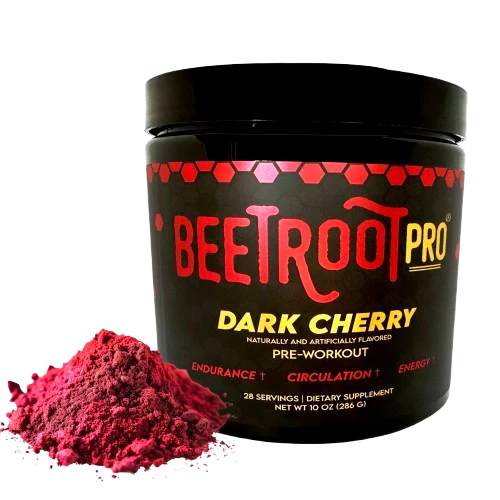
- Leaves 8 grams of carbohydrate and 30 calories per serving, as printed on the Supplement Facts panel.
- Standardizes the nitrate yield so every scoop delivers the same disclosed dose.
What remains is a concentrated, gut-friendly powder that absorbs rapidly and consistently.
Why Standardization Matters as Much as Fiber Removal
Removing fiber solves tolerance. Standardization solves reliability. Nitrate content in whole beets swings with soil nitrogen, growing conditions, and storage time, and a 2019 analysis of 24 beet juice products found nitrate varied 30 percent on average between lots of one product. You cannot build a repeatable race protocol on a dose that changes serving to serving.
Raw beet juice has a second problem beyond fiber: inconsistent nitrate content. The nitrate level in a whole beet varies based on soil nitrogen content, growing conditions, and storage time. A 2019 lab analysis of 45 lots of 24 beet juice products marketed to athletes (Gallardo and Coggan, International Journal of Sport Nutrition and Exercise Metabolism) found:
- Variation between lots of the same product: 30 percent on average, and as high as 83 percent
- Spread between products: roughly 50-fold from lowest to highest
- Products reaching the research floor: only 5 of 24 juice products consistently supplied at least 5 mmol (about 310 mg) of nitrate per serving
Beetroot Pro uses patented NO3-T® Betaine Nitrate, a standardized compound that delivers a precise, reproducible nitrate dose every time. You are not guessing your dose on race day. This matters for both performance (a consistent dose is the only way to judge how you respond; one Beetroot Pro serving yields about 160 mg of dietary nitrate, below the 300 to 600 mg used in performance research) and tolerance (you cannot build a reliable GI protocol around a supplement whose content varies by 30 percent or more between lots).
What the Research Says
Two points from the nitrate literature bear on the extract argument. Performance effects in trials come from roughly 5 to 9 mmol of nitrate (about 310 to 560 mg), and the lowest dose tested head to head, 4.2 mmol, did little. No trial has yet compared GI side effects between beet extract and whole juice.
What the peer-reviewed studies actually show on dose:
| Study | Population | Dose | Result |
|---|---|---|---|
| Hoon et al. 2013 (meta-analysis, IJSNEM) | 17 studies, healthy adults | 300 to 600 mg nitrate | Moderate benefit on time to exhaustion; small, non-significant effect on time trials |
| Jones 2014 (review, Sports Medicine) | Published nitrate trials | About 5 to 9 mmol a day | Favorable effects on exercise responses; dose-response not yet established |
| Wylie et al. 2013 (Journal of Applied Physiology) | 10 healthy men | 4.2, 8.4 and 16.8 mmol | 4.2 mmol changed nothing; 8.4 mmol extended time to task failure by 14 percent; 16.8 mmol added no further gain |
Beetroot Pro's derived figure of about 160 mg of nitrate per serving sits below every dose in that table, so the case for an extract here is tolerance and consistency, not dose.
On side effects, the evidence is thinner than it is often presented. The reviews sometimes cited for GI tolerance (Domínguez 2017, McMahon 2017) assess performance, not gastrointestinal symptoms, and we are not aware of a trial comparing GI complaint rates between beet extract and whole juice. The fiber explanation above is mechanism, not a measured difference.
The takeaway: if you need the nitric oxide benefit for your sport but cannot tolerate whole-juice products, the problem was always the matrix, not the nitrate.
What Athletes Notice After Switching
Athletes moving from raw juice or whole powder to a fiber-free extract consistently report the same four changes: no cramping or urgency during intervals, no earthy taste or texture problem, no mid-race sugar crash, and a consistent performance effect from a dose that no longer varies between servings.
Athletes who switch from raw juice or whole powder to Beetroot Pro extract consistently report:
- No GI cramping or urgency during high-intensity intervals or races
- No earthy taste or texture issues (dark cherry flavor mixes clean)
- No mid-race energy crash from a sugar spike
- Consistent performance effect from the standardized nitrate dose
For runners and triathletes who have written off beet supplementation after a bad experience, the issue was almost certainly the fiber, not the nitrates. For cyclists who have only used raw juice shots because that was the original clinical format, the fiber-free extract typically unlocks measurable watt-output gains without the mid-ride GI risk. If those shots were Beet It Sport, here is how Beet It Sport compares with Beetroot Pro, label to label.
How to Transition from Juice to Extract
Switch the dose, not the timing. Take one extract serving 60 minutes before training, exactly where the juice sat. Test it across two or three hard sessions before racing on it. The 3-day race-week loading protocol carries over unchanged, and the mouthwash restriction applies to both formats.
If you already have a beet protocol built around juice but want to switch to an extract to avoid the GI issues, here is the simplest transition path:
- Switch dose, not timing. Drop the juice. Start with one serving of Beetroot Pro extract 60 minutes before training.
- Test in training first. Do two or three hard training sessions on the new protocol before racing on it.
- Adjust the loading window. The 3-day race-week load protocol from juice (2 doses per day) carries over directly to extract. See the full 60-minute timing protocol guide for the exact window.
- Mouthwash caveat stays the same. No antibacterial mouthwash within 2 hours of your serving. The oral bacteria that convert nitrate to nitrite are required whether you use juice or extract.
The hard part of switching is mostly psychological; dropping a supplement you have used for years feels risky. The physiology is straightforward.
Related reading: What is NO3-T Betaine Nitrate and why does it matter? | Beetroot Powder vs. Beet Juice: The Complete Guide | When to Take Beetroot Powder Before a Race: 60-Minute Protocol | The Clean Athlete's Guide to Nitric Oxide and Lactic Acid Buffering | Optimize for your sport: Runner Protocol | Triathlete Protocol
If the gut is settled and it still is not working: GI distress is only one of the reasons a beet supplement underdelivers. Why your beet supplement isn't working covers the other five, including dose, timing and the mouthwash problem.
Technical
Beetroot Pro
Our product
- Patented betaine nitrate
- Acute Oxygen Efficiency
- 30 Calories Per Serving
Technical FAQ Extension
Does beetroot powder cause stomach cramps?
Raw beetroot powder and juice contain insoluble fiber that is difficult to digest during high-intensity exercise. A refined beetroot extract removes this fiber, eliminating the most common cause of GI distress without reducing nitrate performance.
Is beetroot extract better than beet juice for runners?
For runners specifically, beetroot extract is superior because it removes the fiber that causes GI distress at race intensity. It also provides consistent standardized nitrate dosing, unlike raw juice which varies batch to batch.
How much sugar is in beet supplements?
A standard 250ml beet juice shot contains 22-25g of sugar. Raw beet powder contains 10-12g per serving. Standardized beetroot extract like Beetroot Pro carries 30 calories and 8 g of total carbohydrate per serving, delivering the active nitrate compound.
Related Articles
Apr 13, 2026
Beetroot Powder vs Beet Juice: Which Wins? (2026)
Compared head to head: nitrate dose reliability, sugar content, GI tolerance, and cost. See which form, beet powder or beet juice, wins for athletes.
Jun 2, 2026
Natural Supplements That Lower Blood Pressure
Dietary nitrate, magnesium, potassium, and omega-3s have the strongest evidence for lowering blood pressure. Beetroot cuts systolic BP about 3 to 5 mmHg.
Apr 30, 2026
Beetroot Pro vs Momentous Beet: Which One Delivers?
Beetroot Pro vs Momentous Beet on nitrate dose, standardization, sugar, fiber, and NSF certification. Betaine nitrate vs whole-food beet concentrate.
*Technical citations and PubMed references are provided for performance education only. These statements have not been evaluated by the FDA.