Betalains Benefits and Supplements: Dose and Timing: The Short Answer
Betalains are the red and yellow pigments in beets, antioxidants separate from the nitrate that drives performance. Their best human evidence is in exercise recovery: beetroot juice reduced muscle soreness and sped jump recovery after hard eccentric exercise, and a nitrate-free betalain concentrate (100 mg a day) produced a smaller creatine kinase rise and faster next-day running in triathletes. Some supplements are standardized to a betalain percentage; most nitrate-standardized beet extracts state no betalain figure.
Most of the conversation around beet supplementation focuses on nitrate and nitric oxide. That is appropriate: dietary nitrate is the primary mechanism through which beetroot improves endurance performance, and the clinical evidence for it is strong.
But there is a second class of compounds in beets that receives far less attention in the endurance community despite meaningful evidence for recovery benefit. Betalains, the red-purple pigments responsible for the characteristic color of beet juice, are antioxidants with controlled-trial evidence for reducing delayed onset muscle soreness (DOMS) and speeding recovery after hard exercise.
This post reviews what betalains are, what the human research actually shows (including where it found nothing), how to read a betalain supplement label, and how to dose and time them during the heavy training blocks that define a serious endurance season.
What Are Betalains?
Betalains are nitrogen-containing plant pigments found almost exclusively in beets and other Caryophyllales plants, split into red-purple betacyanins (mainly betanin) and yellow-orange betaxanthins. Their unique nitrogen-ring structure gives them high radical-scavenging activity against the reactive oxygen species generated during intense exercise.
Betalains are a class of nitrogen-containing plant pigments found almost exclusively in plants of the order Caryophyllales, of which beets are the most commonly consumed. They are divided into two subclasses: betacyanins (red-purple) and betaxanthins (yellow-orange). The deep crimson of red beet juice is primarily betanin, a betacyanin.
Betalains are structurally distinct from the anthocyanins found in berries and other purple-pigmented plants. Both classes are antioxidants, but betalains have a unique nitrogen-containing ring structure that gives them high radical-scavenging activity against reactive oxygen species (ROS) generated during intense exercise.
The antioxidant capacity of betalains has been measured using the ORAC (oxygen radical absorbance capacity) and FRAP (ferric reducing ability of plasma) assays, both of which show beet extract in the upper range of commonly consumed plant antioxidants.
Oxidative Stress and Exercise
Intense endurance exercise generates reactive oxygen species (ROS) as a byproduct of mitochondrial energy production; controlled ROS is a normal training signal, but excessive ROS from very long or hard efforts drives muscle membrane damage and the inflammatory cascade behind DOMS muscle soreness. Muscle soreness after a workout, felt 24 to 72 hours later, is partly this oxidative stress response.
Intense endurance exercise generates reactive oxygen species as a byproduct of mitochondrial energy production. Controlled ROS production at moderate levels is a normal training signal that activates antioxidant defenses and promotes adaptation. Excessive ROS production, particularly during very long or very intense efforts, contributes to muscle membrane damage, protein degradation, and the inflammatory cascade responsible for DOMS.
Muscle soreness after a workout, whether from a hard long run, a difficult criterium, or the first heavy block of the season, is partly a result of this exercise-induced oxidative stress. Recovery interventions that reduce ROS accumulation without blunting the adaptive training signal entirely can reduce DOMS muscle soreness and accelerate the return to training.
This is the mechanism through which betalains are proposed to benefit recovery. It is a proposal rather than a settled finding: as the trials below show, the measured benefit is mostly in soreness and next-day function, while blood markers of oxidative stress often did not move.
Betalains Benefits: What Human Trials Show
Human trials point to recovery rather than a broad antioxidant effect. Beetroot juice reduced muscle soreness and sped jump recovery after hard eccentric exercise, while strength, creatine kinase and oxidative stress markers mostly did not change. The one trial that isolated betalains, using a nitrate-free concentrate, found faster next-day running and a smaller rise in creatine kinase.
| Study | Who | What they took | What changed |
|---|---|---|---|
| Clifford et al., Eur J Appl Physiol 2016 | 30 recreationally active men, 100 drop jumps | 125 or 250 ml beetroot juice, 7 servings over the 3 days after | Pain threshold back to baseline by 72 h (placebo still at 80%); jump height 92% vs 74% of baseline at 48 h on the higher dose. Strength, creatine kinase and IL-6 unchanged |
| Clifford et al., Appl Physiol Nutr Metab 2017 | 30 recreationally active men, 100 drop jumps | Beetroot juice vs a nitrate-matched sodium nitrate drink | Juice reduced muscle pain; the nitrate-only drink did not. Strength and creatine kinase unchanged |
| Montenegro et al., Appl Physiol Nutr Metab 2017 | 22 competitive triathletes | Nitrate-free betalain-rich concentrate: 100 mg a day for 6 days, 50 mg before testing | 10 km time trial faster (49.5 vs 50.8 min); creatine kinase rose less (40.5 vs 49.7 U/L); 5 km the next day faster in 17 of 22 |
| Clifford et al., Nutrients 2016 | 20 team-sport players, repeated sprints | 2 x 250 ml beetroot juice a day for 3 days | Jump recovery faster; sprint times, oxidative stress markers and creatine kinase unchanged |
| Clifford et al., Appl Physiol Nutr Metab 2017 | 34 experienced marathoners | Beetroot juice for 3 days after a marathon | No effect on soreness, inflammation or creatine kinase |
Two of these results carry most of the weight. The sodium nitrate comparison matters because it separates the recovery effect from nitrate: juice helped and nitrate alone did not, which points to other beet compounds, betalains the leading candidate. The triathlete trial matters because its concentrate contained no nitrate at all, so its faster next-day run and smaller creatine kinase rise are the closest thing to a betalain-only result in the literature.
A 2022 meta-analysis of six trials (Jones et al., Journal of Dietary Supplements) reached the same shape of conclusion: beetroot juice sped recovery of strength at 72 hours and of jump performance at 24 to 72 hours and reduced muscle pain at 48 to 72 hours, but had no effect on oxidative stress markers or creatine kinase, and C-reactive protein was slightly higher than placebo at 48 hours. The evidence base is small, mostly recreationally active men, and it did not help after a marathon, where soreness had largely resolved within two days regardless of what runners drank.
Stage Races and Back-to-Back Training Days
The recovery evidence matters most where one hard day feeds the next: stage races and heavy training blocks. The clearest data point is next-day performance. Triathletes on a betalain concentrate ran a 5 km time trial 24 hours after a hard 10 km faster than on placebo, 17 of the 22 of them, with a smaller rise in creatine kinase.
The recovery angle matters most in two contexts for endurance athletes: stage racing and heavy training blocks. For the glycogen side of between-stage recovery, see our post-workout carb fueling guide.
In stage racing (a 3 to 7 day cycling or running series with consecutive race days), the ability to recover overnight determines how well you perform on subsequent stages. Athletes who are still sore and flat from Stage 3 underperform on Stage 4, so anything that brings muscle function back sooner between stages has direct competitive value.
In heavy training blocks, the same logic applies. If you do a long ride on Saturday and wake up with aching muscles on Sunday, the quality of Sunday's run depends on how far Saturday's damage has resolved. That 24 to 72 hour window is exactly what the recovery trials measured: soreness resolving sooner and jump performance returning faster, rather than any change in blood markers.
This is also why some athletes use beetroot products strategically at the front end of a rest week, when they are trying to clear accumulated fatigue from a high-volume training block.
How Much Recovery Stress Are You Actually Carrying?
Delayed onset muscle soreness that clears in under 24 hours signals normal adaptive stress; soreness dragging past 48 to 72 hours, paired with a flat next-day session, signals oxidative and inflammatory load outpacing recovery. The gap between those two states is usually a dosing and consistency problem, not a fitness problem.
How Much Recovery Stress Are You Actually Carrying?
Question 1 of 4
How long does soreness last after a hard session?
How Betalains Interact with the Nitrate Pathway
Beets carry both dietary nitrate, which drives acute vasodilation, and betalains, the antioxidant pigments, and the two act through independent mechanisms. How much betalain a given product delivers depends on how it was processed and what it was standardized for, so a nitrate-standardized extract should not be assumed to match the betalain doses used in recovery trials.
Beetroot-derived products can provide both dietary nitrate (for the NO vasodilation mechanism) and betalains (for the antioxidant mechanism). The two mechanisms are independent and do not interfere with each other, and the sodium nitrate comparison above suggests the recovery effect comes from the non-nitrate side.
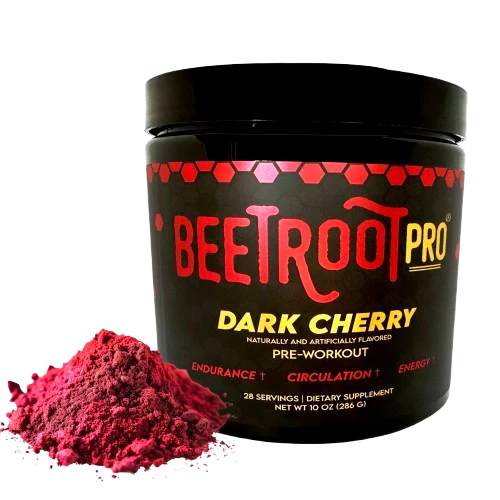
What a specific product delivers is a label question. Beetroot Pro is standardized for nitrate, not betalains, and its label states no betalain amount, so its role in this picture is the nitrate side; any betalain it carries is unquantified. A product built for the recovery evidence would state a betalain figure, which the label section below explains how to read.
However, there is a nuance: some research suggests that very high antioxidant intake immediately after exercise can blunt the training adaptation signal by interfering with ROS-mediated signaling. A trial designed to test this found beetroot juice did not adversely affect acute neuromuscular adaptation to a repeated bout of eccentric exercise, but athletes doing base-building phases where maximal training adaptation is the goal may prefer to time their beet supplementation as a pre-exercise intervention rather than an immediate post-exercise recovery supplement.
Dose and Timing for Recovery
No betalain dose is established. The one betalain-only trial used 100 mg a day of a nitrate-free betalain-rich concentrate for six days, plus 50 mg two hours before exercise. The juice trials used 125 to 250 ml servings, repeated over the three days after hard exercise. You can only match either deliberately if a label states a betalain amount.
The betalain literature is far less specific about dose than the nitrate literature, and the two trial designs point in different directions on timing:
| Approach | What the trial did | What it suggests |
|---|---|---|
| Daily loading | Betalain concentrate every day for 6 days, final dose 2 hours before the effort | Take it consistently through a heavy block, including before key sessions |
| Post-exercise | Beetroot juice immediately after, then at 24 and 48 hours | Take it in the hours and days after a session that will leave you sore |
For stage racing, combining the two is reasonable: a daily serving through the block, with one taken after each stage. During base-building, when training adaptation matters more than feeling fresh, the pre-exercise pattern avoids a large antioxidant load immediately after the session (see the nuance above).
The effect in the trials showed up as soreness resolving sooner and function returning faster over the following one to three days, not as immediate pain relief, so judge it on how the next session feels rather than on the evening after.
Betalain Supplements: How to Read the Label
Betalain supplements fall into two groups. Some are standardized to a betalain percentage, so the label lets you calculate a betalain dose. Most beet powders and extracts are standardized for nitrate or not standardized at all, and state no betalain figure, which makes their betalain content unknown rather than zero.
| What the label says | What you can work out |
|---|---|
| "Standardized to X% betalains" | Betalain per serving: extract weight times the percentage. At 20%, 500 mg of extract carries 100 mg of betalains |
| "Standardized to X% nitrate" or a nitrate mg figure | The nitrate dose, which is what the performance research is built on. Betalain content is not stated |
| "Beetroot powder, X mg" with no standardization | Neither figure. Dried whole beet varies widely in both |
| Juice or juice concentrate | Neither figure, though the recovery trials used whole juice, which carries both |
Three things are worth knowing before you compare products. Betalains break down with heat, light and oxygen, so processing and storage change the content of an unstandardized powder. The deep red color is a loose sign that betacyanins are present, not a dose. And the betalain-rich concentrate in the triathlete trial contained no nitrate, so a product standardized for betalains is not a substitute for a nitrate product if race-day performance is the goal, and the reverse is also true.
Beetroot Pro sits in the second row: it is standardized for nitrate and does not state a betalain amount. Pick by the evidence you want to match, nitrate for performance, a stated betalain figure for the recovery trials.
How Strong Is the Betalain Evidence?
Modest. A handful of small trials, mostly in recreationally active men, show less soreness and faster return of muscle function after hard eccentric or sprint work, and one trial of a nitrate-free betalain concentrate showed faster next-day running. Oxidative stress markers mostly did not change, and a marathon trial found no effect at all.
The endurance community has widely adopted the nitrate-performance narrative and largely overlooked betalains, partly because nitrate's performance effects are larger and easier to measure, and partly because betalain research is a smaller and younger body of work.
That smaller evidence base cuts both ways. It supports trying beet during heavy blocks where soreness is limiting the next session, and it does not support treating betalains as a proven recovery tool or as a replacement for sleep, fueling and load management. The laboratory and animal research on broader effects of betalains is extensive, but it has not been shown to translate to people, so it is not a reason to take them.
The complete loading protocol covers the pre-race timing in detail. For a deeper look at how Beetroot Pro's ingredients compare to other beet supplements on the market, see the comparison guide.
FDA Disclaimer: These statements have not been evaluated by the Food and Drug Administration. This product is not intended to diagnose, treat, cure, or prevent any disease.
Technical
Beetroot Pro
Our product
- Patented betaine nitrate
- Acute Oxygen Efficiency
- 30 Calories Per Serving
Technical FAQ Extension
What are betalains good for?
Betalains are the red and yellow pigments in beets and a few related plants, and they are antioxidants. In people, the best evidence is for exercise recovery: beetroot juice reduced muscle soreness and sped the return of jump performance after hard eccentric exercise, and a nitrate-free betalain concentrate produced faster next-day running and a smaller rise in creatine kinase in triathletes. Laboratory and animal research explores broader effects, but those have not been shown in people.
Are betalains good for you, and do they have side effects?
Betalains are ordinary food pigments, eaten whenever you eat beets, and dietary amounts are considered safe. The most common effect is harmless: red or pink urine or stool after beets, called beeturia. Beets are also high in oxalate, so anyone prone to kidney stones should check with their clinician before taking a concentrated beet product every day.
Does beetroot reduce muscle soreness?
In several small trials, yes. After 100 drop jumps, people drinking beetroot juice had their pain threshold back to baseline by 72 hours while the placebo group was still at 80 percent, and a nitrate-only drink did not produce the same benefit, which points to other beet compounds such as betalains. A 2022 meta-analysis found faster strength and jump recovery and less pain, but no change in oxidative stress markers or creatine kinase, and a trial after a marathon found no effect.
How much betalain should I take?
No dose is established. The one trial that isolated betalains used 100 mg a day of a nitrate-free betalain-rich concentrate for six days, plus 50 mg two hours before exercise. The beetroot juice trials used 125 to 250 ml servings repeated over the three days after hard exercise. Only a product whose label states a betalain amount, usually as a percentage standardization, lets you match either.
Related Articles

Jul 19, 2026
Beetroot Powder Benefits for Men: Dose by Body Weight
What beetroot powder does for men's blood pressure, circulation and endurance, the nitrate dose for your body weight, and why testosterone is not on the list.
Aug 9, 2026
Beetroot Benefits for Women: BP, Iron, Menopause
What beetroot does for women and what it does not. The blood pressure evidence, the iron interaction that gates it, menopause, dosing, and pregnancy safety.
Jun 2, 2026
Natural Supplements That Lower Blood Pressure
Dietary nitrate, magnesium, potassium, and omega-3s have the strongest evidence for lowering blood pressure. Beetroot cuts systolic BP about 3 to 5 mmHg.
*Technical citations and PubMed references are provided for performance education only. These statements have not been evaluated by the FDA.