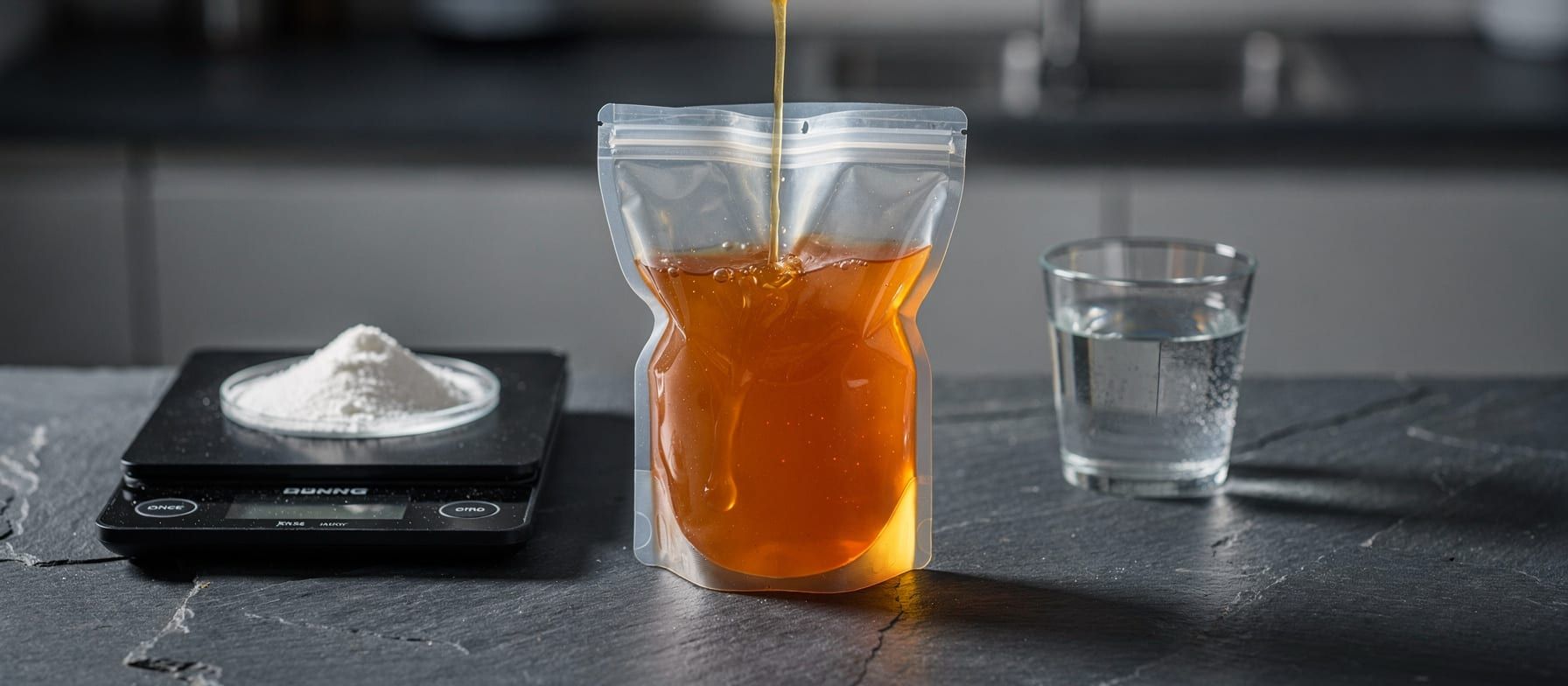
Homemade Maurten Gel Recipe: DIY Hydrogel (2026): The Short Answer
A homemade Maurten-style hydrogel costs about $0.07 per 25 g of carbohydrate versus $0.55 to $0.95 for the commercial gel. Blend maltodextrin and fructose at roughly 1.25 to 1 (about 55/45 by mass) for dual-transport absorption up to 90 g of carbs per hour, then set the gel with food-grade sodium alginate and apple pectin at about 1 percent of fluid weight, split evenly. Heat the water to 60 to 71C, never boiling, and combine with an immersion blender so the alginate network forms.
To make a homemade Maurten-style energy gel, blend maltodextrin and fructose at roughly a 1.25 to 1 ratio (about 55/45 by mass), dissolve them in water heated to 60 to 71C, then set the mixture into a hydrogel with food-grade sodium alginate and apple pectin at about 1 percent of the fluid weight, split 1 to 1. The result delivers dual-transport carbohydrate up to 90 g per hour at roughly $0.07 per 25 g of carbs, versus $0.55 to $0.95 for a commercial gel. The carb ratio and the alginate network are the two things that actually matter; everything else is flavor.
I started making my own gels because the math is absurd. On a long LOTOJA build I was burning through eight to ten commercial gels a week, and at nearly a dollar a packet that is real money for something that is mostly maltodextrin and water. After a season of running homemade flasks on century rides in the Wasatch and back-to-back threshold days, the DIY version held up: same fuel, same gut tolerance, a fraction of the cost, and no foil wrappers stuffed in my jersey. Here is the recipe, the ratio that makes it work, and the honest take on whether the famous hydrogel coating does anything.
What Makes a Maurten Gel a "Hydrogel"?
A hydrogel gel suspends its carbohydrate inside a pectin and alginate matrix that stays liquid in the bottle but firms up on contact with stomach acid. The claimed benefit is faster gastric emptying and less GI distress at high carb intakes. The functional ingredients are sodium alginate and apple pectin at roughly 1 percent of the fluid weight; without them you have a sugar syrup, not a hydrogel.
The original Maurten formula is built around two food-grade hydrocolloids, sodium alginate and pectin, that form a soft gel network when they meet the acidic environment of the stomach. The idea is that encapsulating the sugar slows its contact with the gut wall, which lets you tolerate more grams of carbohydrate per hour with less sloshing and nausea. The carbohydrate itself is ordinary: maltodextrin and fructose. There is nothing exotic in the packet, which is exactly why it is so easy to clone in a kitchen.
Match your gut, flask setup, and race intensity to a DIY gel recipe.
The Homemade Maurten Gel Recipe
A single concentrated flask delivering about 100 g of carbohydrate uses roughly 56 g maltodextrin, 44 g fructose, water to about 150 ml total fluid, 0.75 g sodium alginate, and 0.75 g apple pectin, plus optional sodium and caffeine. Scale the hydrocolloids to 1 percent of your final fluid weight. Because exact grams shift with flask size and carb target, the DIY Energy Gel calculator is the fastest way to get a weighed recipe for your specific flask.
| Ingredient | Per ~100 g carb flask | Role |
|---|---|---|
| Maltodextrin | ~56 g | Glucose-pathway carbohydrate |
| Fructose | ~44 g | Second transport pathway (GLUT5) |
| Water | to ~150 ml fluid | Carrier |
| Sodium alginate | ~0.75 g | Hydrogel network (half of ~1% total) |
| Apple pectin | ~0.75 g | Hydrogel network (half of ~1% total) |
| Sodium citrate or salt | 0.2 to 0.4 g sodium | Electrolyte, flavor |
| Citric acid | pinch (optional) | Cuts the cloying sweetness |
| Caffeine | 0 to 100 mg (optional) | Stimulant |
The hydrocolloid dose is the part people get wrong. It is not a fixed teaspoon; it is about 1 percent of the total fluid weight, split evenly between alginate and pectin. Too little and the gel never sets; too much and you get a rubbery clump that will not flow out of a soft flask. A sub-gram kitchen scale is the one tool you cannot skip.
The Carb Ratio: Maltodextrin to Fructose
Use a maltodextrin to fructose ratio of about 1.25 to 1 (roughly 55/45 by mass). The two sugars use separate gut transporters (SGLT1 and GLUT5), so one source tops out near 60 g per hour while a blend supports about 90 g (Jeukendrup, 2014). Rowlands et al. (2015) found this 0.8 to 1 fructose to glucose ratio performed best.
If you take only maltodextrin (pure glucose chains), you saturate the SGLT1 transporter at around 60 g per hour and the excess sits in your gut and ferments, which is the classic late-race stomach revolt. Adding fructose opens the GLUT5 pathway and raises the practical ceiling toward 90 g per hour, and in well-trained guts higher. A 1.25 to 1 maltodextrin to fructose blend is the sweet spot most of the literature converges on. This is the same logic behind a homemade DIY sports drink mix, just concentrated into a flask instead of a bottle.
Step-by-Step Kitchen Method
Heat the water to 60 to 71C (hot tap to just-steaming, never boiling), whisk in the maltodextrin and fructose until clear, then add the alginate and pectin while blending with an immersion blender for 30 to 60 seconds. Manual stirring will not disperse the hydrocolloids; they clump. Let it cool, and expect it to thicken by roughly 30 percent as the network sets. Refrigerate and use within 2 to 3 weeks.
- Heat the water to 60 to 71C. Do not boil it; excessive heat degrades the gel structure and the flavor.
- Whisk in the maltodextrin and fructose until fully dissolved and clear.
- With an immersion blender running, rain in the sodium alginate and pectin. The blender is mandatory: hand stirring leaves clumps that block a flask nozzle.
- Blend 30 to 60 seconds, add any sodium, citric acid, or caffeine, and blend briefly again.
- Cool to room temperature, then fill your soft flask. Expect about 30 percent thickening as it sets, so make it slightly thinner than you want it.
- Refrigerate. Shelf life is 2 to 3 weeks; a pinch of citric acid that drops the pH below 4.0 extends it past 30 days.
On race morning I fill two 250 ml flasks the night before and keep them cold until the start. One flask covers roughly two to three hours of riding at 80 to 90 g of carbs per hour.
Cost: DIY vs Commercial
Homemade hydrogel costs about $0.06 to $0.08 per 25 g of carbohydrate. The equivalent commercial gel runs $0.55 to $0.95 per 25 g. For an athlete using 80 g of carbs per hour across a five-hour event, that is roughly $1.20 in DIY ingredients versus $9 to $15 in packets, before counting the foil waste.
| Gel | Approx cost per 25 g carbs |
|---|---|
| Homemade hydrogel | $0.06 to $0.08 |
| Maurten Gel 100 | $0.85 to $0.95 |
| GU Energy Gel | $0.55 to $0.70 |
| SiS Go Isotonic | $0.55 to $0.65 |
| PF&H Gel | $0.70 to $0.85 |
The commercial gels are not a rip-off; you are paying for convenience, portability, and quality control, and on travel days I still carry a few. But for high-volume training and any event where you control your own feed, the DIY version is the obvious call.
Does the Hydrogel Coating Actually Help?
It is mixed. Sutehall et al. (2020) found an alginate hydrogel left the stomach faster than the same carbohydrate without it, and a 2026 marathon RCT found steadier pacing but no faster finishes. A 2022 meta-analysis found no performance benefit over a plain carbohydrate drink. Carb ratio and grams per hour matter more; treat the hydrogel as a tolerance aid.
The marathon trial (Zhang et al., 2026, 81 amateur runners taking 60 g of carbohydrate per hour) found alginate gels kept pace steadier across the whole race in its elite group and over the first half in its advanced group, with no difference in finish times. The meta-analysis (Sutehall et al., 2022) found no difference in performance (five studies), carbohydrate oxidation or blood glucose (seven studies each) versus an isocaloric drink without alginate.
What this means practically: if you have a sensitive stomach at high carb intakes, the hydrogel is worth the extra two ingredients because the gastric-emptying and tolerance data are reasonable. If your gut is already iron-clad at 90 g per hour, a simpler DIY fluid gel without the alginate works just as well and is easier to make. Do not pay a premium, in money or effort, expecting the coating alone to make you faster. The same honesty applies to the lactate energy gel trend: real mechanism, mixed performance evidence.
Dialing It In With the Calculator
Rather than hand-calculating grams for your flask size and carb target, the DIY Energy Gel and Flask Emulsifier outputs a weighed, step-by-step recipe: it sizes the batch to a 150ml, 250ml, or 500ml flask, sets the dual-transport ratio automatically, scales the alginate and pectin, and prints carbs per flask and carbs per sip so you can build a sip-per-hour race plan.
The calculator also handles the variables this article keeps general: caffeine dosing, a salted-watermelon hot-weather variant, the citric-acid palate adjustment, and an osmolarity check so the gel does not sit in your gut. Pair it with the Carb Fueling Plan to set your hourly target first, then build the gel to hit it.
The Bottom Line
A homemade Maurten-style gel is a maltodextrin and fructose blend (about 1.25 to 1) set with sodium alginate and apple pectin at roughly 1 percent of fluid weight, made in water heated to 60 to 71C with an immersion blender. It delivers the same dual-transport carbohydrate at a tenth of the cost. The carb ratio and your hourly grams matter far more than the hydrogel coating, which is a tolerance aid rather than a performance booster.
I fuel my races on a homemade flask and a standardized nitrate dose pre-start: the gel covers carbohydrate during the effort, and Beetroot Pro® covers oxygen economy 90 minutes before the gun. Different jobs, one race plan.
Related Reading
- DIY Energy Gel and Flask Calculator
- DIY Sports Drink Powder Mix Calculator
- Lactate Energy Gels: What the Science Actually Says
- Lactate Gel Ingredients: The ExoLactate Teardown: why the commercial lactate gels use iota carrageenan instead of the alginate and pectin system in this recipe.
- Post-Workout Carbs: The Glycogen Recovery Window
- Why Endurance Athletes Need More Carbohydrate: the demand side of the same problem, and why the hourly target keeps climbing.
- How to Build the Perfect Sports Drink Powder for Your Race: the drink-mix equivalent of this recipe, built around carbohydrate and sodium targets rather than gel texture.
- I Tested 4 DIY Recovery Powders vs SiS REGO for 30 Days: what happened when the same DIY approach was run against a commercial product and measured.
FDA Disclaimer: These statements have not been evaluated by the Food and Drug Administration. This product is not intended to diagnose, treat, cure, or prevent any disease.
Technical FAQ Extension
How do you make a homemade Maurten gel?
Blend maltodextrin and fructose at roughly a 1.25 to 1 ratio (about 55/45 by mass), dissolve them in water heated to 60 to 71C, then set the mixture into a hydrogel with food-grade sodium alginate and apple pectin at about 1 percent of the fluid weight, split evenly. Combine with an immersion blender so the alginate network forms.
What is the best maltodextrin to fructose ratio for a DIY energy gel?
Use about 1.25 to 1 maltodextrin to fructose (roughly 55/45 by mass). Glucose and fructose use separate intestinal transporters (SGLT1 and GLUT5), so combining them raises the absorption ceiling from near 60 g of carbohydrate per hour for glucose alone toward 90 g per hour.
How much does a homemade energy gel cost compared to Maurten?
A homemade hydrogel costs about $0.06 to $0.08 per 25 g of carbohydrate. The equivalent commercial gel runs $0.55 to $0.95 per 25 g. Over a five-hour event at 80 g of carbs per hour, that is roughly $1.20 in DIY ingredients versus $9 to $15 in packets.
Does the alginate hydrogel coating actually improve performance?
The evidence is mixed. The hydrogel empties from the stomach faster and may reduce GI distress at high carb intakes, but several trials show no clear time benefit over a plain maltodextrin and fructose mix at the same carb dose. Treat the coating as a tolerance aid, not a proven ergogenic.
How long does a homemade energy gel last?
Refrigerated, a homemade hydrogel keeps for 2 to 3 weeks. Adding a pinch of citric acid that drops the pH below 4.0 extends shelf life past 30 days. Keep flasks cold until use and discard any gel that smells off or separates.
Related Articles
Aug 4, 2026
Lactate Gel Ingredients: ExoLactate Teardown (2026)
ExoLactate's full ingredient list is public. What all 10 ingredients do, the counter-ion math behind the 5 g lactate dose, and what it costs to copy.
Aug 4, 2026
Lactaat Gels: Wat Zegt de Wetenschap? (2026)
Lactaat gels zijn de hype van 2026. De eerlijke wetenschap: lactaat is een echte brandstof, maar de prestatiestudies zijn wisselend.
Jul 16, 2026
ExoLactate Gels: The Honest Evidence (2026)
ExoLactate pairs 40g carbs with 5g lactate per gel. What exogenous lactate actually does, whether the co-ingestion model holds up, and how to test it.
The Ultimate
VO2 Max System
Our product
- Acute Nitric Oxide Vasodilation
- Chronic Lactic Acid Buffering
- Stimulant Free, cGMP Certified Manufacturing
*Technical citations and PubMed references are provided for performance education only. These statements have not been evaluated by the FDA.