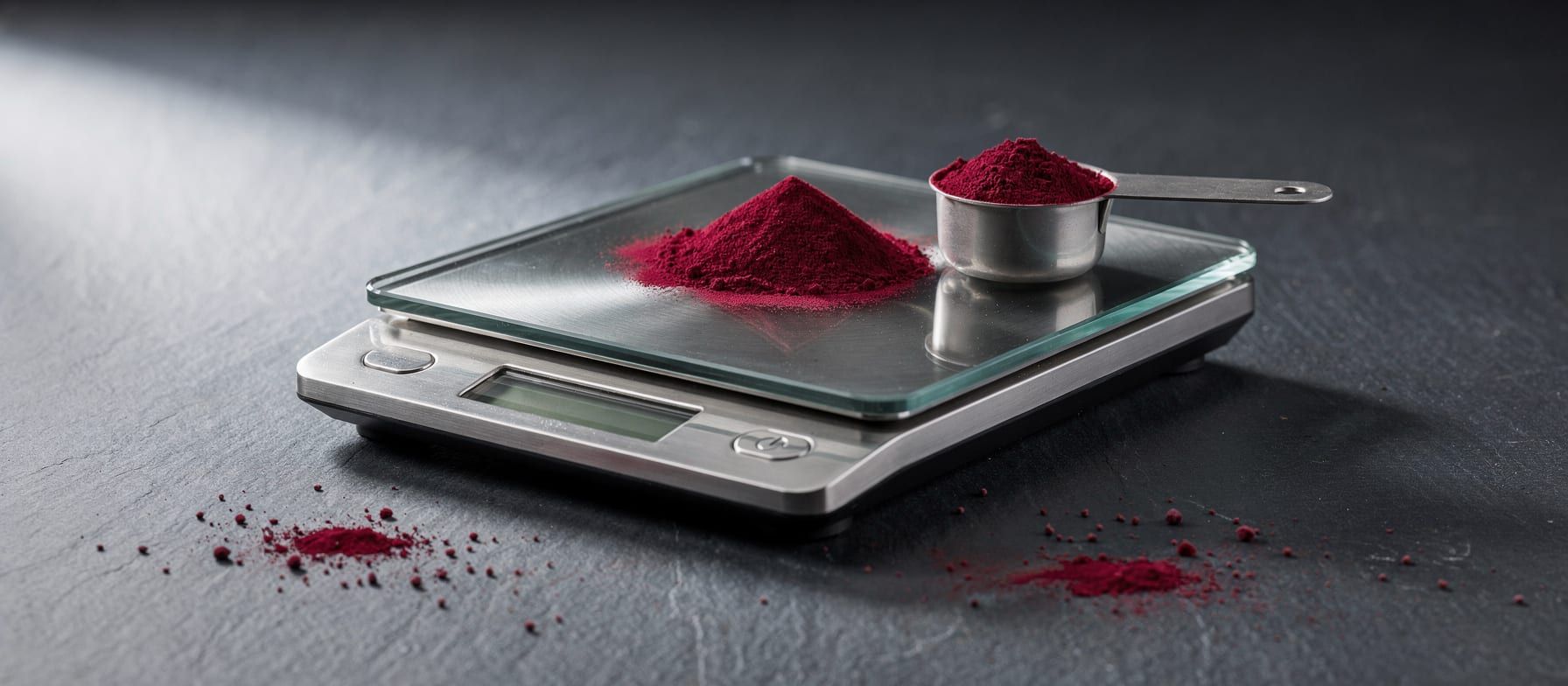
How Much Beetroot Powder Per Day? 300-600mg (2026): The Short Answer
Dose beetroot powder by dietary nitrate, not grams, because independent testing has found nitrate varying roughly 50-fold between beet products. Target 300 to 600mg per day (5 to 10 mmol) for performance, about 150 to 300mg for general cardiovascular health, and 600mg or more split morning and evening during race week, finishing with an acute dose 60 to 90 minutes before the start.
How Much Beetroot Powder Should You Take Per Day?
Dose beetroot powder by milligrams of dietary nitrate, not by grams of powder. For a measurable performance benefit, target 300 to 600mg of dietary nitrate per day (about 5 to 10 mmol). One Beetroot Pro® serving yields about 160mg, below that range. The grams on the scoop are almost meaningless without a nitrate number.
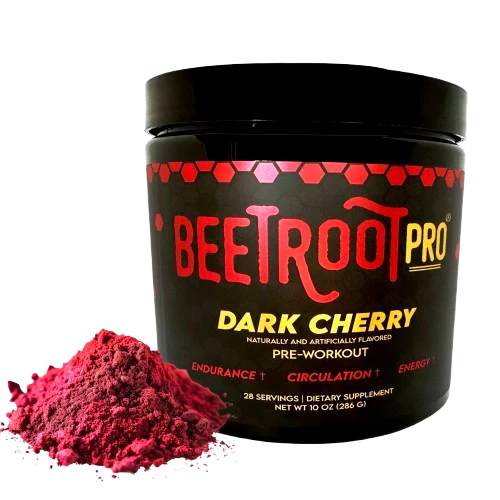
The single most important fact about beetroot powder dosing is that the active compound is dietary nitrate, and a serving of powder is only as useful as the nitrate it delivers. Beetroot Pro® standardizes each serving to an 8,000 mg beet extract, yielding about 160 mg of dietary nitrate, at 30 calories per serving. That is below the 300 to 600mg range the research uses, and it is a published figure you can check rather than a raw powder weight that tells you nothing. The table below maps the common goals an athlete or health-focused user is dosing for.
| Goal | Daily dietary nitrate | One Beetroot Pro® serving (about 160mg) | Typical raw powder equivalent |
|---|---|---|---|
| General health | ~150 to 300mg | Within this range | ~3 to 6g |
| Daily performance | 300 to 600mg | Below this range | Hard to hit reliably with raw powder |
| Race-week loading | 600mg+ split AM/PM | Below this range, even at 2 servings a day (about 320mg) | Not practical with raw powder |
| Acute pre-race | 300 to 600mg | Below this range | Not practical with raw powder |
Notice that grams of raw powder only appear in the first row. That is deliberate: raw, unstandardized powders are reasonable for a general-health nitrate top-up, but they are an unreliable way to reach a true performance dose, for reasons covered in the next section.
| Body weight | Daily dietary nitrate target | Share covered by one BRP serving (about 160 mg) | Timing |
|---|---|---|---|
| Under 60 kg | 5-6 mmol (300-360 mg) | About half | 60-90 min pre-exercise |
| 60-75 kg | 6-7 mmol (360-420 mg) | About 40 percent | 60-90 min pre-exercise |
| 75-90 kg | 7-8 mmol (420-500 mg) | About a third | 60-90 min pre-exercise |
| Over 90 kg | 8-10 mmol (500-600 mg) | About 30 percent | 60-90 min pre-exercise |
Body weight is not the only variable that shifts a man's effective dose. For the cardiovascular and vascular reasons a heavier man may need the higher end of that range, see beetroot benefits for men.
Why Grams Per Day Is the Wrong Way to Dose
Grams per day is the wrong unit because independent testing of 24 beet juice products found a roughly 50-fold range in nitrate per serving, with no labeling standard. Two scoops of identical weight can deliver wildly different nitrate, so the only reliable target is milligrams of dietary nitrate (300 to 600mg per performance dose), never grams of powder.
Beetroot is a crop, and nitrate concentration in the root depends on soil, fertilizer, harvest timing, and processing. When that root is dried and milled, the variability carries straight into the powder. Independent testing of 24 beet juice products marketed to athletes found a roughly 50-fold range in nitrate per serving, and only 5 consistently delivered 5 mmol (about 310mg) or more (Gallardo and Coggan, 2019). A scoop that looks identical to another scoop on a kitchen scale can be the difference between an inert dose and a clinically meaningful one.
This is why "how many grams of beetroot powder per day" is the wrong question. The right question is "how many milligrams of dietary nitrate." To dose correctly you have to read the label for a stated nitrate (NO3) figure in milligrams per serving, not just the gram weight, the percentage of beetroot, or a generic "concentrated" claim. If a product does not publish a nitrate number, you cannot dose it for performance with any confidence. For a deeper breakdown of how to find and verify that number, see how much nitrate is in a beet supplement. The same arithmetic problem applies in capsule form, where the printed milligram figure is dried root weight rather than dietary nitrate; the format-specific version is covered in the beetroot capsules dosage guide. The standardized approach Beetroot Pro® uses, fixing each serving at an 8,000 mg beet extract (yielding 160 mg dietary nitrate), exists specifically to remove this guesswork so the dose is repeatable day to day.
Beetroot Powder Dosage for Pre-Workout and Racing
For pre-workout or racing, take an acute dose of 300 to 600mg of dietary nitrate 60 to 90 minutes before the effort. Blood nitrite is rising by then; in published studies on beet juice it peaks about 2 to 3 hours after a dose and stays elevated for several hours. For best results, swish-and-swallow and avoid antibacterial mouthwash, which can blunt the nitrate-to-nitrite conversion.
Timing matters as much as the dose. The body converts dietary nitrate to nitrite to nitric oxide, and in published studies on beet juice blood nitrite peaks about 2 to 3 hours after intake, then stays elevated for several hours. Taking your dose right at the start line is too late; we recommend 60 to 90 minutes before, which covers the start and the hours after it. The conversion begins in the mouth, where oral bacteria reduce nitrate to nitrite, so two practical habits help: briefly swish the drink before swallowing, and avoid antibacterial mouthwash on race day, since killing those oral bacteria can reduce the benefit.
For a single hard session, one acute dose is enough. For a goal race, multi-day loading adds a benefit on top of the single acute dose, an effect that is most pronounced in well-trained athletes. A practical race-week loading protocol is 2 servings per day (roughly 600mg+ of dietary nitrate, often split into an AM and a PM dose) for 3 to 6 days leading into the event, then a final acute dose 60 to 90 minutes before the start.
| Protocol | Duration | Daily dose | Best for |
|---|---|---|---|
| Acute (single dose) | 1 day | 5-8 mmol | Race day, hard workout |
| Short loading | 3 days | 5-8 mmol/day | Target event within 3 days |
| Full loading | 6-7 days | 5-8 mmol/day | Major A-race, peak week |
| Maintenance | Ongoing | 3-5 mmol/day | Training adaptation, health |
Beetroot Pro delivers standardized dietary nitrate to lower the oxygen cost of every effort.
How Many Scoops of Beetroot Powder Per Day?
How many scoops you need depends entirely on how much dietary nitrate each scoop delivers, which is why scoop count alone is meaningless across brands. With Beetroot Pro®, one serving already supplies a published 160 mg of standardized dietary nitrate (from an 8,000 mg beet extract). That is below the 300 to 600 mg used in the performance trials, so treat scoop count as something to discuss with a coach or dietitian rather than a number to escalate on your own.
If your product publishes a nitrate figure, the math is simple: divide your target (300 to 600mg of dietary nitrate) by the per-scoop nitrate to get scoop count. For an unstandardized raw powder with no published number, no scoop count can be trusted, you are guessing. That is the core limitation of answering "how many scoops" in the abstract.
With a standardized product the arithmetic is at least concrete. One Beetroot Pro® serving is 2 scoops and yields about 160 mg of dietary nitrate, so a single scoop is roughly 80 mg. Both sit below the 300 to 600 mg used in the performance trials. Follow the label serving rather than trying to scoop your way into that range; the next section covers why more is not automatically better.
Can You Take Too Much Beetroot Powder?
There is no established performance benefit to exceeding roughly 600mg of dietary nitrate per dose, so more is not better. Very high intakes are simply unnecessary. Side effects are generally mild: harmless beeturia (pink or red urine), possible GI discomfort from the fiber in raw powders, and a blood-pressure-lowering effect that warrants caution for anyone taking nitrate-based medications.
Beetroot is well tolerated, but a few things are worth knowing. The most common surprise is beeturia, a temporary pink or red tint to urine or stool from beet pigments; it is harmless and not a sign of a problem, and why it happens to some people and not others comes down to stomach acid and oxalate rather than genetics. Large volumes of raw, fibrous beetroot powder can cause mild GI discomfort in some people, which is one more reason a concentrated, standardized dose is easier on the gut than choking down many grams of raw powder.
Dietary nitrate is associated with supporting healthy blood pressure, which is generally a benefit, but anyone already taking nitrate-based heart medications or blood-pressure drugs should talk to a clinician before adding a daily nitrate source, because the effects can compound. None of this is a disease claim; it is simply sensible context. For the full dose-and-brand breakdown on this specific effect, see beetroot powder for blood pressure. The practical takeaway is that there is no upside to mega-dosing: once you are in the 300 to 600mg per dose range, adding more does not buy more performance.
Daily Dosing by Athlete Type
Match your daily beetroot powder dose to your training context. Recreational users and those dosing for health do well on 1 serving per day; athletes in a training block benefit from 1 to 2 servings on hard days; athletes in race week should load with 2 servings per day; and masters athletes sit at the overlap of cardiovascular support and performance, where a consistent daily serving serves both goals.
| Profile | Recommendation |
|---|---|
| Recreational / health | 1 serving per day; consistency matters more than dose size |
| Endurance athlete in a training block | 1 to 2 servings, weighted toward hard or key sessions |
| Athlete in race week | 2 servings per day (AM/PM) for 3 to 6 days, plus an acute dose 60 to 90 min pre-start |
| Masters athlete | 1 daily serving for the cardiovascular and performance overlap; add a second on hard days |
The pattern across every profile is the same: a standardized, repeatable dose, with the 300 to 600mg dietary-nitrate range used in research as the reference point, scaled up only for race-week loading. One Beetroot Pro® serving yields about 160mg, below that range, so know where your own product lands. The profile mainly changes how often and how high within that range you sit, not the underlying target.
Putting It Together
A simple, evidence-aligned daily plan: take 1 standardized serving most days for performance and cardiovascular support, step up to 2 servings per day during the 3 to 6 days of race-week loading, and place a final acute dose 60 to 90 minutes before any race or key session. Always dose by milligrams of dietary nitrate (300 to 600mg per dose), never by grams of powder.
For most athletes the routine looks like this: one serving on ordinary training days, two servings during race week split morning and evening, and a deliberately timed pre-race dose in the 60-to-90-minute window. Skip the antibacterial mouthwash on race morning, swish before you swallow, and do not bother chasing doses above 600mg per dose, the research does not support it.
The reason dosing this precisely is even possible is standardization. Beetroot Pro® publishes an 8,000 mg beet extract per serving, yielding 160 mg dietary nitrate (30 calories per serving, $49.95 for 28 servings), so athletes can compare a serving against the published research figures rather than guessing from gram weights on an unlabeled scoop. If you want a daily nitrate source you can actually dose by the numbers, you can find the standardized formula at Beetroot Pro® sports pre-workout beetroot powder. Comparing options first? See the best beetroot supplement buyer's guide, which ranks products by published nitrate dose, sugar, and price per serving.
FDA disclaimer: These statements have not been evaluated by the Food and Drug Administration. This product is not intended to diagnose, treat, cure, or prevent any disease.
Technical FAQ Extension
How much beetroot powder should you take per day?
Dose by milligrams of dietary nitrate, not grams of powder. For measurable performance benefit, target 300 to 600 mg of dietary nitrate per day, which is 1 to 2 servings of a standardized product (Beetroot Pro delivers an 8,000 mg standardized beet extract, yielding about 160 mg of dietary nitrate). For general cardiovascular support, 1 serving is enough. For race-week loading, take 2 servings per day for 3 to 6 days before your event.
How many scoops of beetroot powder per day?
It depends on the per-scoop nitrate content of your specific product, which varies enormously across brands: a 2019 lab analysis found a roughly 50-fold range among beet juice products alone. With a standardized product you can at least do the arithmetic: a 2-scoop Beetroot Pro serving yields about 160 mg of dietary nitrate, below the 300 to 600 mg used in performance research. With a raw, undisclosed powder you cannot know how many scoops reach the clinical dose, which is the core problem with grams-based dosing.
Can you take too much beetroot powder?
There is no added performance benefit beyond roughly 600 mg of dietary nitrate per dose, so more is not better. Very high intakes mainly produce beeturia (harmless pink urine), possible GI discomfort from raw-powder fiber, and a larger blood-pressure-lowering effect. Athletes taking nitrate-based cardiovascular medications should consult a physician before regular use. Beetroot powder is not a treatment for any condition.
What to avoid when taking beetroot powder?
Three things. Antibacterial mouthwash within about two hours of a dose, because it kills the oral bacteria that start the nitrate to nitric oxide conversion. Dosing by grams of powder, because nitrate content per gram varies roughly 100-fold between products. And starting a daily protocol without asking a physician first if you take blood pressure medication or have a history of kidney stones.
Should I take beet root powder in the morning or at night?
Time it to what you want it for. Before training or a race, take a standardized extract 60 to 90 minutes before you start, or beet juice and raw powder 2 to 3 hours before. For general daily use, the time of day matters less than taking it consistently, and a morning dose is simply easier to remember than an evening one.
How long does it take beetroot powder to kick in?
Plasma nitrite starts rising within the first hour and, in published studies on beet juice, peaks about 2 to 3 hours after a dose. That is why we recommend taking it 60 to 90 minutes before exercise. A single dose lasts several hours, and taking it daily for 3 to 7 days raises baseline nitrate further than any one dose does.
Is beet powder safe for kidneys?
For most people, yes, at normal serving sizes. Beets are a higher-oxalate food, so the group to be careful is anyone with a history of calcium oxalate kidney stones, especially on daily high-volume raw juice or whole-root powder. A standardized extract carries a much smaller oxalate load than raw powder or juice. Anyone with kidney disease or a stone history should check with a physician first.
Related Articles
Jan 30, 2023
Beetroot Powder Benefits: 6 Backed by Trials (2026)
Beetroot powder cuts oxygen cost 1 to 3%, extends time to exhaustion by 15%, and lowers blood pressure 3 to 5 mmHg. See the studies, doses, and effect sizes.
Jul 16, 2026
How Long Beetroot Powder Takes to Lower Blood Pressure
A single dose raises plasma nitrite in about 45 minutes and lowers blood pressure within 60 to 150 minutes. The full timeline, by product format.
Jul 14, 2026
Beetroot Powder for Blood Pressure: Dose and Brands
Beetroot powder can lower systolic blood pressure about 3 to 5 mmHg, but only at a real nitrate dose. See how Beetroot Pro, SuperBeets, and Xendurance compare.
Technical
Beetroot Pro
Our product
- Patented betaine nitrate
- Acute Oxygen Efficiency
- 30 Calories Per Serving
*Technical citations and PubMed references are provided for performance education only. These statements have not been evaluated by the FDA.