Nitric Oxide Foods: Top Sources to Boost Your Levels: The Short Answer
Foods that raise nitric oxide work through two pathways: dietary nitrate (beetroot, arugula, spinach, celery) converts to NO via oral bacteria, while L-arginine and citrulline foods (watermelon, nuts) and dark chocolate flavanols support the enzymatic NOS pathway. For endurance athletes, the nitrate pathway has the stronger performance evidence: the IOC's 2018 consensus statement cites about 310 to 560 mg of nitrate taken 2 to 3 hours before exercise. Arugula is the most nitrate-dense common food; beetroot is the most studied.
Nitric oxide (NO) is a signaling molecule produced throughout the body that dilates blood vessels, improves oxygen delivery to working muscles, and supports muscle efficiency. For endurance athletes, healthy NO availability is one of the few nutrition levers with real performance evidence behind it.
The body produces nitric oxide through two distinct pathways: the dietary nitrate pathway (which requires specific foods and functional oral bacteria) and the enzymatic L-arginine/NOS pathway (which depends on amino acid availability and vascular health). Understanding both pathways helps you choose the right foods at the right times.
What Foods Are Highest in Nitric Oxide Precursors?
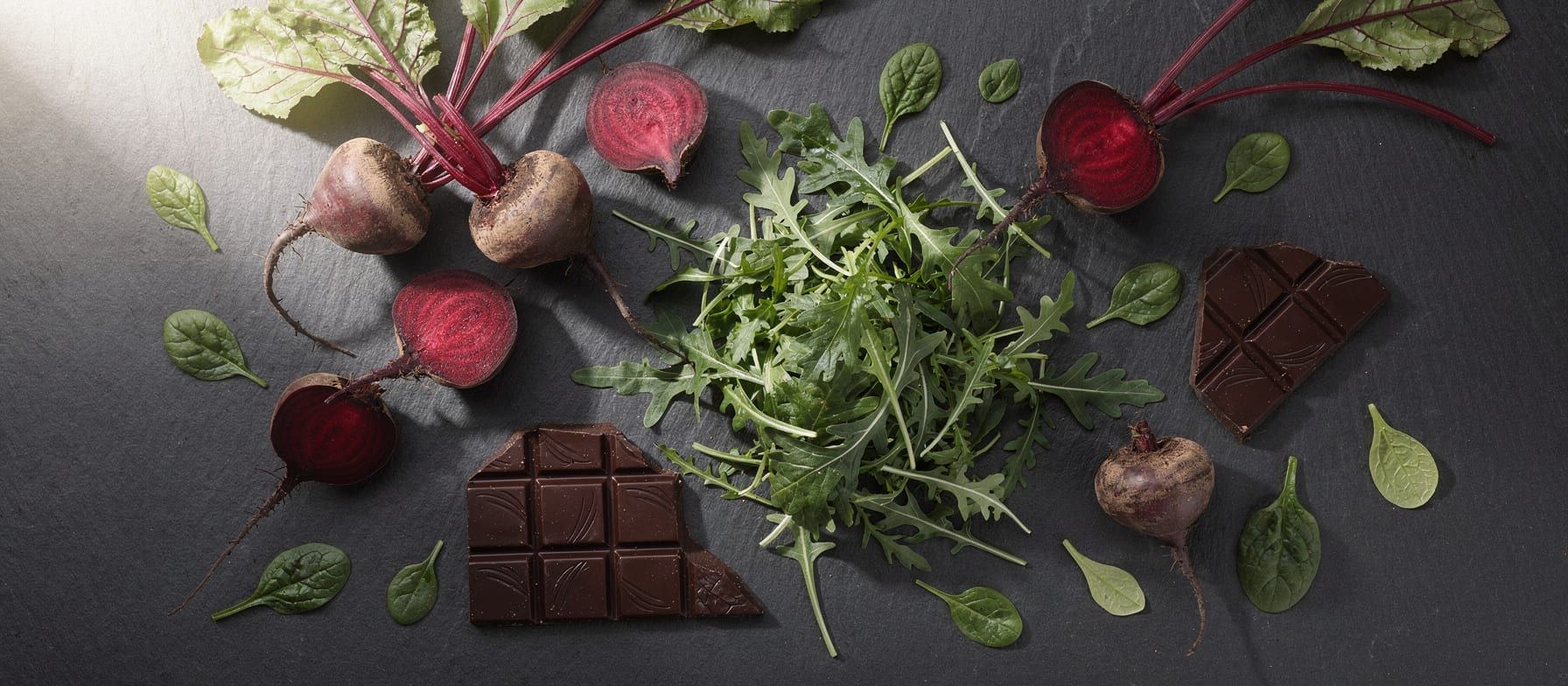
The foods highest in nitric oxide precursors are dark leafy greens and root vegetables rich in inorganic nitrate. Arugula tops the list at roughly 4,000 to 7,000 mg of nitrate per kilogram, followed by spinach (1,500 to 2,900 mg/kg) and beetroot (1,500 to 2,500 mg/kg). These nitrates convert to nitric oxide through a bacterial reduction process in the mouth and gut.
The nitrate content of vegetables varies significantly by species, growing conditions, and preparation method. Raw or lightly cooked vegetables retain the most nitrate; boiling leaches nitrate into the cooking water. The table below summarizes published nitrate ranges for the most studied sources:
| Food | Nitrate Content (mg per kg fresh weight) | Notes |
|---|---|---|
| Arugula (rocket) | 4,000 to 7,000 | Highest of any commonly consumed food |
| Beetroot (raw) | 1,500 to 2,500 | Most studied for exercise performance |
| Spinach | 1,500 to 2,900 | Season and soil affect range significantly |
| Celery | 1,000 to 2,200 | Also a meaningful source |
| Red leaf lettuce | 1,000 to 2,000 | Darker outer leaves are higher |
| Swiss chard | 900 to 1,800 | Often overlooked |
| Pomegranate juice | Low nitrate, high polyphenols | Supports NO via a separate antioxidant mechanism |
| Dark chocolate (70%+) | Minimal nitrate | Works via flavanol-stimulated eNOS activity |
A practical note: arugula is the most nitrate-dense food by weight, but reaching the dose used in performance research (about 310 to 560 mg of nitrate, per the IOC's 2018 consensus statement) takes roughly 45 to 140 grams of raw arugula. That is a large salad, and most athletes are not eating it a couple of hours before a race start. Beetroot in powder or juice form concentrates the nitrate and makes pre-exercise dosing more practical.
How Does Food Actually Convert to Nitric Oxide?
Dietary nitrate from food does not become nitric oxide on its own. It first gets reduced to nitrite by bacteria that live on the tongue and in the mouth, then nitrite is further reduced to nitric oxide in the stomach and bloodstream. This means oral bacteria are not just passengers but essential co-producers of NO from food.
Here is the step-by-step pathway:
- You eat a nitrate-rich food (beetroot, arugula, spinach).
- Salivary glands concentrate nitrate and secrete it back into the mouth.
- Anaerobic bacteria on the tongue surface reduce nitrate to nitrite.
- You swallow. Nitrite reaches the acidic environment of the stomach and is partially converted to nitric oxide directly.
- Remaining nitrite enters the bloodstream and is reduced to NO in blood vessel walls and muscle tissue, especially under low-oxygen conditions (exactly when working muscles need vasodilation most).
The enzymatic pathway is separate: L-arginine (an amino acid) is converted to NO by endothelial nitric oxide synthase (eNOS). This pathway is more relevant to resting vascular health and is the mechanism behind foods like watermelon and dark chocolate.
Practical implication for athletes: skip antibacterial mouthwash on the morning of a race or key workout. In a crossover study of seven healthy volunteers, rinsing with a chlorhexidine antibacterial mouthwash before a nitrate dose abolished the conversion of nitrate to nitrite in saliva and markedly attenuated the rise in plasma nitrite (Govoni et al., Nitric Oxide, 2008). Rinse with water only on race morning if you are relying on dietary nitrate.
How Much Nitrate Do You Need for Performance?
The IOC's 2018 consensus statement puts the performance dose of dietary nitrate at 5 to 9 mmol, about 310 to 560 mg, with acute benefits generally seen 2 to 3 hours after the dose. It reports 1 to 3 percent faster time trials under 40 minutes, and notes that more than three days of daily intake also appears to help, particularly in highly trained athletes.
Meeting this dose from whole food requires larger portions than most athletes realize before a training session or race:
| Food Source | Serving Size to Reach ~400 mg Nitrate | Practical Challenges |
|---|---|---|
| Raw arugula | Approximately 80 to 100 g | Volume, GI bulk before exercise |
| Raw beetroot | Approximately 200 to 250 g | Preparation time, GI bulk |
| Beet juice (commercial, ~250 mg/100mL) | 160 to 200 mL (about 2/3 cup) | Sugar content, cold chain required |
| Spinach | Approximately 170 to 260 g | Very large serving raw |
| Celery | Approximately 200 to 400 g | Large volume, water content |
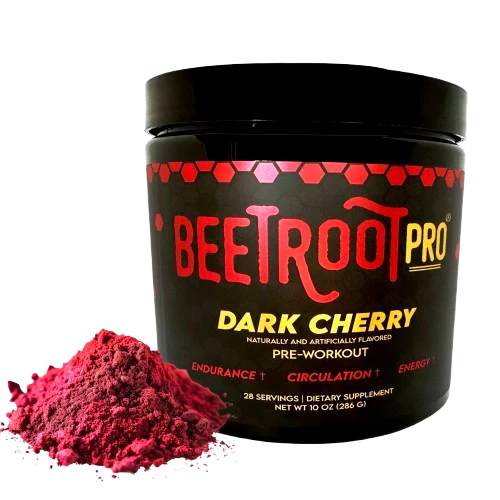
| Beetroot Pro powder | One 2-scoop serving yields about 160 mg, so it does not reach 400 mg on its own | No GI bulk; the figure is derived from an 8,000 mg extract standardized to 2% nitrate |
Timing matters as much as dose. The IOC statement describes acute benefits 2 to 3 hours after a nitrate bolus. For a 7:00 AM race start, that puts the dose at roughly 4:00 to 5:00 AM.
For multi-day events or training blocks, the same statement notes that more than three days of nitrate intake appears beneficial and may suit highly trained athletes. A combination approach, daily dietary nitrate from greens throughout a training block plus a pre-race dose, addresses both the chronic and acute windows.
Nitric Oxide Foods vs. Nitric Oxide Supplements: What's the Difference?
Whole nitrate-rich foods supply dietary nitrate alongside fiber, vitamins and polyphenols, but their nitrate content swings with soil, season and cooking. A standardized beetroot supplement trades that variability for a consistent extract without the volume of a large salad. Food suits the daily baseline; a standardized product suits pre-session convenience.
See how the nitrate to nitric oxide pathway works and how to check how much nitrate a beet supplement actually contains before choosing one.
The honest trade-off breaks down like this:
Whole foods (beetroot, arugula, spinach):
- Provide nitrate alongside antioxidants and fiber
- Support daily vascular health with zero supplement dependency
- Nitrate content varies by batch, season, and cooking method
- Require significant volume to reach the dose used in trials
- May cause GI distress in sensitive athletes when eaten pre-exercise in large quantities
- Many beet juice shots carry double-digit grams of sugar per serving (Beet It Sport prints 13 to 17 g)
Standardized beetroot powder (Beetroot Pro, using NO3-T® betaine nitrate):
- An 8,000 mg beet extract per 2-scoop serving, standardized to 2% nitrate on the Certificate of Analysis, which works out to about 160 mg of dietary nitrate (a derived figure; the Supplement Facts panel lists the extract weight, not a nitrate number)
- No GI bulk, 30 calories, no cooking, no refrigeration
- A standardized extract, so the nitrate content does not swing with season and soil the way whole beets do
- About 160 mg sits below the 310 to 560 mg used in trials, so on its own it is a partial dose rather than the full research dose
- Does not replace daily dietary nitrate from greens; it complements it
The most effective approach for endurance athletes is not choosing one or the other. Eat leafy greens daily for the chronic baseline and use a standardized product when you want a repeatable pre-session serving without GI variables.
Does Dark Chocolate Increase Nitric Oxide?
Dark chocolate at 70% cacao or higher increases nitric oxide through a pathway distinct from dietary nitrate. Flavanols in dark chocolate stimulate eNOS (endothelial nitric oxide synthase), the enzyme that produces NO from L-arginine in blood vessel walls. The effect is real but smaller and slower-acting than the nitrate pathway used by beetroot and leafy greens.
The relevant details:
- The effective dose in most studies is roughly 20 to 40 grams of 70%+ dark chocolate daily (roughly 1 to 2 squares, not a large candy bar).
- Effects on vascular function are measurable after several weeks of regular consumption, not within a single pre-race window.
- Milk chocolate does not produce the same result. Milk proteins bind to flavanols and reduce their bioavailability substantially.
- Dark chocolate also provides a small amount of caffeine (roughly 12 mg per 20 g serving at 70% cacao), which is a separate ergogenic mechanism.
For endurance athletes, dark chocolate is better thought of as a year-round cardiovascular food than an acute performance tool. Do not rely on it in place of dietary nitrate for race-morning dosing.
L-Arginine Foods and the Enzymatic NO Pathway
L-arginine is the amino acid substrate for eNOS, the enzyme that synthesizes nitric oxide in blood vessel walls. Foods highest in L-arginine and its more bioavailable precursor L-citrulline include watermelon, pumpkin seeds, peanuts, and walnuts. However, L-arginine supplements are less reliable than dietary nitrate for acute performance effects because much orally consumed L-arginine is metabolized before reaching blood vessel walls.
The distinction between L-arginine and L-citrulline matters:
- L-arginine is the direct eNOS substrate. When taken orally, a large fraction is broken down in the gut and liver (high first-pass metabolism), so much of the dose never reaches systemic circulation.
- L-citrulline (found in high concentrations in watermelon and watermelon rind) is converted to L-arginine in the kidneys and released back into circulation, bypassing first-pass metabolism. This makes L-citrulline and watermelon more effective at raising plasma arginine than L-arginine supplements at equivalent doses.
Top food sources of L-arginine and L-citrulline:
| Food | Primary Compound | Notes |
|---|---|---|
| Watermelon (flesh) | L-citrulline (2 to 3 g per 2 cups) | Highest whole-food citrulline source |
| Watermelon rind | L-citrulline (higher than flesh) | Not commonly eaten but more concentrated |
| Pumpkin seeds | L-arginine (~5 g per 100 g) | Also a good magnesium source |
| Peanuts | L-arginine (~3 g per 100 g) | Widely available |
| Walnuts | L-arginine (~2.3 g per 100 g) | Also provide omega-3 fatty acids |
| Almonds | L-arginine (~2.5 g per 100 g) | Practical daily source |
For athletes already eating plenty of dietary nitrate, the L-arginine/citrulline pathway provides complementary support. It is not a substitute for the nitrate pathway on race day, but regular watermelon, nuts, and seeds contribute to healthy baseline NO production.
Building a Nitric Oxide Diet for Endurance Athletes
An endurance athlete's nitric oxide nutrition has two layers: a daily baseline from nitrate-rich vegetables and L-arginine foods that supports vascular function through a training block, and a pre-session dose timed 2 to 3 hours before key sessions. Food alone can reach the research dose, but only with large portions eaten well before the start.
A practical day-in-the-life framework for an athlete prioritizing NO support:
Daily baseline (every day):
- Add a large handful of arugula or spinach to lunch (roughly 200 to 400 mg of nitrate, depending on the greens)
- Include one of: beets, celery, or Swiss chard at dinner
- Snack on a small handful of pumpkin seeds or walnuts (L-arginine support)
- 1 to 2 squares of 70%+ dark chocolate (flavanol-based eNOS support)
- Avoid antibacterial mouthwash to preserve oral nitrate-reducing bacteria
Pre-key-session window (2 to 3 hours before threshold work, intervals, or races):
- 2 scoops of Beetroot Pro powder in 8 to 12 oz of water (an 8,000 mg standardized extract, yielding about 160 mg of dietary nitrate, which is below the research dose on its own)
- Alternatively: 150 to 200 mL of concentrated beet juice (check the nitrate content on the label)
- Do not combine with a large high-fat meal, which slows absorption
Rest days and recovery days:
- Pomegranate juice (4 to 8 oz) provides polyphenols that help protect NO from breakdown
- Dark chocolate and watermelon are appropriate rest-day NO-support foods
- Continue the leafy green baseline; rest days are when chronic dietary intake accumulates
A supplement makes the pre-session dose practical, but check the arithmetic: one Beetroot Pro serving covers roughly a third to a half of the research dose described above, so pair it with nitrate-rich food rather than treating it as the whole dose. Eating 200 grams of raw beetroot or a mountain of arugula before a race start is neither comfortable nor practical for most athletes, which is where a powder helps.
For athletes who want a published, repeatable figure on key workouts and races, Beetroot Pro publishes its derivation: an 8,000 mg standardized beet extract per serving, yielding about 160 mg of dietary nitrate, below the 310 to 560 mg used in published trials, without the GI bulk or batch-to-batch variability of whole beets. If you are weighing brands, the best beetroot supplement buyer's guide compares the options on actives, taste and price per serving.
Frequently Asked Questions
What food is highest in nitrate for nitric oxide?
Arugula (rocket) is the most nitrate-dense common food at roughly 4,000 to 7,000 mg per kg of fresh weight, followed by spinach (1,500 to 2,900 mg/kg) and beetroot (1,500 to 2,500 mg/kg). Beetroot is the most studied for exercise performance.
How much nitrate do you need for exercise performance?
The IOC's 2018 consensus statement puts the performance dose at 5 to 9 mmol, about 310 to 560 mg of nitrate, with acute benefits generally seen 2 to 3 hours later. More than three days of daily intake also appears to help.
Does mouthwash stop nitric oxide from food?
Antibacterial mouthwash can blunt it. In a 2008 crossover study, a chlorhexidine rinse before a nitrate dose abolished nitrate-to-nitrite conversion in saliva and markedly attenuated the rise in plasma nitrite. Rinse with water instead before a race.
Does dark chocolate increase nitric oxide?
Yes, through a different pathway from nitrate. Flavanols in 70%+ dark chocolate stimulate the enzyme that makes nitric oxide in blood vessel walls, with effects that build over weeks of regular intake rather than on race morning.
References:
- Maughan RJ, Burke LM, Dvorak J, et al. "IOC consensus statement: dietary supplements and the high-performance athlete." British Journal of Sports Medicine, 2018;52(7):439-455.
- Govoni M, Jansson EA, Weitzberg E, Lundberg JO. "The increase in plasma nitrite after a dietary nitrate load is markedly attenuated by an antibacterial mouthwash." Nitric Oxide, 2008;19(4).
- Lundberg JO, et al. "Nitrate and nitrite in biology, nutrition and therapeutics." Nature Chemical Biology, 2009.
- Larsen FJ, et al. "Effects of dietary nitrate on oxygen cost during exercise." Acta Physiologica, 2007.
- Jones AM. "Dietary nitrate supplementation and exercise performance." Sports Medicine, 2014.
- Wylie LJ, et al. "Beetroot juice and exercise: pharmacodynamic and dose-response relationships." Journal of Applied Physiology, 2013.
- Hobbs DA, et al. "Acute ingestion of beetroot bread increases endothelium-independent vasodilation and lowers diastolic blood pressure in healthy men: a randomized controlled trial." The Journal of Nutrition, 2013;143(9):1399-1405.
- Clifford T, et al. "The potential benefits of red beetroot supplementation in health and disease." Nutrients, 2015.
Technical
Beetroot Pro
Our product
- Patented betaine nitrate
- Acute Oxygen Efficiency
- 30 Calories Per Serving
Technical FAQ Extension
What food is highest in nitrate for nitric oxide?
Arugula (rocket) is the most nitrate-dense common food at roughly 4,000 to 7,000 mg per kg of fresh weight, followed by spinach (1,500 to 2,900 mg/kg) and beetroot (1,500 to 2,500 mg/kg). Beetroot is the most studied for exercise performance. Dietary nitrate becomes nitric oxide through bacteria in the mouth, then in the stomach and bloodstream.
How much nitrate do you need for exercise performance?
The IOC 2018 consensus statement puts the performance dose at 5 to 9 mmol, about 310 to 560 mg of nitrate, with acute benefits generally seen 2 to 3 hours later. More than three days of daily intake also appears to help. From whole food that means large portions, roughly 200 to 250 g of raw beetroot or 80 to 100 g of arugula for about 400 mg.
Does mouthwash stop nitric oxide from food?
Antibacterial mouthwash can blunt it. In a 2008 crossover study, rinsing with a chlorhexidine mouthwash before a nitrate dose abolished nitrate-to-nitrite conversion in saliva and markedly attenuated the rise in plasma nitrite, because the oral bacteria that start the conversion were suppressed. If you rely on dietary nitrate before a race or key session, rinse with water instead.
Does dark chocolate increase nitric oxide?
Yes, through a different pathway from nitrate. Flavanols in dark chocolate of 70 percent cacao or more stimulate the enzyme that makes nitric oxide in blood vessel walls. The effect builds over weeks of regular intake, roughly 20 to 40 g a day, so it suits year-round vascular health rather than race-morning dosing.
Related Articles
Apr 13, 2026
How Aging Lowers Nitric Oxide (and How to Restore It)
Nitric oxide drops with age as eNOS activity declines, raising blood pressure and cutting blood flow. How dietary nitrate restores the pathway after 40.

Apr 21, 2026
Clean Athlete's Guide: Nitric Oxide + Lactic Buffering
Clean sport credentials explained. How to boost nitric oxide without banned stimulants, and why beta-alanine replaced baking soda for lactic buffering.

Apr 13, 2026
How Beetroot Powder Boosts Nitric Oxide for Endurance
Nitrate from beetroot converts to nitric oxide, widening blood vessels for better oxygen delivery. Take it 60 to 90 minutes before exercise.
*Technical citations and PubMed references are provided for performance education only. These statements have not been evaluated by the FDA.