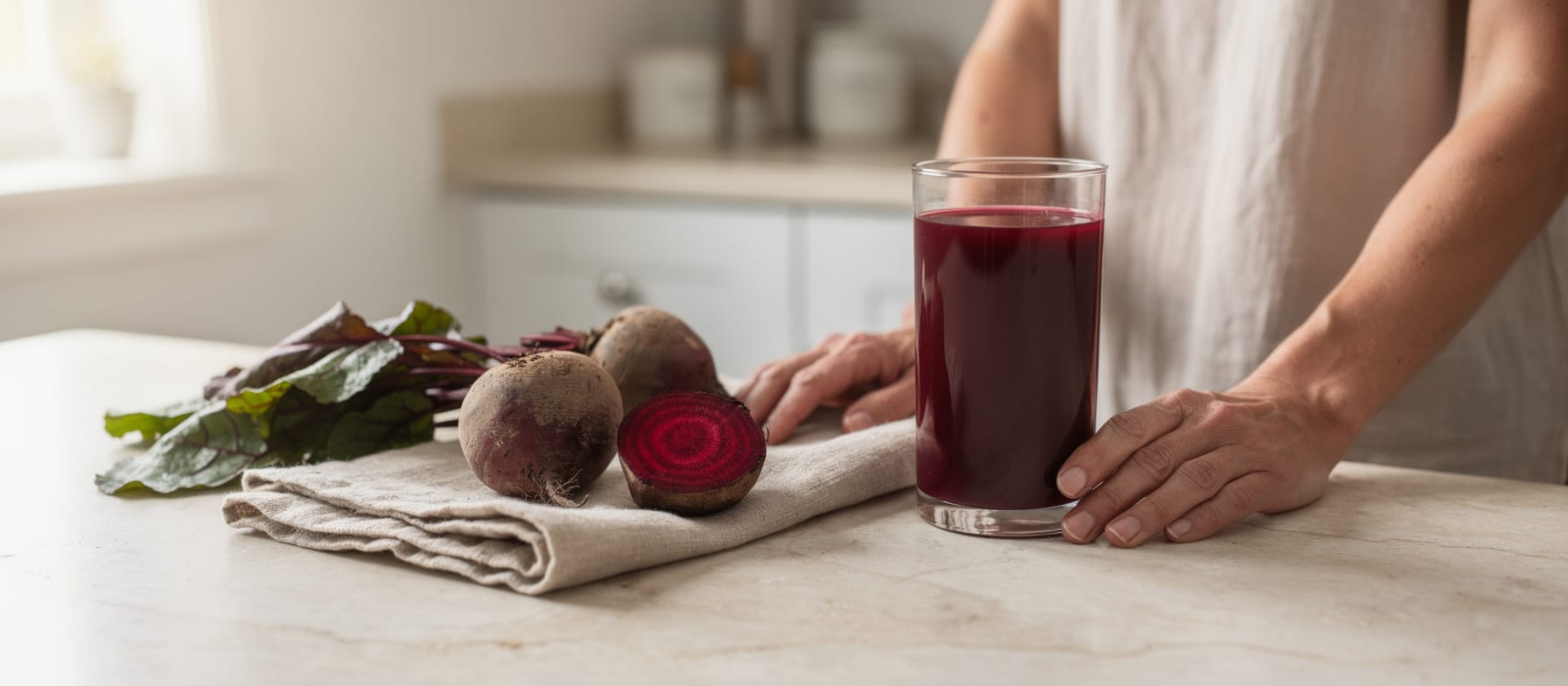
Beetroot Benefits for Women: BP, Iron, Menopause: The Short Answer
Beetroot works the same way in women and men: dietary nitrate becomes nitric oxide, which relaxes blood vessels. The best-evidenced result is a systolic blood pressure reduction of about 3 to 5 mmHg on average. After menopause the body's own endothelial nitric oxide response declines, which gives dietary nitrate's separate pathway a stronger theoretical case. Iron is the variable most often missed: beets are a poor iron source despite the marketing. Claims about estrogen balance, fertility, hair and libido have no controlled evidence.
Search "beetroot benefits for female" and you get a remarkably consistent set of claims: hormone balance, estrogen regulation, ovarian function, egg quality, stronger hair, better skin, higher libido. Almost none of that comes from controlled research in women. What does have real evidence is narrower, less exciting, and considerably more useful, and one of the strongest findings applies specifically to women after menopause.
This page separates the two. Every claim below is labeled by how well it is actually supported.
Medical disclaimer: These statements have not been evaluated by the Food and Drug Administration. Supplements are not intended to diagnose, treat, cure, or prevent any disease. Always consult a physician before starting a new supplement, particularly if you are pregnant or nursing, take blood pressure medication, or have a history of kidney stones.
Do Beetroot Benefits Differ for Women?
The mechanism is identical: dietary nitrate converts to nitrite and then to nitric oxide, which relaxes blood vessel walls. What differs for women is not the pathway but three modifiers that change how much benefit a given dose produces: iron status, menopausal status, and body weight. None of these change what beetroot does. They change how much of it you get.
Most foundational nitrate research enrolled male subjects averaging 75 to 80 kg, which is worth knowing but is less of a problem than it sounds. The dose-response relationship for dietary nitrate is driven by plasma concentration, and plasma volume scales with body mass, so a lighter person reaches target concentration on a smaller absolute dose. A 60 kg woman taking a 300 to 600 mg dietary nitrate serving is, if anything, dosing at or above the concentration the original trials produced in an 80 kg man.
The genuinely female-specific findings are covered in the sections below, and the athlete-specific version of this material lives in beetroot dosing for female athletes. The general evidence that applies regardless of sex, including the VO2 max, recovery and cognitive findings, is reviewed in beetroot powder benefits.
Blood Pressure and Circulation: The Best-Evidenced Benefit
Dietary nitrate lowers systolic blood pressure by about 3 to 5 mmHg on average in meta-analyses, and this is the most reliably reproduced effect in the entire beetroot literature. It is a vascular effect, not a hormonal one, which is why it shows up consistently across sexes and age groups while the hormone-related claims do not.
The mechanism is direct. Nitric oxide signals the smooth muscle in artery walls to relax, the vessel widens, and pressure through it falls. That same widening is what improves blood flow to peripheral tissue, which is the honest basis for most of the "circulation" language on beetroot packaging.
Two things worth being precise about:
- It is a modest effect, not a treatment. A 3 to 5 mmHg average reduction is meaningful at population scale and is roughly comparable to a single lifestyle intervention. It is not a substitute for prescribed antihypertensive medication, and it can compound with one, which is a reason to tell your doctor rather than a reason to avoid it.
- It requires consistency. The acute effect from one serving fades within about 24 hours. The blood pressure benefit shown in trials comes from daily intake, not occasional use.
Full dosing detail is in beetroot powder for blood pressure.
Iron Status Is the Hidden Variable for Women
Iron deficiency is substantially more common in premenopausal women than in men, and it matters here in two ways. Beetroot is widely sold as an iron source and is a poor one, and low iron causes fatigue that is easy to blame on a supplement. No trial we could find has tested whether low iron blunts the nitrate response itself.
The iron question is almost entirely absent from the general-health pages that rank for this topic, and it runs in a direction people find counterintuitive: beetroot is widely marketed as an iron supplement, and it is a poor one. Beets contain non-heme iron in modest amounts with oxalates that inhibit its absorption. Beetroot is not a practical treatment for iron deficiency.
The practical order of operations:
- If you suspect low iron, get ferritin tested before concluding a beetroot product is not working for you.
- Correct iron deficiency with an actual iron protocol directed by your doctor, not with beets.
- Then judge the beetroot response, so that fatigue from low iron is not mistaken for the product failing.
Which Women's Health Claims Hold Up, and Which Do Not
Of the claims commonly attached to beetroot for women, blood pressure, circulation and exercise oxygen efficiency have controlled human evidence. Hormone balance, estrogen regulation, fertility, egg quality, hair growth and libido do not. The libido and sexual-function claims are an extrapolation from the blood flow mechanism, which is plausible but has not been tested in women.
| Claim | Evidence in women | What is actually going on |
|---|---|---|
| Lowers blood pressure | Strong | Direct nitric oxide vasodilation, about 3 to 5 mmHg systolic on average |
| Improves circulation | Strong | Same vasodilation mechanism, measured as flow-mediated dilation |
| Improves exercise oxygen efficiency | Strong | 1 to 3 percent reduction in oxygen cost at a given intensity |
| Supports vascular function after menopause | Moderate to strong | Replaces declining endogenous nitric oxide production |
| Reduces exercise soreness | Moderate | Betalain pigments, a separate mechanism from nitrate |
| Improves sexual function or libido | Untested in women | Extrapolated from the blood flow mechanism, plausible but unproven |
| Balances hormones or regulates estrogen | No controlled evidence | No proposed mechanism connects dietary nitrate to sex hormone synthesis |
| Improves fertility, ovarian function, egg quality | No controlled evidence | Appears on commerce blogs without citation |
| Strengthens hair or improves skin | No controlled evidence | Usually traced to beetroot's folate and vitamin C content, which any vegetable provides |
| Treats iron deficiency anemia | Contradicted | Non-heme iron in modest amounts, with oxalates that inhibit absorption |
Conceding the bottom half of this table costs nothing, because the top half is enough. A supplement with a reproducible 3 to 5 mmHg blood pressure effect does not need invented benefits attached to it.
Beetroot After Menopause
Endothelial nitric oxide function declines after menopause: in Taddei et al. (1996), normotensive women showed no age-related impairment while still menstruating, and it appeared only after menopause. That gives postmenopausal women a strong theoretical case for dietary nitrate, because that route to nitric oxide does not depend on the declining enzyme pathway.
This is the part of the topic where the evidence and the marketing finally point the same direction. There are two routes to nitric oxide in the body: the eNOS pathway, which uses the amino acid L-arginine and requires oxygen, and the nitrate-nitrite-nitric oxide pathway, which uses dietary nitrate from food. Menopause impairs the first. Dietary nitrate feeds the second. The second pathway is effectively a bypass around the one that has weakened.
Research in postmenopausal women has specifically examined beetroot juice and vascular function for this reason. The hormonal detail, including combined oral contraceptives and the Female Athlete Triad, is covered in beetroot for menopause, birth control, and the Triad.
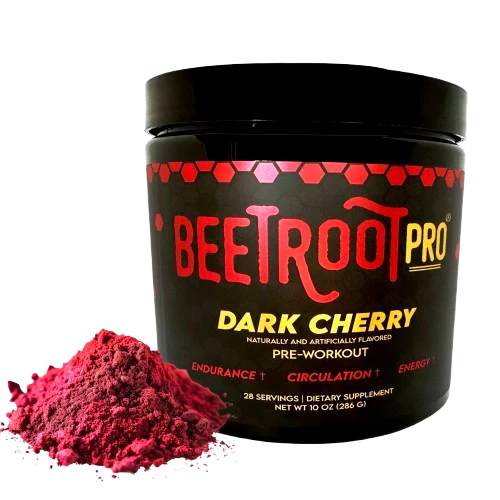
Beetroot Pro delivers standardized dietary nitrate to lower the oxygen cost of every effort.
Exercise Performance in Women
Dietary nitrate reduces the oxygen cost of submaximal exercise by roughly 1 to 3 percent, meaning you hold a given pace at a slightly lower metabolic cost. The effect is real but small, and it is most noticeable in recreational and moderately trained athletes rather than elite ones, whose vascular function is already highly optimized.
Two practical notes specific to women:
- Menstrual cycle phase shifts baseline nitric oxide. The follicular phase produces a higher baseline; the luteal phase is lower. For most people this is not worth dosing around, but it is a plausible reason a serving feels more effective some weeks than others.
- Body weight matters more than sex. Dose by body mass, not by gender. A 55 kg woman and a 55 kg man have the same dosing target.
The full athlete protocol, including the cycle-phase adjustment, is in beetroot for female endurance athletes, and the menopause and contraception adjustments are in beetroot nitrate across hormonal contexts.
How Much Beetroot Should Women Take?
Target 300 to 600 mg of dietary nitrate per day, which is the range used across the research. The number that matters is milligrams of dietary nitrate, not grams of beet powder or milligrams of dried root, because independent testing found nitrate varying roughly 50-fold across commercial beet juice products.
| Goal | Dietary nitrate per day | Timing |
|---|---|---|
| General blood pressure and circulation support | 300 to 600 mg | Any time, taken daily and consistently |
| Postmenopausal vascular support | 300 to 600 mg | Daily; consistency matters more than timing |
| Exercise performance | 300 to 600 mg | 60 to 90 minutes before the session |
| Event or race preparation | 300 to 600 mg | Daily for 3 to 6 days beforehand, plus a dose 60 to 90 minutes before the start |
The reason to check the milligram figure rather than the front-of-bottle weight: independent testing of 24 beet juice products marketed to athletes found a roughly 50-fold range in nitrate per serving, with only 5 consistently delivering 5 mmol (about 310 mg) or more (Gallardo and Coggan, 2019). Two products can print the same dried-root weight and deliver very different amounts of the compound doing the work. How to read a label for this is covered in how much nitrate is in your beet supplement, and the capsule-specific version is at beetroot capsules.
Side Effects, and Who Should Be Careful
The common side effects are beeturia (harmless red or pink urine and stool), gas and loose stools from fiber in whole-root products, and an oxalate load that matters if you have had calcium oxalate kidney stones. The interaction that needs real attention is blood pressure, because the nitrate effect can compound with prescribed antihypertensives.
Specific situations worth flagging:
- Pregnancy and nursing. There is not enough safety data on concentrated dietary nitrate supplements in pregnancy to give a confident answer, and we are not going to invent one. Beets as a food are a normal part of a diet; a concentrated supplement is a different question. Ask your obstetric provider.
- Kidney stone history. Beets are relatively high in oxalates. If you have formed calcium oxalate stones, raise this with your doctor before starting a daily beet product.
- Blood pressure or heart medication. Dietary nitrate lowers blood pressure by design. That is the benefit, and it is also the reason the interaction is real.
- Race morning and mouthwash. Antibacterial mouthwash kills the oral bacteria that perform the first conversion step, which blocks the entire pathway. This applies to everyone, not just women, and it is a surprisingly common way to waste a dose.
The full breakdown is in beetroot side effects.
Frequently Asked Questions
Is beetroot good for women's hormones? There is no controlled evidence that beetroot affects sex hormone levels, and no proposed mechanism connecting dietary nitrate to estrogen or progesterone synthesis. The hormone-balance claims that dominate this topic online are not sourced to human trials. What beetroot does affect is vascular function, and after menopause the case for that vascular support is stronger because declining estrogen impairs the body's own endothelial nitric oxide response. That is a downstream consequence of a hormonal change, not beetroot acting on hormones.
Can beetroot help with iron deficiency or anemia? No, and this is one of the more persistent misconceptions. Beets contain non-heme iron in modest amounts, and they also contain oxalates that inhibit iron absorption. Beetroot is not a practical treatment for iron deficiency. If you suspect low iron, get ferritin tested and correct it with your doctor, rather than expecting beets to fix it or judging a beet product while your iron is low.
How much beetroot should a woman take per day? Target 300 to 600 mg of dietary nitrate per day, the same range used in the research. Dose by body weight rather than by sex, since plasma nitrate concentration depends on body mass. The important part is checking the milligram figure for dietary nitrate on the label, because independent testing has found a roughly 50-fold nitrate range between commercial beet juice products and the dried-root weight on the front of the bottle does not tell you which you bought.
Is beetroot safe during pregnancy? There is not enough safety data on concentrated dietary nitrate supplements during pregnancy to answer confidently, so ask your obstetric provider rather than relying on a supplement page. Beetroot eaten as a vegetable is ordinary food; a concentrated extract or a daily high-dose supplement is a different question and should be a clinical decision.
Does beetroot help with menopause symptoms? It has not been shown to reduce hot flashes, mood symptoms or sleep disruption, and it should not be sold as a menopause remedy. What it does address is the vascular side of menopause: the withdrawal of estrogen impairs the body's own endothelial nitric oxide response, and dietary nitrate supplies that molecule through a separate pathway that does not depend on the enzyme route that has declined. Blood pressure and circulation, yes. Symptom relief, no evidence.
Does beetroot improve skin or hair for women? There is no controlled evidence for either. The claim usually traces back to beetroot's folate and vitamin C content, which are real but unremarkable, and available from most vegetables. If improved circulation produces any secondary effect on skin it has not been measured in a trial, and we are not going to present a plausible story as a finding.
References
- Wylie LJ, et al. Beetroot juice and exercise: pharmacodynamic and dose-response relationships. Journal of Applied Physiology. 2013.
- Bailey SJ, et al. Dietary nitrate supplementation reduces the O2 cost of low-intensity exercise. Journal of Applied Physiology. 2009.
- Taddei S, et al. Age-related reduction of NO availability and oxidative stress in humans. Hypertension. 2001.
- Lansley KE, et al. Acute dietary nitrate supplementation improves cycling time trial performance. Medicine and Science in Sports and Exercise. 2011.
- Taddei S, et al. Menopause is associated with endothelial dysfunction in women. Hypertension. 1996.
- Gallardo EJ, Coggan AR. What's in your beet juice? Nitrate and nitrite content of beet juice products marketed to athletes. International Journal of Sport Nutrition and Exercise Metabolism. 2019.
- Govoni M, et al. The increase in plasma nitrite after a dietary nitrate load is markedly attenuated by an antibacterial mouthwash. Nitric Oxide. 2008.
- Jones AM. Dietary nitrate supplementation and exercise performance. Sports Medicine. 2014.
Technical FAQ Extension
Is beetroot good for women’s hormones?
There is no controlled evidence that beetroot affects sex hormone levels, and no proposed mechanism connecting dietary nitrate to estrogen or progesterone synthesis. The hormone-balance claims that dominate this topic online are not sourced to human trials. What beetroot does affect is vascular function, and after menopause that vascular benefit is genuinely larger because declining estrogen has already reduced the body’s own nitric oxide production. That is a downstream consequence of a hormonal change, not beetroot acting on hormones.
Can beetroot help with iron deficiency or anemia?
No, and this is one of the more persistent misconceptions. Beets contain non-heme iron in modest amounts, and they also contain oxalates that inhibit iron absorption. Beetroot is not a practical treatment for iron deficiency. If anything the question runs the other way: some researchers suspect low iron could blunt the response to beetroot, although no trial has tested it.
How much beetroot should a woman take per day?
Target 300 to 600 mg of dietary nitrate per day, the same range used in the research. Dose by body weight rather than by sex, since plasma nitrate concentration depends on body mass. The important part is checking the milligram figure for dietary nitrate on the label, because commercial beet products range from about 4 mg to 496 mg per serving and the dried-root weight on the front of the bottle does not tell you which you bought.
Is beetroot safe during pregnancy?
There is not enough safety data on concentrated dietary nitrate supplements during pregnancy to answer confidently, so ask your obstetric provider rather than relying on a supplement page. Beetroot eaten as a vegetable is ordinary food; a concentrated extract or a daily high-dose supplement is a different question and should be a clinical decision.
Does beetroot help with menopause symptoms?
It has not been shown to reduce hot flashes, mood symptoms or sleep disruption, and it should not be sold as a menopause remedy. What it does address is the vascular side of menopause: estrogen withdrawal is linked to reduced nitric oxide-dependent blood vessel function (Taddei 1996), and dietary nitrate supplies that molecule through a separate pathway that does not depend on the enzyme route that has declined. Blood pressure and circulation, yes. Symptom relief, no evidence.
Does beetroot improve skin or hair for women?
There is no controlled evidence for either. The claim usually traces back to beetroot’s folate and vitamin C content, which are real but unremarkable, and available from most vegetables. If improved circulation produces any secondary effect on skin it has not been measured in a trial.
Related Articles

Jul 19, 2026
Beetroot Powder Benefits for Men: Dose by Body Weight
What beetroot powder does for men's blood pressure, circulation and endurance, the nitrate dose for your body weight, and why testosterone is not on the list.
Jun 19, 2026
Beetroot for Menopause, Birth Control, and the Triad
Menopause reduces eNOS activity by 50 percent, and oral contraceptives suppress nitric oxide further. Beetroot nitrate dose guidance for each.
Jan 30, 2023
Beetroot Powder Benefits: 6 Backed by Trials (2026)
Beetroot powder cuts oxygen cost 1 to 3%, extends time to exhaustion by 15%, and lowers blood pressure 3 to 5 mmHg. See the studies, doses, and effect sizes.
Technical
Beetroot Pro
Our product
- Patented betaine nitrate
- Acute Oxygen Efficiency
- 30 Calories Per Serving
*Technical citations and PubMed references are provided for performance education only. These statements have not been evaluated by the FDA.