
Best Cordyceps Supplements for Endurance Athletes: The Short Answer
Choosing a cordyceps supplement comes down to four checks: species (Cs-4 mycelium is the human-trial form, not wild-harvested Ophiocordyceps sinensis), extraction concentration (4:1 or higher, not a raw powder), disclosed dose (1,000mg or more is the floor used in performance trials), and third-party testing. Most consumer products fail at least one of these four checks.
What to Check Before Buying a Cordyceps Supplement
Cordyceps supplements vary enormously in what they actually deliver, and the label rarely tells the full story on its own. Four checks separate a product that matches the research from one that does not: the species and form (Cs-4 mycelium vs. wild fruiting body), the extraction concentration, the disclosed dose per serving, and whether the product is third-party tested.
Most of the confusion in this category comes from marketing photos of the wild fungus, which is not the form almost any commercial product actually contains. For the full species and extraction science, see Cordyceps for Endurance: Mycelium vs. Fruiting Body. This post is the buyer's-guide companion: how to translate that science into a purchase decision.
Check 1: Species and Form
Almost every commercial cordyceps product, regardless of what the packaging photo implies, is Cordyceps militaris or the Cs-4 strain of Paecilomyces hepiali grown on a grain substrate, not wild-harvested Ophiocordyceps sinensis. This is not a downgrade: Cs-4 mycelium is the exact form used in the human endurance trials this ingredient's evidence is based on.
Wild Ophiocordyceps sinensis is harvested from Tibetan Plateau caterpillar fungus at a scale that cannot support the global supplement market, is not the form most research used, and when it does appear commercially it commands a price far above what a training-dose bottle should cost. If a product's marketing leans heavily on Himalayan or wild-harvested imagery at a mainstream price, check the actual species line on the Supplement Facts panel.
Check 2: Extraction Concentration
A raw cordyceps powder and a 4:1 extract are not equivalent even at the same milligram weight. Extraction concentrates the active compounds (cordycepin, adenosine derivatives), so a well-labeled 500mg product at 4:1 concentration delivers roughly the equivalent of 2,000mg of raw material, while an unlabeled 1,000mg "powder" product may deliver far less active compound if it is largely grain substrate.
Look for an explicit ratio (4:1, 10:1) or a standardized marker compound percentage on the label. "Cordyceps powder" with no extraction detail is the format most likely to underdeliver relative to its stated weight.
Check 3: Disclosed Dose
Human performance trials on cordyceps typically use 1,000mg to 3,000mg daily of a standardized extract. A product dosed meaningfully below 1,000mg, common in blended formulas where cordyceps is one of many ingredients competing for label space, is unlikely to reproduce trial results regardless of how well-sourced the extract is.
This is where blended formulas (multi-ingredient blends, mushroom coffees) most often fall short: cordyceps ends up as one line among eight, dosed at whatever fits the serving size rather than at a research-informed amount.
Check 4: Third-Party Testing
Fungal-derived ingredients carry a real heavy-metal contamination risk depending on growing conditions, since mycelium readily absorbs trace metals from its substrate. Third-party testing (certificate of analysis available on request, or a visible testing seal) is the only way to verify a batch is clean rather than take the label's word for it.
This applies to every product in the category, including ours: ask, and expect an answer, before trusting a supply chain you cannot see.
Cordyceps Dosage and Timing
Human trials of Cs-4 cordyceps used about 1,000 to 3,000 mg a day; take it with food to limit mild GI upset. It needs no loading phase, but results are mixed: about 1 g a day for 12 weeks raised metabolic and ventilatory thresholds in older adults, while 3 g a day for 5 weeks did nothing for trained cyclists.
| Study | Population | Dose | Result |
|---|---|---|---|
| Chen et al. 2010, Journal of Alternative and Complementary Medicine | 20 healthy adults aged 50 to 75 | Cs-4, 333 mg three times a day for 12 weeks | Metabolic threshold up 10.5% and ventilatory threshold up 8.5%; no change in VO2 max |
| Parcell et al. 2004, International Journal of Sport Nutrition and Exercise Metabolism | 22 endurance-trained male cyclists | CordyMax Cs-4, 3 g a day for 5 weeks | No change in VO2 peak, ventilatory threshold or time trial performance |
| Hirsch et al. 2017, Journal of Dietary Supplements | 28 young adults (10 continued to week 3) | 4 g a day of a mushroom blend containing Cordyceps militaris | No change after 1 week; VO2 max improved after 3 weeks |
Common side effects are mild and GI-related (nausea, dry mouth) at the higher end of the dose range; there is no established interaction with common endurance-athlete medications, but anyone on immunosuppressants should check with a physician first, since cordyceps has some immune-modulating research behind it.
Full Product Comparison
For the complete species, concentration, and dose table across named commercial products (Real Mushrooms, Om Mushroom, Host Defense, Four Sigmatic, Optygen HP, and Endurance360), see the comparison table in Cordyceps for Endurance: Mycelium vs. Fruiting Body.
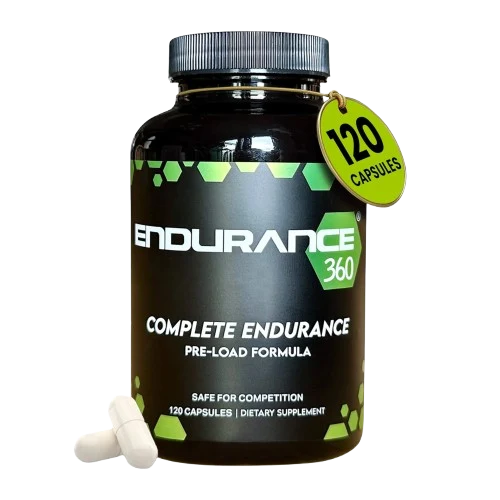
Endurance360 pairs Cs-4 cordyceps mycelium extract at 4:1 concentration with rhodiola in a 1,200mg Cellular Oxygenation blend, alongside a separate Endurance Blend of beta-alanine and creatine monohydrate on the same 14-day loading schedule. The label discloses blend totals, not the individual cordyceps split within that 1,200mg.
Frequently Asked Questions
What is a good daily dose of cordyceps?
1,000mg to 3,000mg daily of a standardized extract (not raw powder) is the range used in human performance research. Products dosed well below 1,000mg, common in multi-ingredient blends, are unlikely to match trial results.
Is Cs-4 the same as wild cordyceps?
No, and that is a good thing for anyone buying a commercial product. Cs-4 is a lab-cultivated strain of Paecilomyces hepiali grown on a controlled substrate, and it is the exact form used in the human endurance trials this ingredient's evidence base rests on. Wild Ophiocordyceps sinensis is a different, far more expensive, and far less consistently studied product.
Does cordyceps have side effects?
Reported side effects are generally mild: nausea or dry mouth at higher doses, usually resolved by taking it with food. There is no well-established interaction with typical endurance-athlete supplements or medications, though anyone on immunosuppressant therapy should check with a physician given cordyceps' immune-modulating research.
Our Product
Complete
Endurance 360
- Chronic Lactic Acid Buffering
- ATP & Cellular Saturation
- Cordyceps & Adaptogen Matrix
FDA Disclaimer: These statements have not been evaluated by the Food and Drug Administration. This product is not intended to diagnose, treat, cure, or prevent any disease.
Technical FAQ Extension
What is a good daily dose of cordyceps?
1,000mg to 3,000mg daily of a standardized extract (not raw powder) is the range used in human performance research. Products dosed well below 1,000mg, common in multi-ingredient blends, are unlikely to match trial results.
Is Cs-4 the same as wild cordyceps?
No, and that is a good thing for anyone buying a commercial product. Cs-4 is a lab-cultivated strain of Paecilomyces hepiali grown on a controlled substrate, and it is the exact form used in the human endurance trials this ingredient's evidence base rests on. Wild Ophiocordyceps sinensis is a different, far more expensive, and far less consistently studied product.
Does cordyceps have side effects?
Reported side effects are generally mild: nausea or dry mouth at higher doses, usually resolved by taking it with food. There is no well-established interaction with typical endurance-athlete supplements or medications, though anyone on immunosuppressant therapy should check with a physician given cordyceps' immune-modulating research.
Continue reading
Related Articles

Jun 2, 2026
Best CoQ10 Supplements for Athletes (2026)
The best CoQ10 supplement for athletes is ubiquinol, 100 to 300mg daily with a fatty meal. Supports mitochondrial ATP and eases statin-related muscle fatigue.

Aug 17, 2026
Best Supplements for Lactic Acid: What Actually Works
Ranked by evidence: beta-alanine, sodium bicarbonate, and exogenous lactate salts, plus the physiology mistake most lactic acid products are built on.
Jun 3, 2026
Stop Leg Cramps: Supplement Protocol & Risk Calculator
Leg cramps have two causes: electrolyte depletion and neuromuscular fatigue. Score yours with the free calculator, then load the 5 supplements that fix both.
*Technical citations and PubMed references are provided for performance education only. These statements have not been evaluated by the FDA.