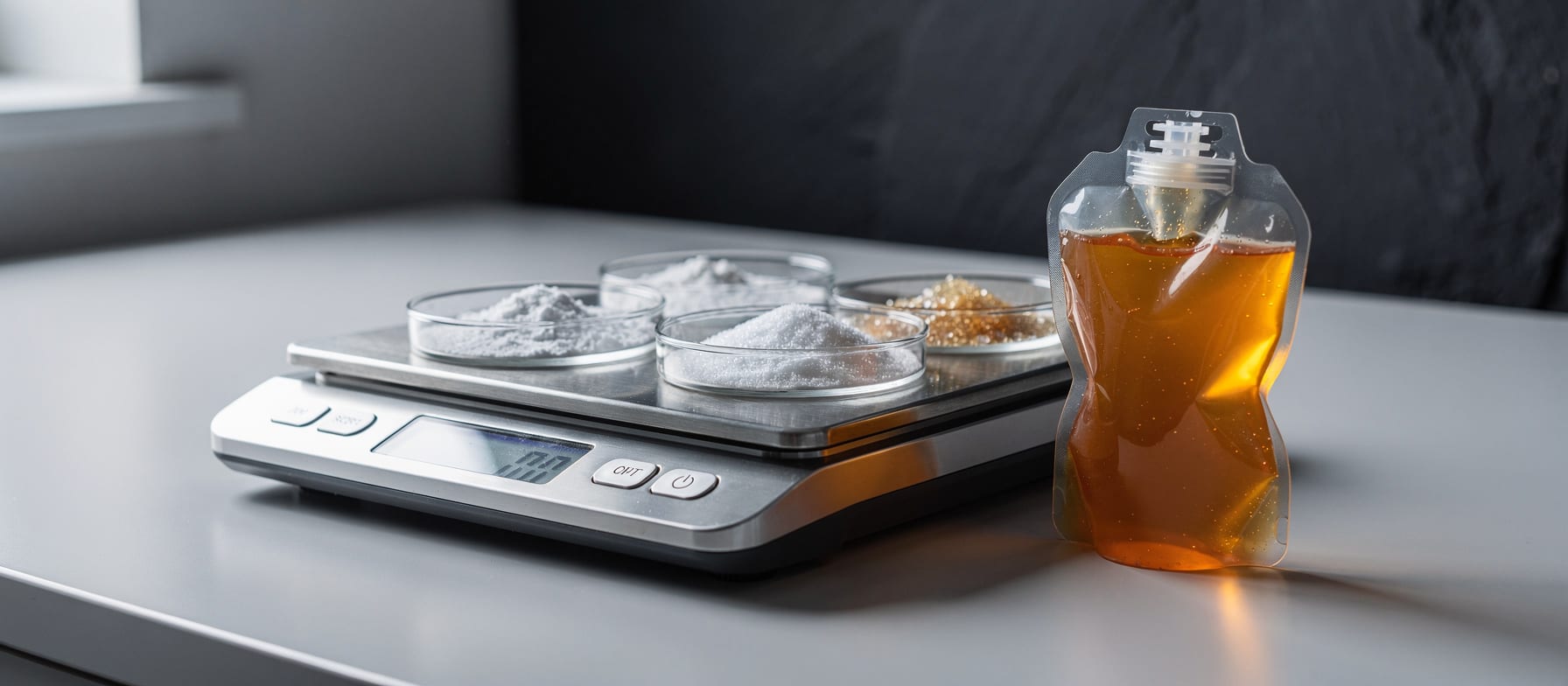
Lactate Gel Ingredients: ExoLactate Teardown (2026): The Short Answer
FLF publishes ExoLactate's full ingredient list: fructose, maltodextrin, water, lactic acid, L-arginine, magnesium lactate, sodium bicarbonate, calcium lactate, iota carrageenan, potassium bicarbonate. There is no exotic molecule in it. The formulation problem it solves is counter-ion load: 5 g of lactate from calcium lactate alone drags in 1,130 mg of calcium, and from magnesium lactate 682 mg of magnesium, roughly twice the 350 mg supplemental upper limit.
Every article about lactate gels describes the technology as secret. The ingredient list is not. FLF prints it on the pack and on the product page, and reading it carefully tells you more about how these gels work than any of the press coverage does. There is no exotic molecule, no novel carrier, and nothing you cannot buy food-grade. What there is instead is a genuinely clever solution to a boring chemistry problem, and once you see the problem, the whole category makes sense.
What is actually in an ExoLactate gel?
ExoLactate's declared ingredients are fructose, maltodextrin, water, lactic acid, L-arginine, magnesium lactate, sodium bicarbonate, calcium lactate, iota carrageenan, and potassium bicarbonate. Every one is a commodity food ingredient. The finished gel delivers 40 g of carbohydrate in a 1:1 glucose-to-fructose ratio plus 5 g of lactate, at a neutral pH.
Sorted by what each one is doing:
| Ingredient | Job in the formula |
|---|---|
| Fructose, maltodextrin | The 40 g carbohydrate load, dual-transport ratio |
| Water | Carrier |
| Lactic acid | The bulk lactate source, in free acid form |
| Sodium bicarbonate, potassium bicarbonate | Neutralize the lactic acid, contribute sodium and potassium |
| Magnesium lactate, calcium lactate | Additional lactate, already in salt form |
| L-arginine | Amino acid, no published rationale from FLF |
| Iota carrageenan | The gel matrix that sets the texture |
Notice what is missing. There is no encapsulation polymer, no liposome, no cyclodextrin, no proprietary-named trademark ingredient. The list reads like a food scientist's answer to a constraint, not like a new discovery.
Why does ExoLactate blend four different lactate sources?
Because a single lactate salt cannot deliver 5 g of lactate without also delivering a punishing dose of its counter-ion. Lactate always arrives attached to something. Calcium lactate at that dose carries about 1,130 mg of calcium; magnesium lactate carries roughly 682 mg of magnesium, near twice the 350 mg supplemental upper limit and a frank laxative dose mid-race.
This is the actual engineering problem, and it is the thing no cycling-press article about lactate gels has spelled out. Run the numbers for 5 g of lactate from each salt on its own:
| Lactate source | Amount needed for 5 g lactate | Counter-ion delivered | Practical verdict |
|---|---|---|---|
| Calcium lactate | 6.13 g | 1,130 mg calcium | 87% of the daily value in one gel |
| Magnesium lactate | 5.68 g | 682 mg magnesium | ~2x the 350 mg supplemental UL, laxative |
| Sodium lactate | 6.29 g | 1,290 mg sodium | Viable, but a very salty single gel |
| Potassium lactate | 7.19 g | 2,190 mg potassium | Too much potassium for a repeated-dose product |
(Figures are for anhydrous salts. Commercially you usually buy hydrated forms, calcium lactate pentahydrate and magnesium lactate dihydrate, which contain proportionally less mineral per gram and so need even more powder.)
Now the ingredient list stops looking mysterious. Spread that 5 g across free lactic acid plus magnesium and calcium lactate, and no single mineral has to carry the whole load. The sodium and potassium arrive via the bicarbonates rather than as lactate salts, which lets FLF tune the mineral profile and the lactate dose semi-independently. That is the trick.
What is the "proprietary encapsulation technology"?
Reading the ingredient list, the most likely explanation is in-pack acid-base neutralization rather than encapsulation in any literal sense. Free lactic acid plus sodium and potassium bicarbonate react to form sodium and potassium lactate in situ, venting carbon dioxide and landing the finished gel at neutral pH. This is an interpretation of the published list, not a confirmed description of FLF's process, which remains unpublished while patent applications are pending.
Treat the paragraph above as a reasoned reading, not as fact. FLF has said publicly that they used chemical and physical properties to buffer lactic acid efficiently and to build a matrix that makes it digestible and palatable. That description is consistent with the ingredient list, and the list contains exactly the reagents you would need. But the company has not confirmed the mechanism, and there may be process detail (order of addition, temperature, hold times) that the ingredient list simply cannot reveal.
What the list does rule out is the more dramatic reading. There is no encapsulating agent among the declared ingredients, so whatever "encapsulation" means here, it is not a coating around a lactate particle.
The one genuine outlier is L-arginine. FLF publishes no rationale for it. Two readings are plausible: it is an amino acid buffer contributing to the pH-neutral target, or it is there as a nitric oxide precursor, the same physiological endpoint dietary nitrate reaches by a completely different route. The evidence base for oral arginine as an NO strategy in trained athletes is notably weaker than the nitrate literature, which is one reason beetroot nitrate rather than arginine is the better-supported path to the same target.
Why iota carrageenan instead of alginate?
Iota carrageenan sets a soft, elastic, shear-thinning gel that flows out of a sachet and reforms in the pack, and unlike the alginate-pectin system in hydrogel-style gels it does not depend on stomach acid to trigger its structure. For a product already engineered to sit at neutral pH, a pH-independent gelling agent is the consistent choice.
This matters more than it sounds. The Maurten-style hydrogel approach uses sodium alginate plus pectin, which forms its gel structure when it meets acid in the stomach. That is the whole mechanism. But ExoLactate is deliberately pH-neutral, and it is carrying bicarbonates that actively consume stomach acid. An alginate system inside a bicarbonate-buffered gel would be fighting its own formulation. Iota carrageenan sidesteps the conflict entirely: it sets on cooling with calcium ions, and there is calcium lactate right there in the formula to do it.
If you have built alginate hydrogels at home with our DIY Energy Gel calculator, this is the one place where the ExoLactate build genuinely departs from the homemade Maurten approach, and it is a deliberate, well-reasoned departure rather than a cost saving.
How does Enervit's lactate gel differ?
Enervit's C2:1PRO Lactate Gel Mix takes the opposite approach: 10 g of lactate from sodium lactate alone, paired with 90 g of carbohydrate in a 2:1 glucose-to-fructose ratio, plus vitamin B1. Where FLF spreads the counter-ion load across several minerals to keep each one low, Enervit accepts a single large sodium load and delivers twice the lactate.
The two products are a clean natural experiment in the same category:
| ExoLactate (FLF) | Enervit C2:1PRO Lactate Gel Mix | |
|---|---|---|
| Lactate per serving | 5 g | 10 g |
| Lactate source | Lactic acid + Mg/Ca lactate + bicarbonates | Sodium lactate |
| Carbohydrate | 40 g, 1:1 ratio | 90 g, 2:1 ratio |
| Counter-ion strategy | Spread across four minerals | Sodium only |
| Availability | European retail, US to follow | After La Vuelta 2026 |
Enervit's choice is defensible for a different reason than FLF's. Endurance athletes want sodium anyway, so a sodium-heavy lactate source is not purely a cost to be minimized the way a magnesium load would be. The two formulations are optimizing against the same constraint with different tolerances for where the mineral lands.
Neither company has published a performance trial on its own protocol. As covered in our evidence review of exogenous lactate, the human performance data on oral lactate remains mixed regardless of which salt delivers it.
The Breakaway Pack pairs acute nitrate efficiency with chronic buffering, and saves $19.90 bought together.
What does the lactate in a €5.16 gel actually cost?
ExoLactate retails at €30.95 for a box of six, about €5.16 per gel, against €2 to €3 for a premium carbohydrate gel. The lactate itself is the cheapest part: 5 g of lactate from food-grade calcium lactate is roughly $0.12 of raw material, and the 40 g carbohydrate load adds about $0.14. Ingredient cost is not product cost, but the gap is worth understanding before you buy a box.
To be fair to FLF, raw ingredient cost is never what you are paying for in a manufactured gel. A sealed sachet, wet-fill co-packing, QA, batch testing, shelf-life validation, distribution, and margin are all real, and they dominate the bill of materials in every energy gel on the market, not just this one. The honest comparison is not "$0.26 of powder versus €5.16," it is that the novel ingredient in the novel product costs about twelve cents.
What that changes is the calculus on trying it. If you want to know whether exogenous lactate does anything for your body, you do not need to spend €31 to find out. Food-grade lactate salts are inexpensive and widely available, and our DIY Energy Gel calculator will scale the dose for you, split it across flasks, and show the mineral load you are actually taking on.
Can you build an ExoLactate-style gel at home?
Most of it, yes. The carbohydrate base, the lactate salts, and a carrageenan matrix are all available food-grade. What you cannot replicate at home is the pH control and the shelf-stable sealed sachet, so a homemade version is a same-day, refrigerated build rather than a race-bag product with a two-year shelf life.
The practical home version, and its honest limits:
- Reproducible: the 1:1 or 2:1 carbohydrate ratio, the total lactate dose, and the spread of that dose across calcium and magnesium lactate to keep any single mineral tolerable.
- Reproducible with care: a soft carrageenan set, though matching a commercial texture takes iteration and a sub-gram scale.
- Not reproducible: validated pH control, aseptic fill, and shelf stability. Build it the day before, keep it cold, and treat it as perishable.
- Do not skip: trial it in training. Every consistent finding in the oral-lactate literature is about dose-dependent GI distress, and it worsens as duration climbs.
The same caution that applies to the commercial product applies double to a kitchen version. You are testing a mild buffer with mixed performance evidence, not building speed. Get your carbohydrate intake and your sodium plan right first, because those two have far deeper evidence behind them than anything in this article.
Frequently asked questions
Is there a secret ingredient in ExoLactate? No. The full declared list is fructose, maltodextrin, water, lactic acid, L-arginine, magnesium lactate, sodium bicarbonate, calcium lactate, iota carrageenan, and potassium bicarbonate. Every one is a commodity food ingredient. The innovation, if there is one, is in how they are combined and processed, not in a novel molecule.
Why does ExoLactate contain sodium bicarbonate? Most likely to neutralize the free lactic acid in the formula, producing sodium lactate in the pack and bringing the finished gel to a neutral pH. That reading follows from the ingredient list rather than from any FLF disclosure. The bicarbonate also contributes sodium, which endurance athletes want anyway.
How much calcium and magnesium am I getting from a lactate gel? FLF has not published a per-mineral breakdown, so the honest answer is that we do not know for this product. What we can say is the constraint: 5 g of lactate from calcium lactate alone would carry about 1,130 mg of calcium, and from magnesium lactate about 682 mg of magnesium. Blending the sources is how a formulator keeps each of those numbers manageable.
Is exogenous lactate on the WADA prohibited list? No. Lactate is an endogenous metabolite and is not prohibited by WADA, the NCAA, or USADA. Certification applies to products rather than ingredients, so drug-tested athletes should confirm any specific product is third-party batch tested.
Is a lactate gel worth €5 per serving? That depends entirely on whether exogenous lactate works for you, and the published evidence says the effect is small and inconsistent. Given the raw lactate costs about twelve cents, a cheap home trial is the rational way to answer the question for your own body before committing to a box.
Related reading
- Lactate Energy Gels: What the Science Says: the evidence review behind the formulation detail in this article.
- ExoLactate and Exogenous Lactate Gels: the product-level breakdown and the co-ingestion model.
- Lactate vs Bicarbonate vs Beta-Alanine: how the three buffers compare on mechanism, timeline, and evidence strength.
- How to Get Rid of Lactic Acid in Muscles: why the burn is hydrogen ions rather than lactate, and why no supplement meaningfully speeds clearance.
- Homemade Maurten Gel Recipe: the alginate-pectin hydrogel system this formulation deliberately avoids.
- DIY Energy Gel and Flask Emulsifier: build the carbohydrate base and scale the optional lactate add-on to your bodyweight.
References
Ingredient and specification detail is taken from FLF's published product listing and Enervit's own product announcement. The counter-ion figures are calculated from standard molecular weights; the performance evidence is covered in the linked evidence review.
- FLF. ExoLactate Gel product listing. Declared ingredient list and 40 g carbohydrate / 5 g lactate specification.
- Enervit. C2:1PRO Lactate Gel Mix announcement. 90 g carbohydrate, 10 g sodium lactate, vitamin B1.
- Ewell et al. (2024). The Influence of Acute Oral Lactate Supplementation on Responses to Cycle Ergometer Exercise. Nutrients.
- Bordoli et al. (2024). Effects of Oral Lactate Supplementation on Acid-Base Balance and Prolonged High-Intensity Interval Cycling Performance. Journal of Functional Morphology and Kinesiology.
- Sutehall et al. (2020). Addition of an Alginate Hydrogel to a Carbohydrate Beverage Enhances Gastric Emptying. Medicine and Science in Sports and Exercise 52(8):1785-1792.
This article is educational and not medical or anti-doping advice. Ingredient interpretations are our reading of publicly declared lists and are not confirmed by the manufacturers named. The active ingredients discussed are not on current prohibited-substance lists, but the products themselves are not independently certified; drug-tested athletes should confirm with their governing body before use.
Technical FAQ Extension
Is there a secret ingredient in ExoLactate?
No. The full declared list is fructose, maltodextrin, water, lactic acid, L-arginine, magnesium lactate, sodium bicarbonate, calcium lactate, iota carrageenan, and potassium bicarbonate. Every one is a commodity food ingredient. The innovation, if there is one, is in how they are combined and processed, not in a novel molecule.
Why does ExoLactate contain sodium bicarbonate?
Most likely to neutralize the free lactic acid in the formula, producing sodium lactate in the pack and bringing the finished gel to a neutral pH. That reading follows from the ingredient list rather than from any FLF disclosure. The bicarbonate also contributes sodium, which endurance athletes want anyway.
How much calcium and magnesium am I getting from a lactate gel?
FLF has not published a per-mineral breakdown, so the honest answer is that we do not know for this product. What we can say is the constraint: 5 g of lactate from calcium lactate alone would carry about 1,130 mg of calcium, and from magnesium lactate about 682 mg of magnesium. Blending the sources is how a formulator keeps each of those numbers manageable.
Is exogenous lactate on the WADA prohibited list?
No. Lactate is an endogenous metabolite and is not prohibited by WADA, the NCAA, or USADA. Certification applies to products rather than ingredients, so drug-tested athletes should confirm any specific product is third-party batch tested.
Is a lactate gel worth 5 euros per serving?
That depends entirely on whether exogenous lactate works for you, and the published evidence says the effect is small and inconsistent. Given the raw lactate costs about twelve cents, a cheap home trial is the rational way to answer the question for your own body before committing to a box.
Related Articles

Jul 16, 2026
ExoLactate Gels: The Honest Evidence (2026)
ExoLactate pairs 40g carbs with 5g lactate per gel. What exogenous lactate actually does, whether the co-ingestion model holds up, and how to test it.

Aug 4, 2026
Lactaat Gels: Wat Zegt de Wetenschap? (2026)
Lactaat gels zijn de hype van 2026. De eerlijke wetenschap: lactaat is een echte brandstof, maar de prestatiestudies zijn wisselend.
Jun 29, 2026
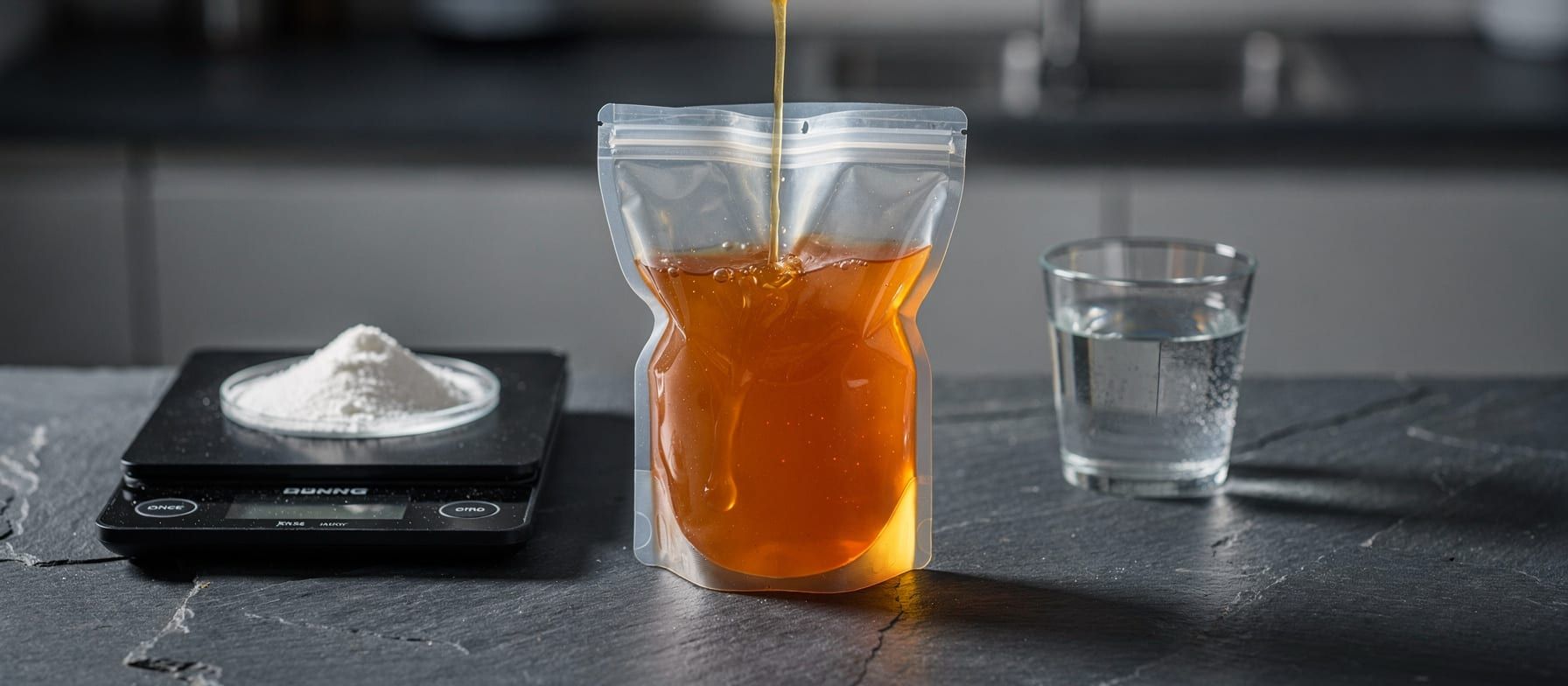
Homemade Maurten Gel Recipe: DIY Hydrogel (2026)
How to make a homemade Maurten-style energy gel: the maltodextrin to fructose ratio, the hydrogel matrix, and exact doses.
The Ultimate
VO2 Max System
Our product
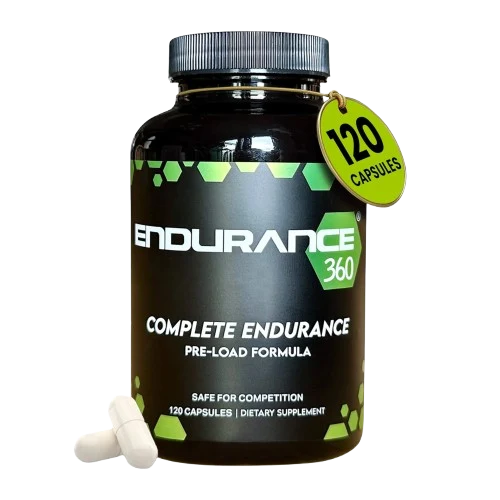
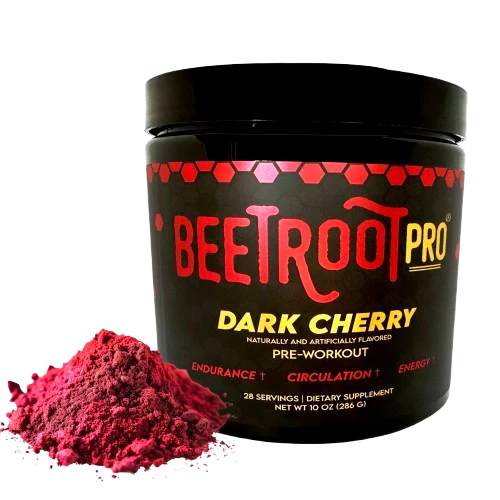
- Acute Nitric Oxide Vasodilation
- Chronic Lactic Acid Buffering
- Stimulant Free, cGMP Certified Manufacturing
*Technical citations and PubMed references are provided for performance education only. These statements have not been evaluated by the FDA.